
Epoxy Flooring Guide
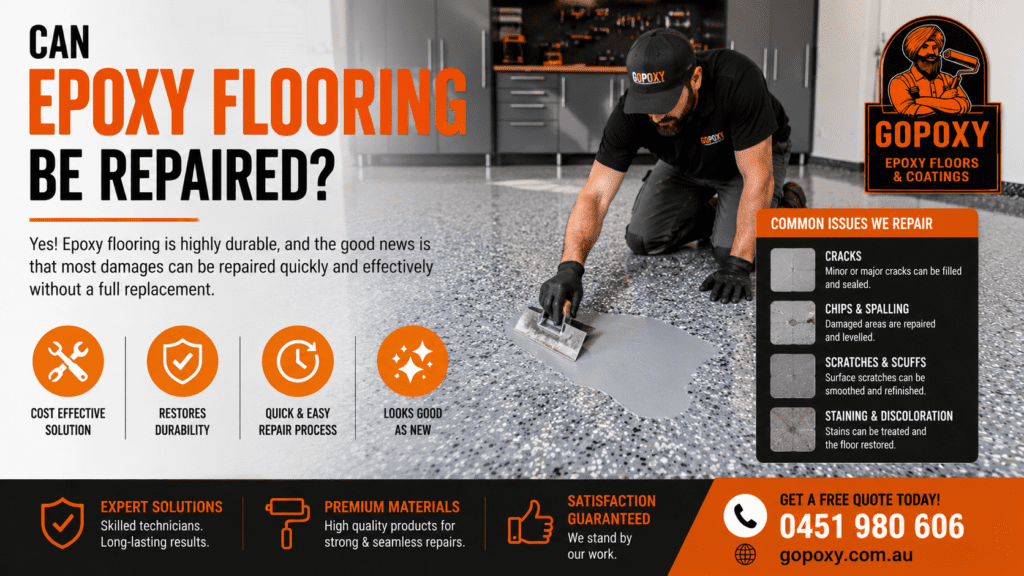
Can Epoxy Flooring Be Repaired?
Chips, cracks, peeling, scratches — a complete guide to what can be repaired, what needs replacing, and how GoPoxy’s 5–10 year warranty protects every installation.
Yes
Most damage is repairable
5–10 Yrs
GoPoxy warranty on every job
15–25 Yrs
Lifespan when installed correctly
Epoxy flooring is one of the toughest, most durable floor coatings available — but no floor is completely immune to damage. Whether it is a chip from a dropped tool, a surface scratch from dragging equipment, or a section of coating that has started to lift after years of service, the question most homeowners and business owners ask is the same: can this be fixed?
The short answer is yes — in most cases, epoxy flooring can be repaired. The longer answer depends on the type of damage, how widespread it is, what caused it, and the age and condition of the existing floor. Understanding the difference between damage that is worth repairing and damage that warrants a full recoat is what this guide is about.
We will also cover GoPoxy’s 5–10 year warranty on completed installations — because the best repair strategy is avoiding the need for one in the first place.
Yes — Epoxy Flooring Can Be Repaired
Unlike ceramic tile or timber flooring, where damage to one section often means removing and replacing large areas, epoxy flooring has the significant advantage of being a liquid-applied coating. That means damaged sections can be ground back, prepped, and recoated — sometimes blending seamlessly into the surrounding floor, sometimes with a visible repair line, but in either case restoring the floor’s function and durability.
The repairability of any given epoxy floor comes down to three key factors:
1. Type of Damage
Surface scratches and small chips are the easiest to address. Delamination and widespread peeling require more work because the root cause must be identified and resolved first.
2. Extent of the Damage
A single chip in one corner of a garage is a localised repair. Damage covering 40% or more of a floor’s surface is often more cost-effective to address with a full recoat than with a patchwork of individual repairs.
3. The Epoxy System Used
Flake epoxy floors are generally easier to patch and blend than metallic epoxy floors, where the unique pigment patterns make localised repairs more visible. Solid colour floors fall somewhere in between.
Types of Epoxy Floor Damage — and How Each Is Fixed
Not all epoxy floor damage is created equal. Here is a breakdown of the most common types of damage and what a professional repair looks like for each.
Surface Scratches
What causes it: Dragging furniture, equipment, or tools across the floor. Fine surface scratching from grit and dirt underfoot over time.
How it is repaired: Light scratches that affect only the topcoat can often be buffed out or made less visible without any recoating. Deeper scratches that penetrate into the base layer are addressed by lightly abrading the surrounding area, applying a thin patch coat, and reapplying the clear topcoat over the section.
Repair outcome: Very good. Surface scratch repairs are generally the most invisible of all epoxy repairs when done correctly.
Chips and Gouges
What causes it: Dropping heavy tools, equipment, or weights onto the floor. Impact from vehicle jack stands or heavy machinery being moved across the surface.
How it is repaired: The chipped area is cleaned and the edges are ground smooth to create a clean repair boundary. An epoxy filler matched to the original product is packed into the void and allowed to cure. On flake epoxy floors, matching flakes are broadcast into the repair before the filler cures, followed by a fresh topcoat. On solid colour floors, a patch coat is feathered into the surrounding area.
Repair outcome: Good to very good on flake floors where the flake blend can be matched. Solid colour repairs may show a faint repair line depending on the age and UV exposure of the surrounding floor.
Cracks
What causes it: Cracks in the epoxy coating almost always originate in the concrete slab beneath. Hairline surface cracks, concrete shrinkage cracking, and active structural movement in the slab all transfer through to the epoxy layer above.
How it is repaired: Non-structural, stable cracks are ground out slightly to create a clean V-shaped channel, filled with a flexible epoxy or polyurethane crack filler, allowed to cure, and then recoated. Active structural cracks — where the concrete is still moving — require the underlying slab issue to be resolved before any surface repair is worthwhile, as the crack will simply reappear through any new coating.
Repair outcome: Good for stable non-structural cracks. Active structural cracks require a concrete specialist before the epoxy can be successfully repaired.
Peeling and Delamination
What causes it: Peeling epoxy is almost always a sign of one of two things — inadequate surface preparation at the time of original installation (the most common cause by a wide margin), or moisture vapour transmission from the concrete slab pushing the coating up from below.
How it is repaired: All peeling sections must be ground back to bare concrete. The root cause — whether inadequate original prep or a moisture issue — must be diagnosed and resolved. On moisture-affected floors, a moisture-tolerant primer is applied before any new epoxy product. The floor is then recoated from scratch in the affected area, or fully if the delamination is widespread.
Repair outcome: Full restoration is achievable, but this is the most involved type of epoxy repair and the one where professional diagnosis is most critical. Patching over peeling epoxy without addressing the cause guarantees repeat failure.
Repair or Replace? How to Decide
One of the most common questions GoPoxy gets asked is whether a damaged floor is worth repairing or whether it makes more sense to strip it back and start fresh. Here is a practical framework for making that call.
| Damage Scenario | Recommendation | Why |
|---|---|---|
| One or two small chips or scratches | Repair | Localised, cost-effective, minimal downtime |
| Surface scratching across large area | Recoat topcoat | Full topcoat refresh gives uniform result |
| Stable hairline cracks, 1–2 locations | Repair | Fill, seal, and recoat the section |
| Active structural cracks (still moving) | Fix slab first | Epoxy repair will re-crack without concrete fix |
| Peeling in 1–2 small areas | Repair | Grind back, resolve cause, patch recoat |
| Widespread peeling or delamination | Full recoat | Cost-effective; patchwork repairs won’t hold |
| Floor over 15 years old, heavily worn | Full recoat | Refresh from scratch for best long-term result |
If you are unsure which category your floor falls into, the safest move is to have a professional assess it. GoPoxy offers free on-site assessments — the team will give you an honest recommendation on repair versus recoat based on the actual condition of your floor, not on what generates the most revenue. Call 0451 980 606 to arrange an inspection.
Why Epoxy Floors Fail — and How to Avoid It
Understanding why epoxy floors fail prematurely is the most useful thing you can know before either commissioning a repair or installing a new floor. The overwhelming majority of premature epoxy failures share a common root cause.
The four most common causes of premature epoxy floor failure:
1. Inadequate surface preparation
By far the number one cause. Skipping or rushing diamond grinding means the epoxy cannot form a chemical bond with the concrete and will eventually delaminate — sometimes within months. Every GoPoxy installation begins with thorough mechanical diamond grinding using professional equipment, not acid etching or a quick sweep.
2. Moisture in the concrete slab
Moisture vapour rising through a concrete slab creates hydrostatic pressure that pushes the epoxy coating up from below. This is especially relevant in coastal and high-humidity areas. GoPoxy tests every slab for moisture before applying any product and uses moisture-tolerant primers where needed.
3. Low-quality or mismatched products
Budget DIY epoxy kits and low-solids water-based products look similar to professional systems at the time of application but fail far sooner. They also do not bond as reliably with the concrete surface even with good preparation.
4. Application in unsuitable conditions
Epoxy has specific temperature and humidity requirements during application and curing. Installing in extreme heat, cold, or high humidity can affect the chemical reaction that gives epoxy its strength. Professional installers monitor conditions and adjust their process accordingly.
The pattern is consistent: floors installed correctly with proper preparation and quality products rarely need significant repair within their first decade of use. Floors installed quickly and cheaply often fail within two to three years — and the cost of stripping them back and starting again usually exceeds what a quality installation would have cost the first time.
GoPoxy’s 5–10 Year Warranty: What It Covers
Every completed epoxy flooring installation by GoPoxy is backed by a 5–10 year warranty covering both workmanship and materials. This is not a limited or conditional fine-print warranty — it is a genuine commitment that reflects the confidence GoPoxy places in its preparation process, product selection, and installation quality.
What GoPoxy’s warranty means for you:
✅
Workmanship covered
Any failure attributable to the installation process is covered for the warranty period.
✅
Materials covered
Product defects or failures relating to the epoxy materials used are included in the warranty.
✅
Peace of mind
You invest in a floor knowing that GoPoxy stands behind the result — not just for weeks, but for years.
✅
Local accountability
GoPoxy is a local business. When you call, you talk to the people who did the work — not a call centre.
The warranty period — 5 to 10 years depending on the system and application — reflects both the expected lifespan of the product and GoPoxy’s investment in doing the preparation and installation correctly the first time. A floor installed by someone who cuts corners on preparation cannot be backed by a meaningful warranty, because the installer knows it will not hold. The GoPoxy warranty exists precisely because the preparation and products are done right.
For full warranty terms and conditions, contact GoPoxy directly on 0451 980 606 or email gopoxy.com.au@gmail.com.
How to Maintain Your Epoxy Floor and Prevent Damage
A professionally installed epoxy floor is one of the lowest-maintenance surfaces you can have. But a small number of straightforward habits will keep your floor looking its best for the full life of the installation and reduce the likelihood of damage that requires repair.
🧹 Sweep regularly
Grit and sand underfoot act like sandpaper on the topcoat over time. A quick sweep or dust-mop every week prevents gradual surface abrasion.
🧦 Use pH-neutral cleaners
Harsh acidic or alkaline cleaners can dull or degrade the topcoat over time. A mild pH-neutral floor cleaner diluted in warm water is all you need for regular mopping.
⚡ Clean spills promptly
Fuel, battery acid, and some harsh chemicals can attack the epoxy topcoat if left to sit. Wipe up spills as soon as they occur to protect the surface.
🔧 Protect from sharp impacts
Place rubber mats under heavy gym equipment or machinery with sharp metal feet. Use a rubber mat in areas where tools are frequently set down.
🚗 Use tyre-friendly mats
Placing a mat under stationary vehicles reduces the small amount of plasticiser transfer from rubber tyres onto the topcoat surface during extended parking.
🔍 Address damage early
A small chip left unattended can allow moisture to get under the coating and start a delamination process. Small repairs carried out early are always cheaper and easier than large ones left too long.
GoPoxy Services — Installation, Repair, and More
Whether you need a brand new epoxy floor installed with a 5–10 year warranty, an existing floor repaired, or a damaged coating stripped back and recoated from scratch, GoPoxy covers the full range of residential and commercial epoxy flooring work.
🏠 Residential Garage Epoxy
Fixed-price packages for single and double garages. $999 single, $1,399 double. Full installation including prep, flake system, and polyurethane topcoat.
Learn more ›🏳 Epoxy Flake Flooring
The most popular residential and commercial system. Full-broadcast flake available in dozens of colour blends. Durable, anti-slip, and easy to maintain.
Learn more ›✨ Metallic Epoxy Flooring
Premium decorative marble-effect finishes for prestige garages, showrooms, and high-end residential interiors. Custom quoted per project.
Learn more ›🏢 Commercial Epoxy Flooring
Retail fit-outs, offices, cafés, showrooms, and schools. Decorative and functional systems installed with minimal business downtime.
Learn more ›🏭 Industrial Epoxy Flooring
Heavy-duty 100% solids systems for warehouses, workshops, factories, and mechanical bays. Built for forklift traffic, chemical exposure, and high loads.
Learn more ›🔓 Epoxy Floor Repair & Recoating
Localised chip and crack repairs, full topcoat refreshes, and complete strip-back-and-recoat services. GoPoxy repairs floors installed by any contractor.
Get a repair quote ›🏠 Residential Interior Epoxy
Living areas, home gyms, basements, and laundries. Self-levelling and flake systems for a seamless, low-maintenance finish inside the home.
Learn more ›🔧 Concrete Grinding & Repair
Standalone concrete preparation, crack filling, levelling, and surface grinding. Essential groundwork before any coating is applied — or as a standalone service.
Learn more ›Need a Repair Quote or a New Installation?
GoPoxy offers free assessments on both new installations and existing floor repairs. Every new installation is backed by a 5–10 year warranty.
Frequently Asked Questions
Everything you need to know about epoxy floor repair, maintenance, and GoPoxy’s warranty.
Related Reading
Get in Touch
Questions? The GoPoxy Team Is Ready.
Phone: 0451 980 606 | Email: gopoxy.com.au@gmail.com