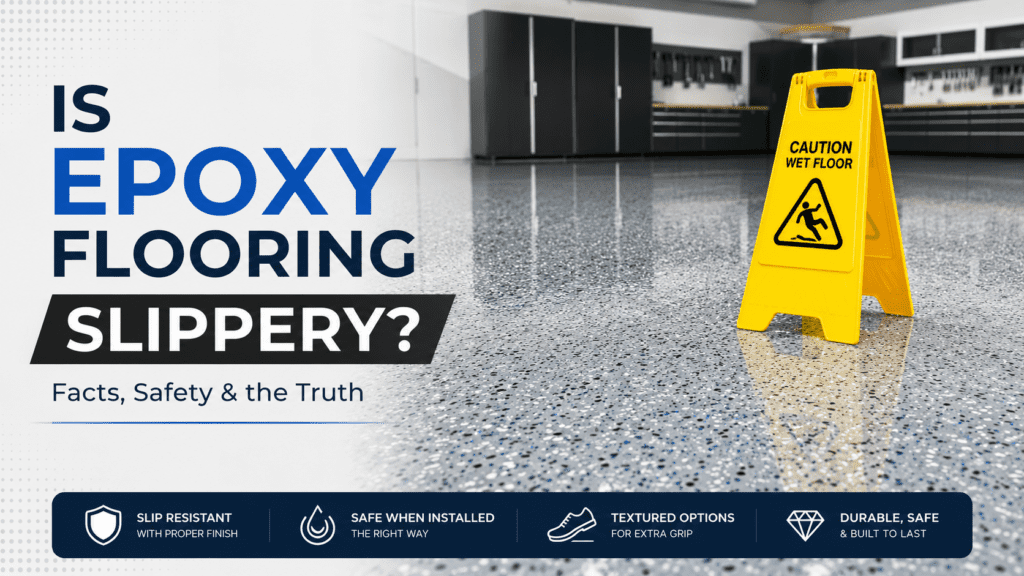
Is Epoxy Flooring Slippery?
The complete Melbourne guide to epoxy floor slip resistance — what affects it, how to fix it, and how to choose the safest epoxy floor for your home, garage, or business.
Why Do People Ask: “Is Epoxy Flooring Slippery?”
It is one of the most common questions GoPoxy receives from Melbourne homeowners, business owners, and warehouse managers considering an epoxy floor installation. The concern is completely valid — a slippery floor is a serious safety risk, particularly in wet environments like garages, bathrooms, commercial kitchens, and industrial facilities.
The short answer: not all epoxy flooring is created equal when it comes to slip resistance. A basic, smooth, high-gloss solid colour epoxy — especially when wet — can indeed be slippery. However, the vast majority of professional-grade epoxy floor systems installed by Melbourne specialists like GoPoxy are specifically designed to be non-slip and safe underfoot in all conditions.
The key factors that determine whether an epoxy floor is slippery or non-slip include the type of epoxy system used, the topcoat applied, whether an anti-slip aggregate is incorporated, and the quality of the installation. Understanding these factors helps you make the right choice for your Melbourne property from the very beginning.
GoPoxy Tip: When you request a free site visit from GoPoxy, we assess your space, intended use, and foot traffic to recommend the exact epoxy system with the right slip resistance rating for your property — at no extra cost.
What Makes an Epoxy Floor Slippery?
To understand slip risk properly, it helps to know what creates it. An epoxy floor becomes slippery when there is insufficient friction between a shoe sole (or bare foot) and the floor surface. Several factors can reduce that friction:
-
!High-gloss smooth topcoat: A polished, mirror-like epoxy surface has very low surface texture. When wet — whether from rain, a spill, or washing — the coefficient of friction drops sharply, creating a slip hazard. This is most common with cheap DIY kits or budget solid-colour epoxy systems.
-
!Water, oil, or chemical contamination: Any liquid on the floor surface reduces friction. Oil and grease — common in garages and workshops — are particularly dangerous on smooth surfaces. Even a professionally installed smooth epoxy can become hazardous in oily conditions.
-
!No anti-slip aggregate: Standard smooth epoxy systems without any anti-slip additive rely solely on their natural texture — which in gloss systems is minimal. Without an aggregate (such as broadcast sand, aluminium oxide, or quartz), there is nothing to maintain traction when wet.
-
!Worn or degraded topcoat: An epoxy floor that has aged past its service life — with a degraded or peeling topcoat — can develop uneven, slippery patches that are even more dangerous than a new smooth floor. This is why professional installation and quality materials matter for long-term safety.
-
!Incorrect product for the environment: Using a residential-grade epoxy in a wet commercial kitchen or industrial space — without the appropriate slip resistance rating — is a common cause of epoxy floor slip incidents. Always match the system to the environment.
The good news: every single one of these risks is entirely preventable with the right epoxy system, correctly installed by professionals. GoPoxy’s standard residential and commercial epoxy floor systems are specifically selected to address all these factors.
Which Epoxy Floor Systems Are Slip-Resistant?
Modern professional epoxy flooring in Melbourne offers a wide range of systems with built-in or added slip resistance. Here is how GoPoxy’s core systems compare when it comes to traction and safety:
| Epoxy System | Dry Slip Resistance | Wet Slip Resistance | Best For |
|---|---|---|---|
| ⭐ Flake Epoxy (Chip/Broadcast) | Excellent | Excellent (built-in) | Garages, Homes, Commercial |
| Solid Colour Epoxy (smooth) | Good | Poor (when wet) | Low-moisture interiors only |
| Solid Colour + Anti-slip Additive | Good | Moderate–Good | Garages, Light Commercial |
| Metallic Epoxy (smooth) | Good | Poor (when wet) | Interior decorative only |
| Metallic Epoxy + Anti-slip Additive | Good | Moderate | Interior with low moisture |
| Industrial Epoxy (quartz broadcast) | Excellent | Excellent | Warehouses, Factories, Wet Areas |
The clear winner for slip resistance across all conditions is flake epoxy flooring — also known as chip epoxy or broadcast epoxy. The vinyl flake chips broadcast into the wet base coat create a naturally textured surface that provides outstanding traction whether dry or wet. No additive is needed — the slip resistance is built into the system itself. This is one of the key reasons flake epoxy has become Melbourne’s most popular garage floor system.
Anti-Slip Additives for Epoxy Flooring — How They Work
For epoxy systems where a smooth aesthetic is preferred — such as solid colour epoxy or metallic epoxy flooring — GoPoxy can incorporate professional-grade anti-slip additives into the topcoat. These significantly increase traction without dramatically changing the visual appearance of the floor.
Common Anti-Slip Additives Used in Professional Epoxy Installations
-
✓Aluminium oxide: The most common and effective anti-slip aggregate for epoxy topcoats. Fine aluminium oxide particles are broadcast into the clear polyurethane topcoat while wet, creating a consistently grippy surface that provides excellent traction and durability. This is GoPoxy’s preferred additive for smooth systems in wet-risk areas.
-
✓Silica sand: Fine quartz or silica sand can be broadcast into the topcoat or incorporated into the epoxy mix. More visible than aluminium oxide, silica creates a slightly more textured finish with good slip resistance. Commonly used in industrial and warehouse environments.
-
✓Polymer grit / non-slip grit: A finer, polymer-based anti-slip aggregate that is often used in areas where a balance of aesthetics and safety is needed — such as retail spaces and showrooms. Less visible than sand but still effective in most conditions.
-
✓Vinyl flake chips (broadcast system): In flake epoxy systems, the vinyl chips themselves serve as the anti-slip aggregate. This is the most decorative anti-slip solution and the most popular in Melbourne residential settings.
Epoxy Flooring Slip Resistance Ratings — What Melbourne Should Know
In Australia, slip resistance for floor surfaces is governed by AS/NZS 4586:2013 — Slip Resistance Classification of New Pedestrian Surface Materials. This standard uses a Pendulum Test Value (PTV) to classify surfaces from P0 (very slippery) to P5 (very slip-resistant). For public and commercial spaces, a minimum classification of P4 in wet conditions is typically required under the Building Code of Australia.
Here is what Melbourne property owners need to know about epoxy flooring and slip ratings:
-
P0P0–P1 (Very Slippery): Smooth, high-gloss epoxy without anti-slip additives in wet conditions. Not suitable for any area with moisture risk. Unfortunately, many cheap DIY epoxy kits fall into this category.
-
P2P2–P3 (Moderate): Smooth epoxy with some texture or light anti-slip additive. Acceptable for dry indoor areas only. Not suitable for garages, bathrooms, or commercial spaces with regular wet traffic.
-
✓P4–P5 (Slip Resistant): Flake epoxy systems, industrial quartz-broadcast epoxy, and solid epoxy with professional anti-slip additives typically achieve P4–P5 ratings. This is the standard GoPoxy targets for all garage, commercial, and industrial installations.
When you engage GoPoxy for your Melbourne epoxy floor installation, you can request information about the expected slip resistance classification for the specific system recommended for your space. For commercial and industrial installations, we can provide documentation on the system’s tested slip resistance to assist with compliance requirements.
Is Garage Epoxy Flooring Slippery? The Melbourne Garage Answer
Melbourne garage epoxy flooring is one of the most common applications GoPoxy handles — and slip resistance is always a central consideration. Garages are wet-risk environments: cars come in wet from rain, cars are washed inside, hoses are used, and oil and fuel spills are common. A slippery garage floor is a genuine safety risk.
Here is the definitive answer for Melbourne garage owners:
Flake Epoxy = Non-Slip
GoPoxy’s flake epoxy garage floor system is naturally non-slip. The vinyl chip texture provides excellent traction in wet and dry conditions. No additive needed — the system is inherently safe.
Smooth Epoxy = Needs Additive
A smooth solid-colour epoxy garage floor should always have an anti-slip aggregate added to the topcoat for garage use. GoPoxy always recommends aluminium oxide in the clear coat for smooth garage systems.
Oil-Contaminated = Additional Risk
Oil and fuel can reduce traction on any floor surface. For garages where significant oil exposure is expected, GoPoxy recommends a full-broadcast flake system or industrial quartz topcoat for maximum grip.
Professional Install = Consistent Safety
A professionally installed epoxy floor by GoPoxy is slip-resistant across the entire surface — no thin patches, no uneven coverage, no areas where the anti-slip aggregate was missed. Consistency is everything for safety.
For a complete look at GoPoxy’s Melbourne garage epoxy options, costs, and before-and-after results, visit our best garage epoxy flooring service Melbourne page.
Is Epoxy Flooring Slippery in Commercial Spaces?
For commercial epoxy flooring in Melbourne — retail stores, offices, showrooms, cafés, gyms, and medical facilities — slip resistance is not just a safety issue, it is a legal obligation. The Building Code of Australia requires minimum slip resistance ratings in any space open to the public, and a slip-related injury can expose a business to significant liability.
GoPoxy recommends the following approach for commercial epoxy flooring in Melbourne:
-
✓Retail and Office: Solid colour or decorative epoxy with aluminium oxide anti-slip additive in the clear topcoat. Achieves P3–P4 classification suitable for most indoor commercial environments.
-
✓Cafés, Restaurants, Commercial Kitchens: Industrial-grade epoxy with full quartz broadcast or full-flake broadcast. Minimum P4 wet classification essential. GoPoxy recommends a high-aggregate topcoat specifically formulated for food-service wet environments.
-
✓Gyms and Fitness Centres: Flake epoxy or rubber-additive epoxy topcoat. Slip resistance critical for high-activity areas, particularly around water fountains and change room entries.
-
✓Medical and Aged Care: Maximum slip resistance priority. GoPoxy recommends P5-rated systems with fine anti-slip aggregate that maintains safety without creating a trip hazard for mobility-impaired users.
Is Epoxy Flooring Slippery in Warehouses & Industrial Spaces?
For warehouse and industrial epoxy flooring in Melbourne, slip resistance is a workplace health and safety (WHS) requirement. Forklift traffic, wet areas near wash bays, chemical spills, and constant foot traffic from workers in heavy boots all demand a floor that performs safely in the most demanding conditions.
GoPoxy’s industrial epoxy flooring systems use full-broadcast quartz or silica aggregate into the topcoat, achieving P5 slip resistance ratings that meet and exceed Australian WHS requirements. These systems are specifically designed to maintain traction under oils, water, and chemical exposure — the conditions most commonly encountered in Melbourne warehouses, factories, and distribution centres.
For guidance on choosing the right system, read our detailed guide: How to Choose the Right Warehouse Epoxy Flooring in Melbourne.
How to Make an Existing Epoxy Floor Less Slippery
If you already have an epoxy floor installed and are concerned about slip risk — particularly if it is smooth, high-gloss, and gets wet — there are several solutions GoPoxy can provide:
-
1Apply an anti-slip topcoat: GoPoxy can apply a new clear anti-slip topcoat — incorporating aluminium oxide or polymer grit — over your existing epoxy floor. This is often the fastest, most cost-effective solution that dramatically improves traction without full removal and reinstallation.
-
2Full resurfacing with flake epoxy: If your existing floor is old, worn, or damaged, GoPoxy can remove the existing coating, prepare the substrate, and install a new flake epoxy flooring system with built-in slip resistance. This gives you a brand new, long-lasting, safe floor.
-
3Anti-slip floor tape or mat: A temporary solution for high-risk spots — steps, entry points, or wash areas — while a longer-term resurfacing is planned. Not a substitute for proper anti-slip epoxy, but useful as an interim measure.
-
4Concrete resurfacing: In some cases where the existing epoxy is severely degraded, GoPoxy’s concrete resurfacing service provides a fresh, properly prepared substrate ready for a new high-performance, slip-resistant epoxy system.
Choosing the Right Epoxy System for Safety — GoPoxy’s Recommendations
After completing over 2,000 epoxy flooring projects across Melbourne, Perth, Sydney, and Adelaide since 2020, GoPoxy has developed clear recommendations for the safest epoxy flooring systems by environment:
| Space / Environment | GoPoxy Recommended System | Slip Rating |
|---|---|---|
| Residential garage (standard) | Flake / Chip Epoxy | P4–P5 ✓ |
| Residential home interior | Solid colour epoxy + aluminium oxide coat | P3–P4 |
| Retail / office (dry) | Decorative epoxy + anti-slip topcoat | P3–P4 |
| Commercial kitchen / café | Industrial quartz-broadcast epoxy | P4–P5 ✓ |
| Warehouse / factory floor | Industrial epoxy full quartz broadcast | P5 ✓ |
| Showroom / luxury interior | Metallic epoxy + fine anti-slip topcoat | P3 (dry environments) |
| Medical / aged care facility | High-aggregate epoxy — P5 rated system | P5 ✓ |
For a complete breakdown of epoxy flooring costs across all system types and space sizes, see our guides: How Much Does Epoxy Flooring Cost in Melbourne? and Double Garage Epoxy Flooring Cost in Melbourne.
Frequently Asked Questions: Is Epoxy Flooring Slippery?
It depends entirely on the type of epoxy system and topcoat used. A smooth, high-gloss epoxy without any anti-slip aggregate can be slippery when wet — particularly if it has a mirror-like finish. However, professional epoxy systems like GoPoxy’s flake epoxy flooring are naturally slip-resistant even when wet due to the texture created by the vinyl chip broadcast. For smooth systems, aluminium oxide or quartz aggregate can be added to the topcoat to significantly improve wet slip resistance. For any space with moisture exposure — garages, commercial kitchens, bathrooms — GoPoxy always recommends and installs a system with appropriate anti-slip properties.
For residential spaces like garages and homes, flake epoxy flooring (also called chip epoxy or broadcast epoxy) provides the best natural slip resistance of any decorative epoxy system. The vinyl flake chips create a consistently textured surface that grips well in both wet and dry conditions. For industrial and commercial environments, industrial quartz-broadcast epoxy with a full aggregate topcoat provides the highest slip resistance — typically achieving P5 under Australian standards. GoPoxy can recommend and install the right system for your space.
Yes — in many cases GoPoxy can apply a new anti-slip clear topcoat over an existing epoxy floor, incorporating aluminium oxide or polymer grit to significantly improve traction. This is a cost-effective option if the existing epoxy is in good structural condition but lacks adequate slip resistance. If the existing floor is worn, peeling, or damaged, a full resurfacing and reinstallation is the better long-term solution. Contact GoPoxy for a free assessment of your existing floor and the best path forward.
Yes — when the correct epoxy system is used. GoPoxy’s standard flake epoxy garage floor system is specifically designed for Melbourne garage environments, including wet weather entry. The vinyl chip texture provides excellent wet traction for both foot traffic and vehicle tyres. GoPoxy always recommends flake epoxy or a solid colour system with anti-slip additive for any Melbourne garage — never a plain smooth epoxy — to ensure year-round safety regardless of weather conditions.
Professional epoxy flooring systems installed by GoPoxy are selected and applied to meet or exceed the relevant Australian standards — primarily AS/NZS 4586:2013 for slip resistance classification. GoPoxy’s flake epoxy and industrial quartz systems typically achieve P4–P5 classifications in wet conditions. For commercial and industrial installations where documented slip resistance is required for compliance purposes, GoPoxy can provide system specification sheets with tested slip resistance data.
If your existing garage epoxy floor is slippery, the most effective solutions are: (1) applying a new anti-slip clear topcoat with aluminium oxide aggregate over the existing floor — quick, affordable, and effective; or (2) if the floor is old or damaged, a full concrete resurfacing and new flake epoxy installation. GoPoxy offers free site visits to assess your specific situation and recommend the most cost-effective solution. Contact us via our contact page or via our Google Business profile.
Metallic epoxy flooring is one of the more slip-prone epoxy systems in its standard form because it features a very smooth, mirror-like glossy surface with minimal texture. For this reason, GoPoxy always recommends adding a fine anti-slip aggregate to the topcoat of any metallic epoxy installation in areas with moisture exposure. Metallic epoxy is best suited for interior spaces with low wet-traffic risk — such as living rooms, offices, and showrooms — where its stunning visual impact can be enjoyed without significant slip risk. For wet areas, flake epoxy or industrial systems are safer choices.
GoPoxy’s flake epoxy flooring — which includes built-in anti-slip properties — is priced from approximately $65 to $85 per m² installed for Melbourne residential garages. For commercial and industrial anti-slip epoxy systems, pricing depends on the space size, substrate condition, and specific system selected. Adding an anti-slip additive to a smooth epoxy system is a relatively low-cost upgrade — typically adding only a small amount per m² to the topcoat application. For a detailed cost breakdown, see our guide: How Much Does Epoxy Flooring Cost in Melbourne?
Smooth epoxy flooring can be slippery for pets — particularly dogs — as their paw pads struggle to grip very smooth surfaces, which can cause joint stress over time. For pet owners, GoPoxy recommends flake epoxy flooring with its naturally textured surface, or a smooth epoxy with a fine anti-slip aggregate in the topcoat. Both options provide significantly better traction for pets than smooth high-gloss epoxy or bare concrete. If you have pets, mention this to GoPoxy during your free site visit and we will tailor our recommendation accordingly.
A well-maintained, professionally installed epoxy floor should not become more slippery over time — in fact, the anti-slip aggregate tends to remain effective throughout the floor’s lifespan. However, if the topcoat degrades, becomes worn, or starts to peel due to poor installation or age, this can reduce traction. This is why professional installation with quality commercial-grade materials is so important — it ensures the floor maintains its anti-slip properties for its full intended lifespan (10–15 years for residential, longer for industrial systems). If you notice your existing epoxy floor becoming slippery, contact GoPoxy for an inspection.