
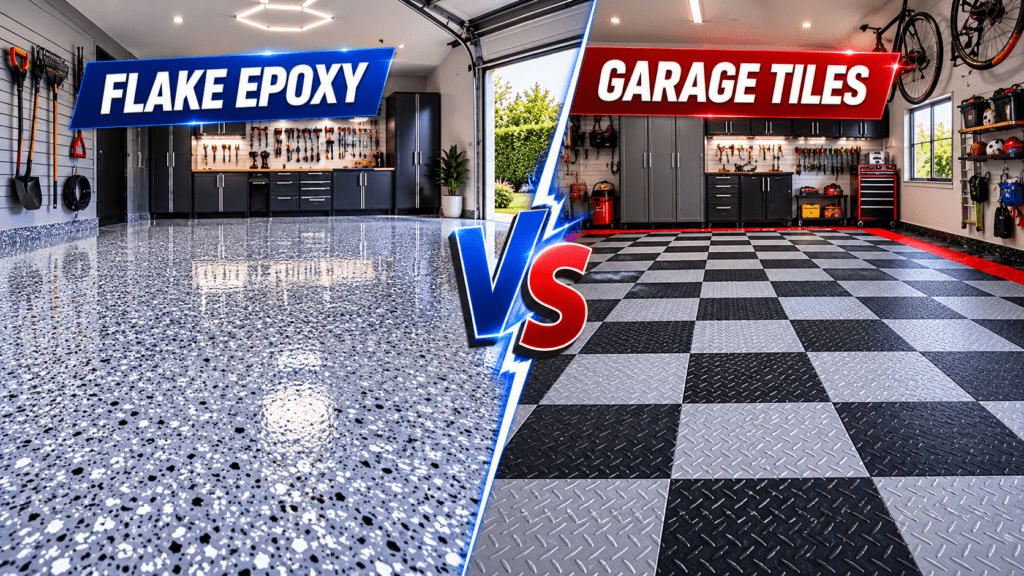
Flake Epoxy VS Garage Tiles
The complete, honest comparison — which garage floor solution wins for Melbourne homeowners in 2026? Cost, durability, installation, slip resistance, and long-term value.
What Are Flake Epoxy Flooring and Garage Tiles?
🟠 Flake Epoxy Flooring
- Multi-layer liquid epoxy resin system applied directly to your concrete slab
- Vinyl colour flake chips broadcast into the wet base coat create the decorative texture
- Sealed with a clear polyurethane topcoat for protection and gloss
- Chemically bonds to the concrete — becomes part of the slab
- Installed by a professional in a single day
- Seamless, no gaps, no joints
🔵 Garage Floor Tiles
- Interlocking PVC, polypropylene, or rubber tiles laid over existing concrete
- Click together like a puzzle — no adhesive required in most cases
- Available in various patterns (coin, diamond, flat) and colours
- Sit on top of the concrete — not bonded to it
- Can be installed by a confident DIYer over a weekend
- Has joints and seams between every tile
Both options are a massive improvement over bare, stained concrete. The question is which one is the better investment for your specific Melbourne garage — and the answer depends on several important factors we’ll break down in detail.
The Full Comparison — Every Factor That Matters
| Factor | 🟠 Flake Epoxy | 🔵 Garage Tiles |
|---|---|---|
| Upfront cost (per m²) | $65–$85/m² installed | $15–$45/m² (DIY) |
| Long-term value | Excellent — 10–15 year lifespan | Moderate — tiles shift, crack, fade |
| Installation | Professional — 1 day | DIY-friendly weekend project |
| Durability | Exceptional — withstands vehicle weight | Good — hot tyres can lift tiles |
| Slip resistance | Built-in anti-slip texture (P4–P5) | Good when dry, risky when wet |
| Water & moisture | Fully sealed — water sits on surface | Water seeps under tiles → mould risk |
| Chemical resistance | Resistant to oil, fuel, brake fluid | Some chemicals can degrade PVC |
| Aesthetics | Showroom finish, 50+ colour options | Clean, but tile pattern is visible |
| Easy to clean | Sweep or mop — one seamless surface | Dirt collects in tile joints |
| Hot tyre resistance | Excellent (professional-grade) | Can lift and deform under hot tyres |
| Cold crack resistance | Flexible enough for Melbourne temps | Can crack in extreme cold |
| Repairability | Needs professional patch if damaged | Single tiles can be replaced easily |
| Removability | Permanent — not designed to remove | Fully removable — take it with you |
| Property value | Increases resale appeal significantly | Minor improvement |
| Maintenance | Minimal — just regular cleaning | Tiles shift and need re-seating |
Cost Comparison: Upfront vs Long-Term
Cost is the factor that most Melbourne homeowners focus on first — and on the surface, garage tiles appear to win easily. A set of interlocking PVC tiles for a standard double garage (36m²) can cost as little as $500–$800 in materials from a hardware store, installed yourself over a weekend. A professional flake epoxy flooring installation for the same space typically costs $2,300–$3,000 installed.
That’s a significant upfront difference — and for homeowners on a tight budget, tiles are a legitimate short-term solution. But the honest long-term cost picture looks very different.
-
✓
Flake epoxy: 10–15 year lifespan. A professionally installed GoPoxy flake epoxy floor installed today is likely to still be performing perfectly in 2036–2041. No replacement costs, no shifting tiles, no faded panels. The $2,500 you spend today works out to roughly $180–$250 per year over its lifespan — exceptional value for a working garage.
-
✗
Garage tiles: typically need replacing in 5–8 years. PVC tiles fade, crack, and deform — particularly under vehicle weight and hot tyres in a Melbourne summer. By year 5–6, most tile installations look noticeably worn. Replacing them adds another $600–$1,200 in materials. Over 15 years, you may spend the same or more than epoxy, with significantly more effort.
-
✗
Hidden costs of tiles. The price per tile doesn’t include floor preparation (tiles installed over uneven, cracked concrete shift constantly), edge trim pieces, transition strips, adhesive tape for perimeters, or the time cost of installation. These can add $200–$500 to the total.
-
✓
Epoxy adds resale value. A clean, seamless epoxy garage floor is a genuine selling point for Melbourne homes. Buyers notice and value it. Real estate agents consistently report that a quality garage epoxy floor increases perceived property value. Tiles don’t have the same effect.
Bottom line on cost: If you need a quick, budget-conscious solution and plan to sell or renovate within 2–3 years, tiles can make sense. If you want the best long-term value for a Melbourne garage you’ll use and live with for years, flake epoxy flooring is the smarter financial decision.
🟠 Flake Epoxy Score
🔵 Garage Tiles Score
Durability: Which Floor Survives Melbourne Garage Life?
A Melbourne garage is a demanding environment. Vehicles drive in and out daily. Hot tyres — especially after a summer drive — sit on the floor. Oil, fuel, and brake fluid get spilled. Tools and heavy equipment get dragged across the surface. Winter brings moisture and mud. The floor needs to handle all of it, year after year.
How Flake Epoxy Handles Melbourne Garage Conditions
GoPoxy’s flake epoxy flooring is specifically formulated for exactly these conditions. The multi-layer system — diamond-ground concrete base, epoxy primer, colour base coat, vinyl flake broadcast, and polyurethane topcoat — creates a surface that is chemically bonded to the slab and nearly impervious to the typical demands of a working Australian garage.
Hot tyre pickup — the single biggest enemy of DIY epoxy kits and garage tiles — is not an issue with GoPoxy’s commercial-grade formulas. The polyurethane topcoat is heat-stable well beyond normal tyre temperatures. Oil and fuel spills wipe off cleanly. Heavy equipment and trolley jacks don’t damage the surface. After 10 years, a well-maintained GoPoxy floor still looks close to the day it was installed.
How Garage Tiles Handle Melbourne Garage Conditions
Quality interlocking garage tiles — particularly rigid polypropylene options — are genuinely durable for lighter-use garages. However, they have well-documented weaknesses in high-use Australian garage environments:
- ✗Hot tyre damage: PVC tiles can soften and deform under hot tyres, particularly in a Melbourne summer where garage temperatures can exceed 40°C. This causes tiles to lift, bubble, and shift — requiring replacement of affected panels.
- ✗Shifting and creeping: Even interlocking tiles shift over time under repeated vehicle movement. Within 12–18 months, most tile installations develop visible gaps and misalignment around the wheel tracks.
- ✗Moisture trapping: Water, oil, and chemicals seep into the joints and under the tiles. In Melbourne’s humid conditions, this creates mould and mildew growth beneath the tiles — invisible until the tiles are lifted, and potentially damaging to the concrete substrate beneath.
- ✗UV fading: Tiles near garage doors or windows that receive sunlight fade and discolour over 3–5 years, creating a patchy, uneven appearance that can’t be repaired without replacing entire sections.
Slip Resistance: Which Is Safer for Melbourne Families?
Slip resistance is non-negotiable in a Melbourne garage, where wet cars are driven in during winter rain, where hoses are used to wash vehicles, and where children and pets might enter the space. Both flake epoxy and garage tiles offer better slip resistance than bare concrete — but they perform very differently when wet.
🟠 Epoxy Slip Resistance
- Vinyl flakes create natural anti-slip texture across 100% of the surface
- Achieves P4–P5 rating under AS/NZS 4586:2013 in wet conditions
- Consistent grip across the entire floor — no slippery patches
- Anti-slip performance maintained for the full lifespan of the floor
- Safe for barefoot, rubber-soled shoes, and pet paws
🔵 Tile Slip Resistance
- Diamond and coin patterns provide good grip when dry
- Water pools on flat tile surfaces between patterns — slippery when wet
- Tile edges can be a trip hazard if tiles shift or lift
- Oil contamination makes smooth-patterned tiles very slippery
- No standardised anti-slip rating for most retail tile products
For families with children, elderly residents, or anyone working in a garage that regularly gets wet, flake epoxy’s consistent P4–P5 slip resistance is a meaningful safety advantage. To learn more about this topic, read our detailed guide: Is Epoxy Flooring Slippery?
Aesthetics: Which Looks Better in a Melbourne Garage?
Let’s be honest — the reason most Melbourne homeowners upgrade their garage floor isn’t just practicality. They want a garage that looks as good as the rest of their home. This is where flake epoxy flooring has a very clear advantage.
A flake epoxy floor installed by GoPoxy creates a seamless, terrazzo-style finish that genuinely transforms a garage. The reflective polyurethane topcoat bounces light around the space, making it feel larger and brighter. With over 50 colour combinations available, every GoPoxy floor is tailored to the homeowner’s aesthetic. The result looks like a professional showroom or luxury workshop — not a garage.
Garage tiles look neat and clean when freshly installed, but they always look like tiles. The grid pattern of joints is visible no matter how good the product is. Over time, as tiles shift, fade, and collect dirt in the joints, the visual impact deteriorates significantly. They’re a practical flooring solution — but they’re not a design statement.
Interior design perspective: If you’ve invested in renovating your Melbourne home — a new kitchen, bathroom, or outdoor area — a flake epoxy floor completes the picture. Garage tiles, regardless of quality, look like a compromise. When you spend time in a well-finished epoxy garage, it doesn’t feel like a garage at all.
Maintenance: Which Is Easier to Live With?
Day-to-day maintenance is where the seamless nature of flake epoxy flooring becomes a significant practical advantage for busy Melbourne households.
Cleaning a Flake Epoxy Floor
Cleaning a GoPoxy flake epoxy floor is genuinely simple. Loose dirt and debris — leaves blown in from the garden, tyre grit, dust — sweep away in minutes. Oil and fuel spills wipe up with a cloth and a simple degreaser. A mop with warm water and a pH-neutral cleaner is all that’s needed for a deep clean. Because the surface is completely seamless, there are no joints or edges where dirt can accumulate. The whole floor can be cleaned in 10–15 minutes.
Cleaning Garage Tiles
Garage tiles are significantly more effort to keep clean. Dirt, grit, and oil work their way into the joints between tiles during every car entry — and once they’re in, they’re difficult to remove. A pressure washer is often the only effective cleaning tool for tile joints, and regular pressure washing accelerates tile degradation. Tiles also need to be periodically re-seated when they shift, and individual faded or damaged tiles need replacement. Over a year, tiles require meaningfully more time and effort to maintain than epoxy.
Our Verdict: Flake Epoxy Wins for Melbourne Garages
For Melbourne homeowners who want the best-performing, best-looking, and best long-term value garage floor, flake epoxy flooring is the clear winner in almost every category. Garage tiles are a viable option for short-term budgets or rentals — but for a home you own and want to enjoy, epoxy is the smarter investment.
When Garage Tiles Are the Right Choice
We’re epoxy specialists — but we’re also honest. There are genuine situations where garage tiles are the more sensible option for Melbourne homeowners:
- →Rental properties where you can’t permanently modify the floor. If you’re renting and want to improve the garage floor without a permanent change, interlocking tiles are a smart, reversible solution you can take with you when you move.
- →Very tight budget with a short planning horizon. If you need a solution this weekend for under $500, tiles are a practical stopgap while you save for a proper epoxy installation.
- →Temporary workshop or events space. If you’re setting up a temporary workspace or using the garage for an event, removable tiles offer flexibility that a permanent epoxy floor doesn’t.
- →Concrete in very poor condition. If your concrete slab is severely damaged and you’re not ready to invest in concrete resurfacing before an epoxy install, tiles can hide the worst of it temporarily. Note: GoPoxy’s concrete resurfacing service can prepare even badly damaged slabs for a quality epoxy installation.
Ready for Melbourne’s Best Garage Floor?
GoPoxy has installed 2,000+ flake epoxy floors across Melbourne, Perth, Sydney & Adelaide since 2020. Book your free, no-obligation site visit — we’ll assess your garage and provide a transparent written quote.
Get in Touch With GoPoxy Melbourne
Ready to upgrade your Melbourne garage floor? Contact us for a free site visit and written quote — no obligation, no pressure.