Hot Tyre Transfer — Melbourne 2026 The honest answer — what causes it, how to prevent it, and why GoPoxy’s system keeps Melbourne garage floors looking perfect for 10 to 15 years.
GoPoxy Team 13 min read 2,653 words
Hot Tyre Transfer — Melbourne 2026
The honest answer — what causes it, how to prevent it, and why GoPoxy’s system keeps Melbourne garage floors looking perfect for 10 to 15 years.
Hot Tyre Transfer is the #1 Cause of Epoxy Floor Failure
Short Answer
Yes — hot tyres absolutely can and will damage a standard epoxy garage floor. This is called hot tyre transfer (or hot tyre pickup) and it is the number one cause of epoxy garage floor failure in Melbourne. However — and this is critical — a properly installed epoxy floor with a commercial-grade UV-stable polyurethane topcoat is highly resistant to hot tyre damage and will handle normal vehicle use for 10 to 15 years without issue.
The difference between a floor that peels and a floor that lasts is almost always one thing: the quality of the topcoat and the surface preparation underneath it.
If you have ever seen a Melbourne garage floor with strange peeling patches, bubbling areas, or sections where the epoxy coating has simply lifted away from the concrete — there is a very high probability you were looking at the aftermath of hot tyre transfer. It is the most commonly asked-about epoxy floor problem GoPoxy encounters from Melbourne homeowners, and it is also one of the most preventable — when the floor is installed correctly from the start.
In this complete guide, GoPoxy — Melbourne’s most trusted epoxy flooring specialists with over 2,000 completed projects — explains exactly what hot tyre transfer is, what causes it, which vehicles pose the most risk, and why GoPoxy’s commercial-grade installation system eliminates it entirely from our clients’ floors.
01
What Exactly Is Hot Tyre Transfer on Epoxy Floors?
Hot tyre transfer — also known as hot tyre pickup — is a form of thermal adhesion failure that occurs when vehicle tyres that are still at elevated temperature from driving park on an epoxy garage floor. Here is the physics of what happens:
Vehicle Drives & Parks
Tyres reach 60–100°C+ during normal Melbourne driving — especially on warm days or after highway use
→
Heat Transfers to Floor
Hot tyre rubber transfers heat directly into the epoxy surface — softening and plasticising the top layer
→
Tyre Bonds to Epoxy
Softened epoxy adheres to tyre rubber — when the car moves, the epoxy peels off the concrete in patches
The result is immediately visible and devastating — patches of epoxy peeled from the floor in the exact shape of the tyre contact points, often leaving bare concrete exposed. Once this process starts, it tends to worsen with every drive-in and drive-out cycle until the floor is beyond cosmetic repair and requires full reinstallation.
GoPoxy is called in to inspect failed Melbourne garage floors on a weekly basis — and in the vast majority of cases, the root cause is the same: the original contractor used an inferior product, skipped the polyurethane topcoat, or both. This is entirely preventable with the correct installation system.
02
Which Vehicles Are Most Likely to Cause Hot Tyre Damage in Melbourne Garages?
Not all vehicles pose the same hot tyre transfer risk. Here is how different vehicle types rank for hot tyre damage risk on Melbourne epoxy garage floors:
Vehicle Type
Tyre Temp Risk
Why
GoPoxy Solution
Small car (daily driver)
Low–Medium
Standard tyres, moderate heat
Standard PU topcoat
SUV / medium 4WD
Medium
Heavier weight, larger tyre contact
Standard PU topcoat
Large 4WD / dual cab ute
Medium–High
Wide tyres, high mass, greater heat
Commercial PU topcoat
Performance / sports car
High
Low-profile, high-performance tyres run very hot
Commercial PU topcoat
Motorbikes
High
Concentrated point load, narrow hot tyre
Commercial PU topcoat
Caravan / trailer
Medium–High
Heavy load on small contact area
Heavy-duty 3-coat system
03
Why Do Cheap Melbourne Epoxy Floors Fail From Hot Tyres?
Understanding why some Melbourne garage floors are destroyed by hot tyres while others survive for a decade and beyond comes down to understanding the three critical failure points that cheap contractors routinely cut corners on:
Failure Point 1 — No Polyurethane Topcoat
This is the primary cause of hot tyre damage across Melbourne. Standard epoxy resin has a relatively low glass-transition temperature — the temperature at which it begins to soften. When cheap Melbourne contractors skip the polyurethane topcoat to save cost and time, the epoxy surface is left directly exposed to tyre heat. A UV-stable aliphatic polyurethane topcoat has a glass-transition temperature well above the range produced by even the hottest vehicle tyres — which is precisely why GoPoxy includes it on every single installation as non-negotiable.
Failure Point 2 — Water-Based or Low-Solids Epoxy Products
Water-based epoxy products — commonly used in hardware store DIY kits and by cost-cutting Melbourne contractors — have significantly lower solids content and correspondingly lower heat resistance than 100% solids commercial-grade epoxy. These products begin to soften at temperatures easily reached by everyday vehicle tyres. GoPoxy uses only 100% solids commercial-grade epoxy resins on every residential and commercial job — the same products specified for hospitals, food processing facilities, and heavy industrial environments.
Failure Point 3 — Inadequate Surface Preparation (Acid Etching)
Even a good epoxy product will fail under hot tyre stress if it was not properly bonded to the concrete in the first place. Acid etching — used by cheaper Melbourne operators — creates the appearance of a prepared surface but delivers nowhere near the mechanical profile required for a permanent epoxy bond. When thermal stresses from hot tyres are added to an already weakly bonded coating, the result is rapid delamination. Diamond grinding — which GoPoxy uses on every single job — creates the deep, open concrete profile that allows epoxy to mechanically key into the substrate and remain bonded under all thermal and physical stresses.
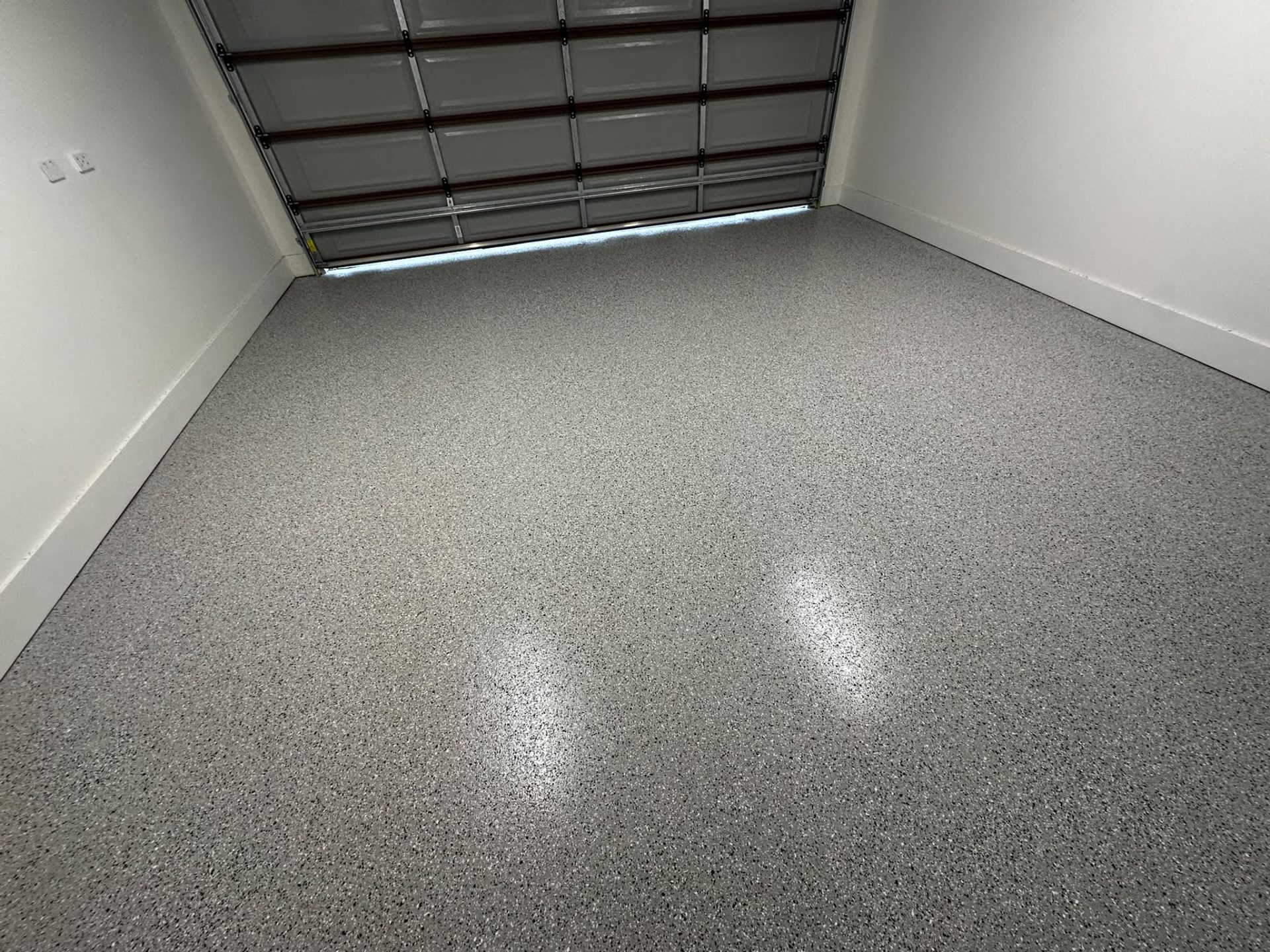
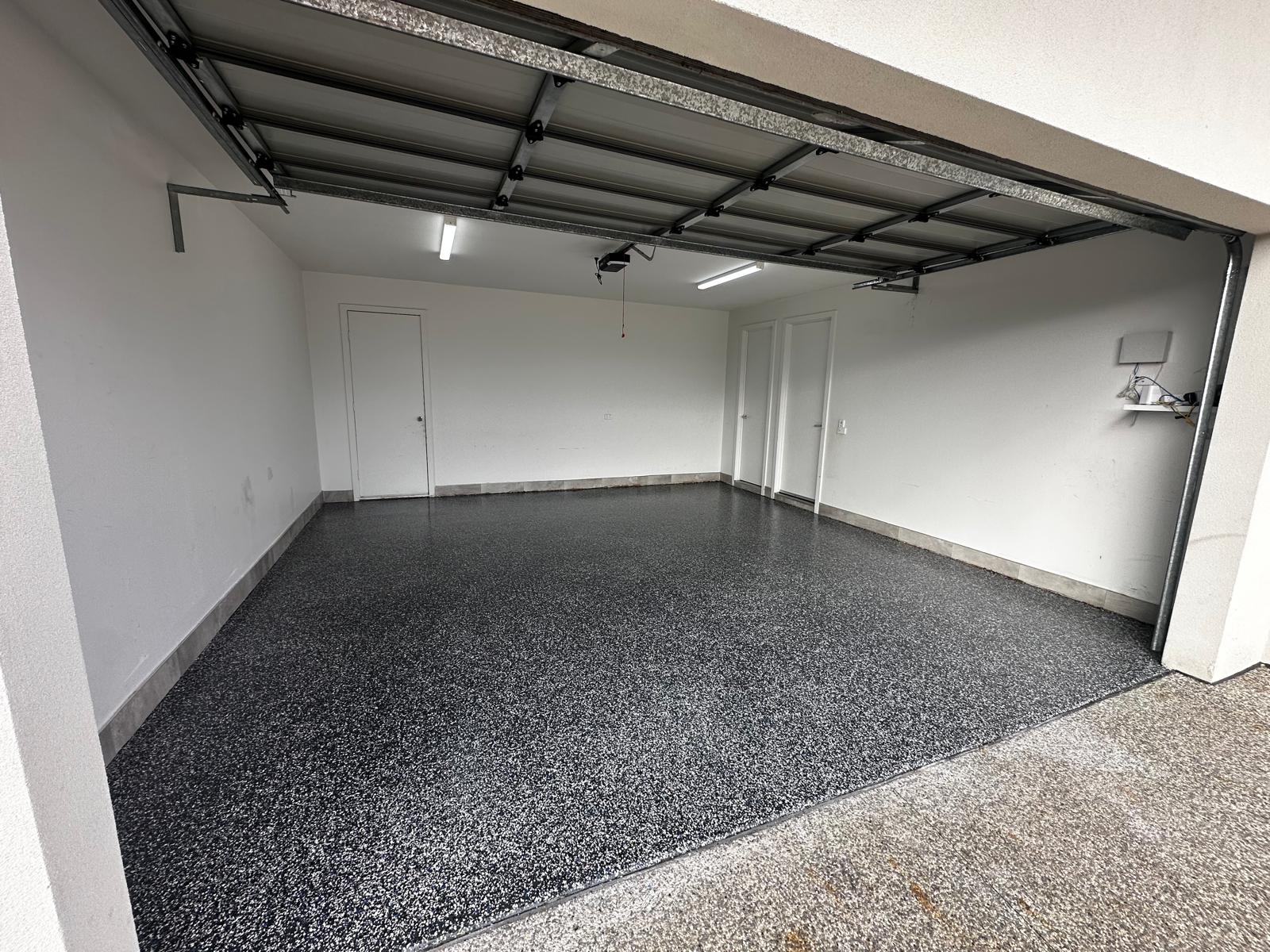
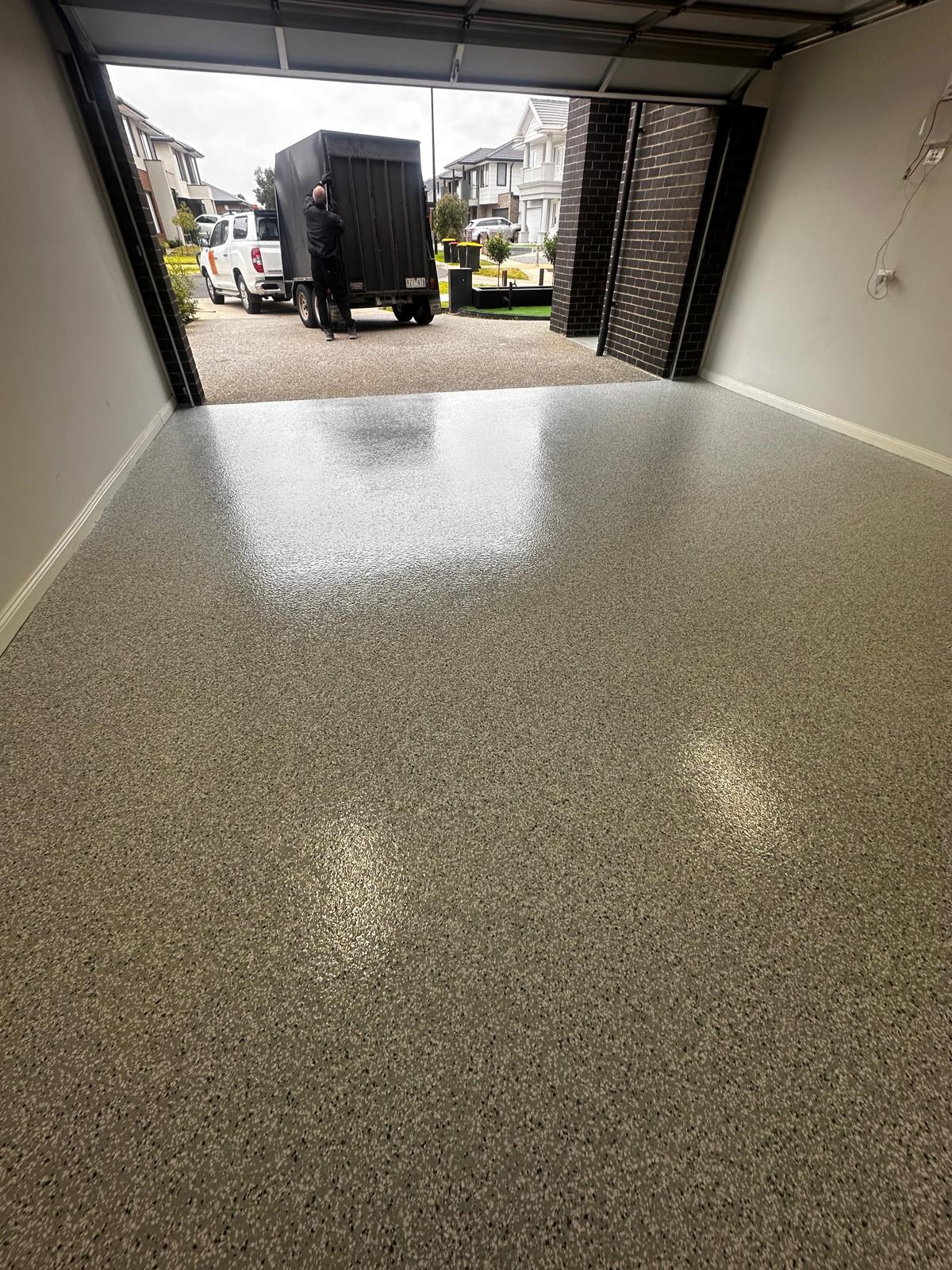
A GoPoxy flake epoxy installation in Melbourne — the UV-stable polyurethane topcoat applied over every installation prevents hot tyre transfer and protects the floor for 10 to 15 years of daily vehicle use.
04
How to Prevent Hot Tyre Damage on Your Melbourne Epoxy Garage Floor
Here is exactly how to prevent hot tyre transfer on your Melbourne epoxy garage floor — both at installation stage and in ongoing daily use:
Prevention Strategy 1 — The Most Important: Choose a Contractor Who Includes a PU Topcoat
Before signing any Melbourne epoxy flooring quote, confirm that a UV-stable aliphatic polyurethane topcoat is included. Ask specifically: “Is a polyurethane topcoat included in your quote?” If the answer is no or the contractor seems unsure, walk away. This single element is the difference between a floor that handles hot tyres for 10 to 15 years and one that fails within months. GoPoxy includes a commercial-grade UV-stable polyurethane topcoat on every single installation without exception — it is never an optional extra.
A UV-stable polyurethane topcoat on a poorly bonded floor system will still eventually fail under hot tyre stress — because the entire system above the concrete is weakly attached. Diamond grinding creates the mechanical bond that holds the entire system firmly to the concrete under thermal stress. GoPoxy uses commercial-grade diamond grinding equipment on every job. This is why our floors remain bonded under hot tyre conditions that would lift a cheaper installation within weeks.
Even on a quality GoPoxy installation, it is good practice to allow hot tyres to cool for 5 to 10 minutes before driving directly onto the floor after a long motorway run. For the vast majority of daily Melbourne driving — short trips, commutes, school runs — tyres never reach the temperatures associated with hot tyre transfer. This is only a precaution for high-performance vehicles or extended highway driving.
Prevention Strategy 4 — Use Rubber Tyre Mats for High-Performance Vehicles
Melbourne homeowners with high-performance vehicles, track cars, or motorcycles that regularly generate high tyre temperatures can place rubber tyre mats or parking pads at the tyre contact points as an additional layer of protection. This is an extra precaution — a proper GoPoxy installation with polyurethane topcoat handles everyday vehicle use without any need for mats.
05
The GoPoxy Installation System — Why Our Floors Don’t Peel
Every single GoPoxy epoxy garage floor installation in Melbourne follows a 5-step process that eliminates every known cause of hot tyre transfer and coating failure:
1
Commercial Diamond Grinding
Every Melbourne floor GoPoxy installs starts with commercial diamond grinding — opening the concrete surface to create the mechanical bond profile that holds the entire system under thermal and physical stress.
2
Commercial Penetrating Primer
A commercial-grade penetrating primer fills the opened concrete pores, seals moisture pathways, and creates the chemical foundation for maximum epoxy adhesion.
3
100% Solids Epoxy Base Coat
The 100% solids epoxy base coat is applied at the correct film thickness — not diluted, not water-based. For flake systems, vinyl chips are broadcast while the base coat is wet.
4
Grout Coat (Flake Systems)
For flake epoxy installations, a grout coat of clear epoxy fills over the broadcast flakes — locking them in position and creating a smooth, stable base for the topcoat.
5
UV-Stable Polyurethane Topcoat
The critical final layer. GoPoxy’s UV-stable aliphatic polyurethane topcoat provides hot tyre transfer resistance, UV stability so the floor never yellows, anti-slip traction, scratch resistance, and chemical resistance. Included on every installation as standard — never optional.
Hot tyres, epoxy floors, and Melbourne garages — answered clearly.
Yes — hot tyres can and do damage standard epoxy garage floors through a process called hot tyre transfer. Vehicle tyres reach 60–100°C+ during normal driving in Melbourne. When these hot tyres park on a standard epoxy floor, the heat softens the epoxy surface, which bonds to the tyre rubber. When the vehicle moves, the epoxy peels away from the concrete in patches. However, a properly installed epoxy floor with a UV-stable commercial-grade polyurethane topcoat — as applied by GoPoxy on every installation — is highly resistant to hot tyre transfer and handles normal Melbourne vehicle use for 10 to 15 years without issue.
Hot tyre transfer (also called hot tyre pickup) is the most common cause of epoxy garage floor failure in Melbourne. It occurs when vehicle tyres that are still hot from driving park on an epoxy floor. The heat softens the epoxy surface, which bonds to the tyre rubber. When the vehicle moves next, the epoxy peels off the concrete in patches shaped exactly like the tyre contact points. This is almost entirely preventable by using a UV-stable polyurethane topcoat — which GoPoxy includes on every installation as standard.
The most effective way to prevent hot tyre damage on a Melbourne epoxy garage floor is to have a UV-stable aliphatic polyurethane topcoat applied as part of the installation. This topcoat has a glass-transition temperature significantly above what vehicle tyres produce, preventing tyre bonding entirely. GoPoxy includes this topcoat on every installation as standard — it is never optional. Additionally: use 100% solids commercial-grade epoxy products, ensure diamond grinding surface preparation, allow very hot performance car tyres to cool briefly before driving onto the floor, and place rubber tyre mats if using track or racing vehicles.
Cheap epoxy garage floors in Melbourne peel for three main reasons: 1) No polyurethane topcoat — the epoxy surface is directly exposed to hot tyre heat with nothing to protect it; 2) Water-based or low-solids epoxy products that soften at much lower temperatures than commercial-grade 100% solids systems; 3) Acid etching instead of diamond grinding for surface preparation, meaning the epoxy was never properly mechanically bonded to the concrete and fails under the first real thermal or physical stress. GoPoxy prevents all three failure modes on every installation.
Yes — GoPoxy flake epoxy flooring resists hot tyre transfer because a UV-stable polyurethane topcoat is applied over the flake system on every installation. The topcoat is the critical protective element. Flake epoxy without a polyurethane topcoat would still be vulnerable to hot tyre pickup — but GoPoxy includes this topcoat as standard on every Melbourne flake epoxy garage floor. At $65–$85/m², GoPoxy’s flake epoxy with polyurethane topcoat delivers excellent hot tyre resistance for 10 to 15 years across all standard Melbourne vehicles.
A hot-tyre-resistant epoxy garage floor from GoPoxy in Melbourne costs $65–$85/m² for flake epoxy and $100–$150/m² for metallic epoxy — both include the UV-stable polyurethane topcoat as standard. A standard Melbourne double garage of 55m² costs approximately $3,575–$4,675 for a flake epoxy system with polyurethane topcoat. All GoPoxy prices include diamond grinding, all coats, PU topcoat, clean up, and written warranty. Book a free site visit at gopoxy.com.au/contact for your exact written quote.
Yes — an epoxy garage floor damaged by hot tyre transfer in Melbourne can be repaired or fully reinstalled. Small isolated areas of tyre pickup can sometimes be patch-repaired, but widespread delamination typically requires a full reinstallation. GoPoxy can assess the extent of damage during a free site visit and recommend the most appropriate solution. Any reinstallation by GoPoxy will include commercial diamond grinding and a mandatory polyurethane topcoat to ensure the problem does not recur. Contact us at gopoxy.com.au/contact to arrange your assessment.
For Melbourne garages housing high-performance vehicles, sports cars, or motorcycles that regularly generate elevated tyre temperatures, GoPoxy recommends a commercial-grade 3-coat epoxy system with a UV-stable polyurethane topcoat at $55–$85/m². For extreme performance or track vehicles, an epoxy mortar system at $80–$120/m² provides additional thermal resistance and impact tolerance. GoPoxy assesses every Melbourne garage and vehicle situation during the free site visit to recommend the most appropriate system.
Want a Hot-Tyre-Resistant Epoxy Floor for Your Melbourne Garage?
Free site visit · Written quote · Polyurethane topcoat included as standard · Diamond grinding guaranteed
The answer to “can hot tyres damage an epoxy garage floor?” is yes — but only when the floor was not installed correctly. With GoPoxy’s commercial diamond grinding, 100% solids epoxy, and mandatory UV-stable polyurethane topcoat on every job, hot tyre transfer simply does not occur on our floors. That is why GoPoxy Melbourne garage floors perform for 10 to 15 years across Craigieburn, Mickleham, Toorak, Sunbury, Reservoir, and every suburb in between, while cheap floors installed without these standards fail within months. Explore our flake epoxy service, metallic epoxy service, and garage epoxy guide, check our Google reviews, follow us on Facebook and Pinterest, or visit gopoxy.com.au/contact to book your free site visit today.
Narre Warren is really two suburbs sharing a name: 1990s estates with thirty-year-old slabs, and newer pockets where the concrete is barely weathered. What garage epoxy flooring costs here, and why an older slab is not too old to coat.
Mickleham has changed faster than almost any suburb in Melbourne's north. What commercial painting actually involves here: why the buildings are different, why the floor matters as much as the walls, and how to avoid paying for the same disruption twice.
If your commercial space needs both painting and a new floor, the most expensive decision you can make is hiring two contractors. Not because of their rates — because of the second shutdown.