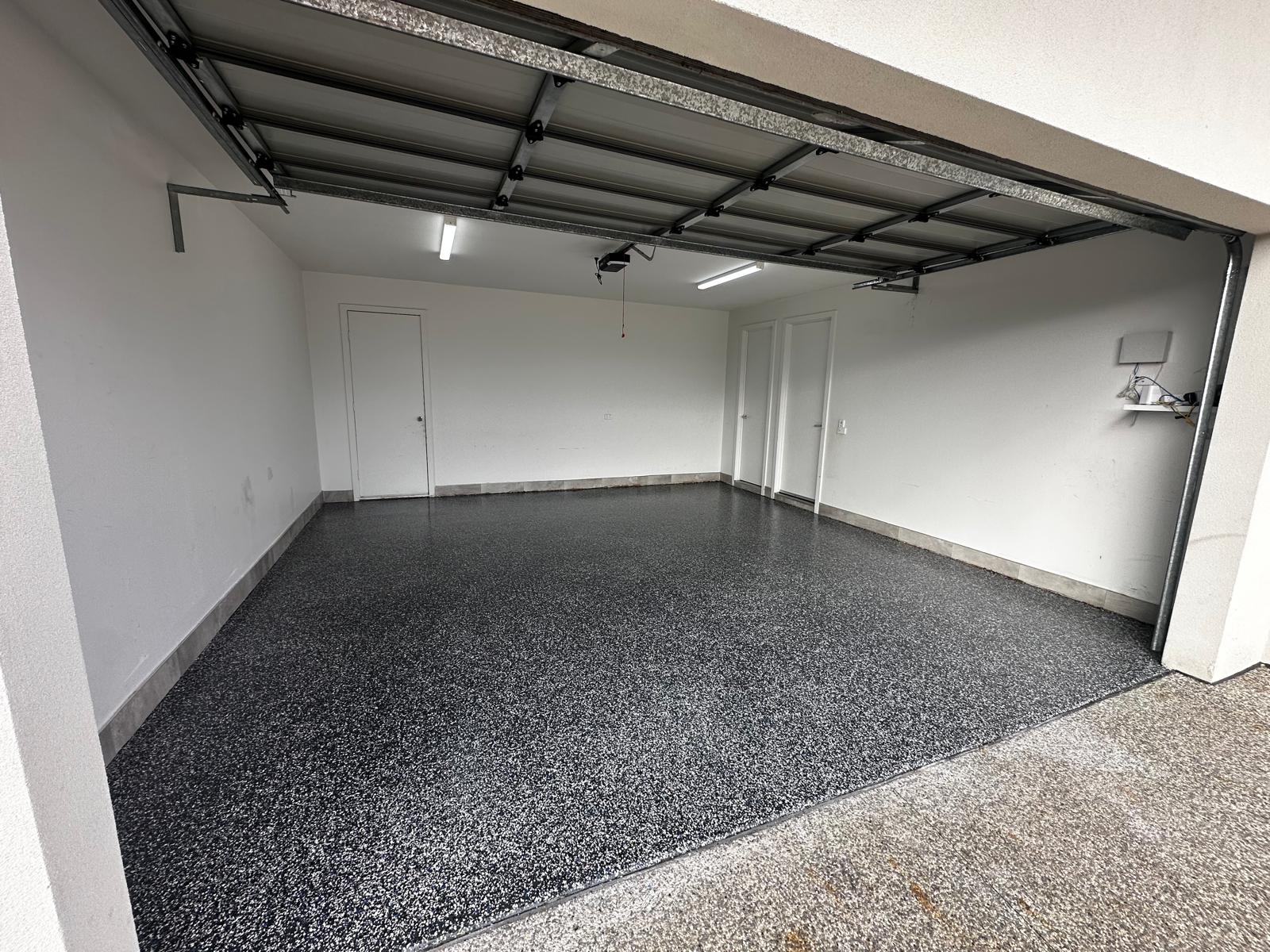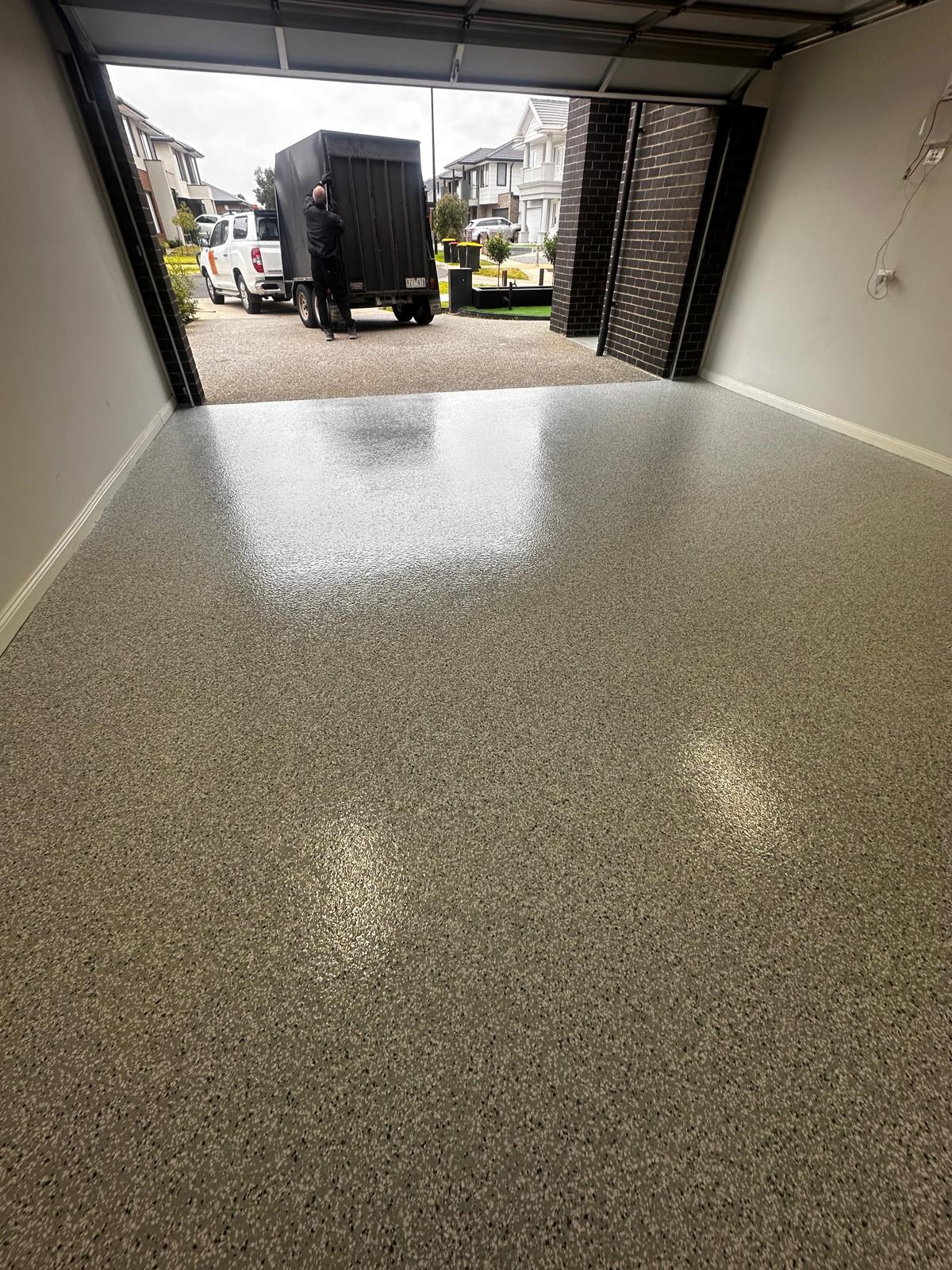
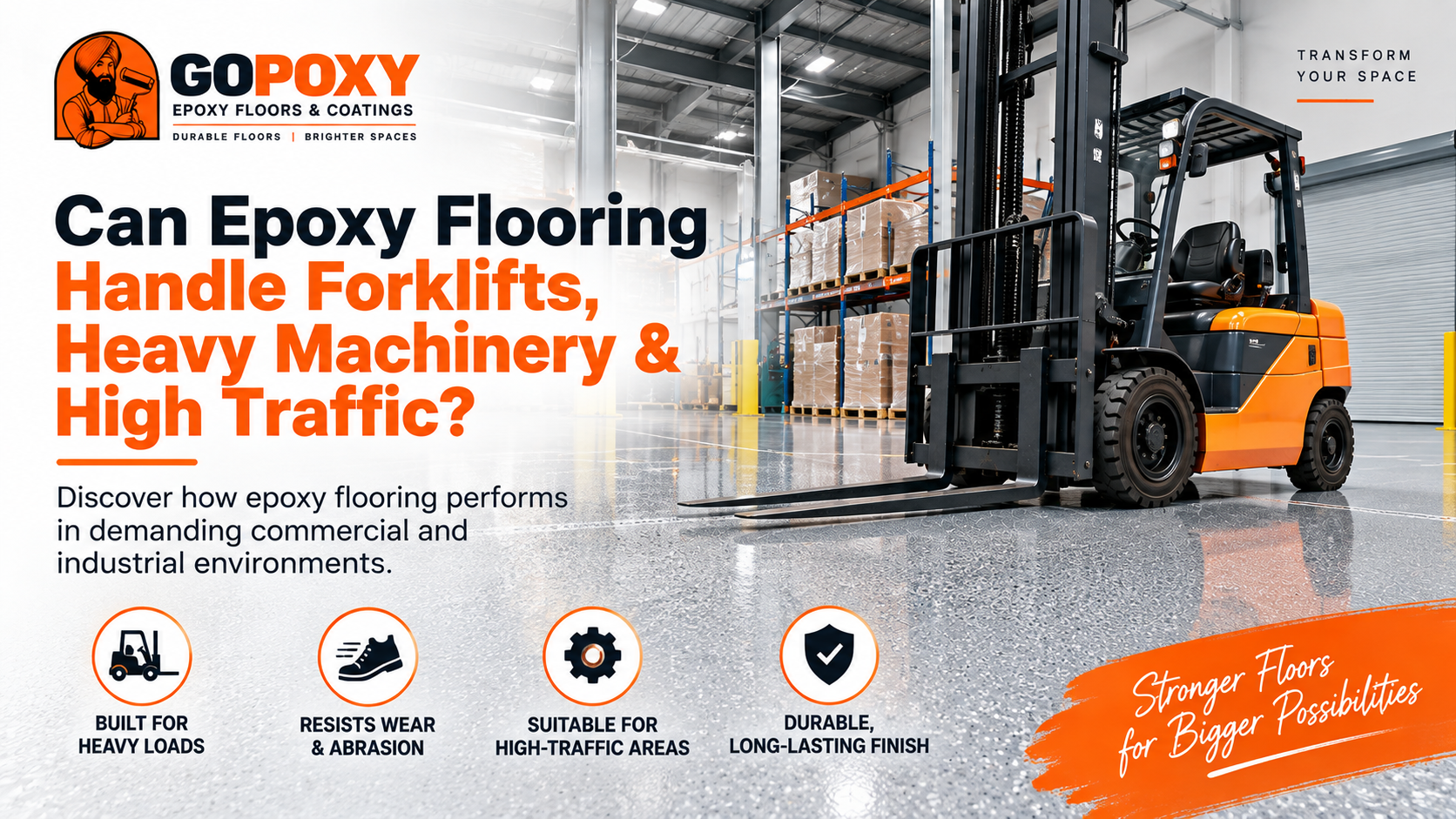
Yes — properly specified and professionally installed epoxy flooring is suitable for warehouses, factories and commercial spaces exposed to forklifts, machinery and heavy foot traffic. The qualifier matters more than the answer, because an under-specified coating in a heavy-duty environment will fail regardless of how good the product is.
The short answer
Epoxy handles forklifts, heavy machinery and high traffic when the system matches the duty. Performance depends on seven things: concrete condition, surface preparation, the epoxy system selected, coating thickness, expected traffic and load, installation quality, and the topcoat or protection system. Get those right and the floor lasts. Get one wrong and it does not.
That list is the whole article. Everything below explains what each item means in a working facility.
Can epoxy flooring handle forklift traffic?
Yes, and forklifts are the benchmark most industrial epoxy flooring in Melbourne is specified against. But it is worth understanding what a forklift actually does to a floor, because it is not what most people assume.
It is not the weight. Concrete carries enormous compressive load, and a loaded forklift sitting still is close to a non-event. The damage comes from movement:
- Point loading under turning wheels. A counterbalance forklift pivoting concentrates load into a very small contact patch and drags it sideways. Turning points wear faster than anything else on a floor.
- Braking and acceleration, which apply shear force rather than straight compression.
- Repeated travel along the same routes. Traffic is never evenly distributed — pick lanes and dock approaches carry the majority of movement.
- Tyre abrasion, particularly from solid or polyurethane tyres, which are far harder on a coating than pneumatic ones.
- Impact from dropped pallets, tines catching the floor, and equipment set down heavily.
Pallet jacks deserve a mention because they are often harder on a floor than forklifts. Small, hard wheels concentrate load into a tiny contact area and get pulled and turned constantly.
None of this makes epoxy unsuitable. It makes uniform specification unsuitable. A coating adequate for a showroom is not adequate for a distribution centre, and a single specification averaged across a whole warehouse will under-serve the lanes that do the work. Good forklift flooring builds heavier film where the traffic actually is.
Is epoxy flooring suitable for heavy machinery?
In the right specification, yes. Heavy duty epoxy flooring is routinely installed in:
- Manufacturing facilities
- Warehouses and distribution centres
- Factories and production floors
- Workshops and service bays
- Automotive facilities
- Storage and logistics buildings
What these environments demand from a floor:
| Demand | What it means in practice |
|---|---|
| Mechanical wear | Constant abrasion from wheels, tools and equipment dragged across the surface |
| Impact resistance | Dropped components, pallets, and machinery set down without ceremony |
| Point loading | Machine feet, racking baseplates and jack stands concentrating load |
| Vibration | Plant running continuously, transmitted into the slab |
| Oil and chemical exposure | Hydraulic fluid, coolants, lubricants and process chemicals |
| Thermal movement | Washdown, steam cleaning, or plant that runs hot |
Where machinery is fixed rather than mobile, the questions change — compressive load under baseplates matters more than abrasion. That is a specification conversation, and it should happen before a price is given. See factory epoxy flooring and warehouse epoxy flooring.
How does epoxy perform in high-traffic commercial areas?
High traffic is not only about vehicles. A busy commercial floor absorbs:
- Constant pedestrian movement, often the same routes all day
- Trolleys, cages and stock movement
- Pallet jacks and electric tugs
- Forklifts at loading docks
- Delivery equipment being wheeled in and out
Businesses choose commercial floor coatings for four properties, and it is worth being clear about which ones actually matter to you:
| Property | Why it matters |
|---|---|
| Durability | The floor survives the traffic rather than being resurfaced every few years |
| Seamlessness | No joints or grout for dirt to collect in, and nothing to trip on |
| Cleanability | Non-porous, so spills sit on top instead of soaking in |
| Wear resistance | Traffic lanes do not become visible tracks within a year |
Compared with bare concrete, the difference in a busy facility is immediate — mainly because bare concrete generates dust continuously as its surface breaks down, and that dust ends up on stock, equipment and staff.
Why surface preparation matters for heavy-duty epoxy flooring
This is the part that decides whether the floor lasts, and it is the part invisible once the job is finished.
Concrete inspection
Before any system is specified, the slab is assessed for:
- Cracks — their size, pattern and whether they are still moving
- Contamination — oil, grease, silicone, release agents, and how deep they have penetrated
- Moisture — tested with in-slab probes, not a visual check
- Existing coatings — what is there, how well it is bonded, whether it can stay
- Surface condition — laitance, spalling, previous patching, joint condition
A quote written without this is a guess. On a large industrial floor, a guess is an expensive thing to get wrong.
Mechanical preparation
Coatings bond mechanically — they grip an opened concrete profile rather than soaking in. Creating that profile means removing the weak, cement-rich laitance layer at the surface, which looks like sound concrete but has almost no strength.
Diamond grinding handles most floors. Shot blasting is often better on very large areas, heavily contaminated slabs or thick existing coatings. Both open the surface; which is appropriate depends on the slab. Acid etching is not preparation for industrial work — the reasoning is in diamond grinding vs acid etching.
Repairs and joints
Cracks are routed out into a clean channel, filled with a structural repair compound and ground flush. Spalled areas and pits are made good. Expansion and control joints are treated differently — they exist so the slab can move, and must be honoured with a flexible filler rather than bridged. A rigid coating run across a moving joint splits along the line, usually within the first year.
What happens if epoxy flooring is installed incorrectly?
The failure tells you what was skipped.
| Symptom | Most likely cause |
|---|---|
| Blistering or bubbling | Moisture in the slab, untested |
| Peeling away in sheets | Laitance left on, or contamination |
| Delamination at edges and joints | Edge preparation rushed or joints bridged |
| Straight-line cracking | An expansion joint coated over |
| Premature wear in lanes | Film too thin, or system under-specified |
| Uneven finish or roller marks | Applied outside the temperature window, or pot life exceeded |
| Poor adhesion generally | Preparation, every time |
The pattern is consistent: the coating is rarely the problem. The system is preparation plus product plus application, and the first of those three does most of the work. There is a fuller diagnostic guide in why factory floors fail.
What type of epoxy flooring is best for forklifts?
There is no universally best system — only the one appropriate to your site. The realistic options:
| System | Suitable applications |
|---|---|
| Standard epoxy | General commercial areas, light traffic, storage |
| Heavy-duty epoxy | High-traffic commercial environments, regular forklift movement |
| Flake epoxy | Garages, showrooms and selected commercial areas where appearance matters |
| High-build epoxy | Areas needing additional coating thickness for wear or levelling |
| Epoxy plus protective topcoat | Higher wear environments needing extra abrasion and chemical resistance |
| Trowel-applied screed | Severe impact, heavy point loading, or rebuilding a worn surface |
A polyaspartic or polyurethane topcoat is worth considering where abrasion, UV exposure or chemical contact is significant. It carries the wear so the build coats underneath do not. Where the environment involves steam cleaning or constant wet service, a polyurethane cement screed is frequently the better system than epoxy at all — an honest contractor will say so.
Thickness is a specification decision rather than a quality grade. Thicker is not automatically better; it is matched to the duty.
Can epoxy flooring handle oil and chemical spills?
Considerably better than bare concrete, which is porous and absorbs contaminants permanently — the reason an old workshop slab has dark shadows nothing removes.
A sealed, non-porous floor keeps spills on the surface where they can be cleaned up. For warehouses, workshops and automotive facilities, that alone justifies the floor.
But chemical resistance is not universal. It depends on the specific system, the chemical, its concentration, the temperature and how long it sits before being cleaned. A system that shrugs off hydraulic oil may not tolerate a concentrated solvent or acid.
The practical instruction: give your contractor the actual list of substances your site handles, not a general description. A system should be matched to that list rather than assumed to cope.
How long does industrial epoxy flooring last?
Anyone quoting a fixed number without seeing your site is guessing. Longevity depends on:
- Traffic volume — a floor doing two forklift movements an hour is not the floor doing two hundred
- Forklift frequency and type, including tyre compound
- Load intensity and how concentrated it is
- Surface preparation quality — the largest single factor
- System selection relative to the duty
- Maintenance, particularly keeping grit off the surface
- Chemical exposure
- UV or outdoor exposure, where applicable
What can be said fairly: a correctly specified, properly prepared industrial floor gives many years of service in a demanding environment, and an under-specified one can fail within two. The variable is not the brand of resin. Related reading in how long epoxy flooring lasts.
How do you maintain a commercial epoxy floor?
Straightforward, and the single highest-value habit is the least glamorous one.
- Sweep or scrub regularly. Grit under wheels is what abrades a floor. Keeping it off does more for the life of the surface than anything else.
- Clean spills promptly rather than leaving them to sit.
- Use pH-neutral products. No acids, no harsh solvents, nothing abrasive.
- Inspect traffic lanes periodically — wear shows there first.
- Address damage early, while it is still a repair rather than a rebuild.
Detailed guidance on spills and marks is in how to remove oil, fuel and tyre marks from epoxy flooring.
Epoxy flooring vs bare concrete for forklift areas
| Bare concrete | Epoxy-coated concrete | |
|---|---|---|
| Dusting | Continuous as the surface breaks down | Sealed — no dusting |
| Oil and chemicals | Absorbed permanently | Sits on the surface, cleanable |
| Surface wear | Progressive, visible in lanes | Resistant, when correctly specified |
| Cleaning | Difficult — porous and uneven | Seamless, sweeps and scrubs easily |
| Appearance | Deteriorates visibly | Finished, with line marking possible |
| Cost | Nothing up front | Investment, offset over the floor's life |
Honest caveat: coating is not automatically the right answer everywhere. A slab in genuinely poor condition may need resurfacing before any coating is worth applying, and a low-traffic store area may not justify the spend at all.
Where heavy-duty epoxy flooring is used
- Factories and production floors — see factory epoxy flooring
- Warehouses and distribution centres — see warehouse epoxy flooring
- Workshops and service bays
- Automotive facilities
- Commercial buildings and retail — see commercial epoxy flooring
- Showrooms — often flake or metallic finishes
- Commercial kitchens — see restaurant and kitchen flooring
- Storage and logistics facilities
How to choose a commercial epoxy flooring contractor
Eight questions. The answers separate contractors far more reliably than the prices do.
- Do you inspect and test the concrete first? Including moisture, with a stated method.
- What preparation method will you use, and why? Grinding or shot blasting, and the reasoning.
- Which system do you recommend for my traffic? Named by product, not "epoxy".
- What traffic is it specified for? Forklift type, frequency, load.
- What film thickness, and does it vary in the lanes?
- What topcoat, and what does it add?
- What warranty applies, and what does it exclude?
- Can you show comparable commercial projects?
A quote that arrives as a rate per square metre and a total, with none of the above, has not engaged with your site. Pricing context in commercial epoxy flooring cost in Melbourne, and downtime planning in how long a commercial floor puts your business out of action.
Final verdict
Epoxy flooring is a practical solution for warehouses, factories and commercial environments exposed to forklifts, machinery and high traffic — provided the system is correctly specified and professionally installed.
Those two conditions are not boilerplate. They are where the entire difference sits between a floor that serves a facility for years and one that starts lifting in the pick lanes within eighteen months.
The resin is a commodity. The specification and the preparation are not.
Frequently asked questions
Can epoxy flooring handle forklift traffic?
Yes, when the system is specified for it. A coating suitable for a showroom is not suitable for a distribution centre running counterbalance forklifts all day. Film thickness, system type and preparation all have to match the actual traffic, which is why forklift areas are quoted after a site inspection rather than from a rate per square metre.
What damages an industrial floor most — the weight or the movement?
The movement. Static weight is rarely the issue; concrete carries enormous compressive load. Damage comes from point loading under turning wheels, braking, repeated travel along the same lanes, and impact from dropped pallets and equipment.
Why do pick lanes wear out before the rest of the floor?
Because a specification averaged across a whole warehouse under-serves the lanes. Traffic is never evenly distributed — the same routes carry the majority of movement. A sensible specification builds heavier film in those lanes rather than treating the floor as uniform.
Is epoxy suitable for pallet jacks?
Yes, and pallet jacks are often harder on a floor than forklifts. Their small, hard wheels concentrate load into a very small contact patch, and they are pulled and turned constantly. Any system specified for forklift traffic should account for them.
What thickness does an industrial epoxy floor need?
It depends entirely on the duty. A thin roller-applied coating suits light commercial use; heavy industrial environments may need a high-build system or a trowel-applied screed several millimetres thick. Thickness is a specification decision, not a quality grade — thicker is not automatically better, it is matched to the traffic.
What is the difference between an epoxy coating and an epoxy screed?
A coating is a thin film, generally under a millimetre, applied by roller or squeegee. A screed is a trowel-applied system several millimetres thick with aggregate through it. Coatings protect a sound slab; screeds rebuild a worn surface and absorb far heavier impact.
Can epoxy handle oil and chemical spills?
It resists many common workplace contaminants far better than bare concrete, which absorbs them permanently. Chemical resistance is not universal though — it depends on the specific system, the chemical, the concentration and how long it sits. Give your contractor the actual list of substances your site handles.
Will hot tyres or hydraulic fluid damage it?
A correctly specified system with a suitable topcoat handles both in normal use. Problems arise where a light-duty coating has been used in a heavy-duty environment, or where spills are left to sit rather than cleaned up.
How long does an industrial epoxy floor last?
There is no single figure, and anyone quoting one without seeing your site is guessing. Longevity depends on traffic volume, load intensity, preparation quality, system selection, maintenance and chemical exposure. A correctly specified floor in a well-run facility gives many years of service; an under-specified one can fail within two.
What causes industrial floors to fail early?
Almost always the bond rather than the coating. Moisture in the slab, inadequate preparation, contamination the grinder never reached, or the wrong system for the duty. All four are decided before the first coat is applied.
What does blistering mean?
Usually moisture. Water vapour rising through the slab has nowhere to go under an impermeable coating, so pressure builds until it lifts the floor from underneath. It is why moisture testing before quoting matters more than almost anything else.
Why would a floor peel away in sheets?
Preparation or contamination. Either the laitance was left on, or something in the concrete — oil, silicone, a release agent — prevented adhesion. It is not a coating defect.
Does the whole warehouse have to close?
No. Industrial floors are almost always staged bay by bay or aisle by aisle, or run overnight, so the facility keeps operating. The programme is agreed before work begins.
How is preparation done on a large industrial floor?
Diamond grinding suits most floors. Shot blasting is often the better choice for very large areas, heavy contamination or removing thick existing coatings. The right method depends on the slab, and a contractor should tell you which they are using and why.
Do cracks need repairing first?
Yes. Cracks get routed out into a clean channel, filled with a structural repair compound and ground flush. Expansion and control joints are treated differently again — they must be honoured with a flexible filler, never coated over.
How should a commercial epoxy floor be maintained?
Sweep or scrub regularly to keep grit off the surface, since grit under wheels is what abrades a floor. Clean spills promptly. Use pH-neutral cleaning products rather than acids or harsh solvents. Inspect traffic lanes periodically and address damage early, while it is still a repair rather than a rebuild.
Is epoxy better than bare concrete for a forklift area?
For most sites, yes — bare concrete dusts continuously, absorbs oil permanently and is harder to clean. But it is a specification question, not an automatic answer. A slab in poor condition may need resurfacing before any coating is worth applying.
Can line marking be applied over an epoxy floor?
Yes, and re-marking is a good moment to review your WHS layout rather than simply reproducing the old lines. Marking is applied after the topcoat has cured.
What should I ask a commercial flooring contractor?
Do you inspect and test the slab first? What preparation method, and why? Which system do you recommend for my traffic? What film thickness? What topcoat? Is it specified for forklifts? What warranty applies? Can you show comparable commercial projects?
Do you work on industrial sites across Melbourne?
Yes. We are based in Mickleham and work across the metropolitan area, including the industrial precincts in Dandenong, Truganina, Thomastown, Broadmeadows, Campbellfield, Laverton and Derrimut.
Planning a commercial or industrial flooring project?
We are a Melbourne-based industrial and commercial flooring contractor working across the metropolitan area since 2020, including the industrial precincts in Dandenong, Truganina, Thomastown, Broadmeadows, Campbellfield and Laverton.
We inspect the slab, test it for moisture, map where your traffic actually goes, and specify a system against the duty — then give you a written programme with return-to-service times per area.
Call 0451 980 606 or book a free site inspection to discuss the right flooring system for your requirements.
Planning an epoxy floor in Melbourne?
Book a free on-site inspection and get a fixed written quote — no obligation.