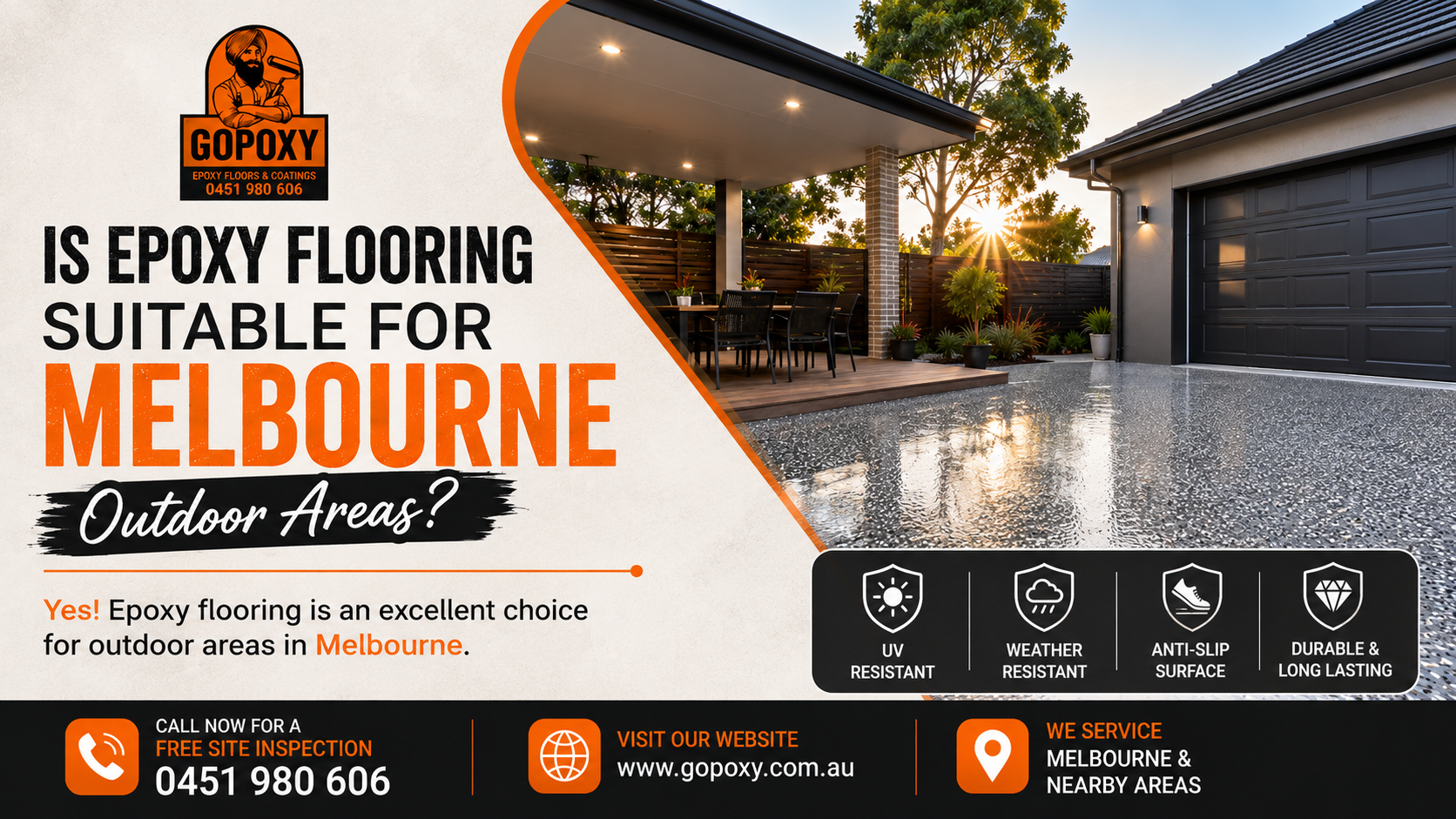
Short version: it depends entirely on how much direct sun the area gets — and on which product goes on last. Here is where outdoor epoxy works in Melbourne, where it does not, and what to use instead when it does not.
The short answer
Epoxy flooring is suitable for covered Melbourne outdoor areas — alfresco spaces, verandahs, covered patios, carports and roofed pool surrounds — when finished with a UV-stable polyaspartic topcoat. Bare epoxy is not UV stable and will amber and chalk in direct sunlight within one to two years. For fully exposed areas such as driveways and open paths, concrete sealing or resurfacing is the right system instead.
Why bare epoxy fails outdoors
Epoxy resin has one significant weakness, and outdoors is exactly where it shows: it is not UV stable.
Ultraviolet light breaks down the polymer chains at the surface of the coating. Two things follow, and both are cosmetic rather than structural — which is precisely why they catch people out.
- Ambering. The coating shifts yellow-brown. It is most obvious on light greys, whites and blues, and on any clear coat over a decorative finish.
- Chalking. The surface degrades to a fine powder, gloss disappears, and the colour goes flat and dusty. Run a hand across it and it comes away marked.
The floor is still bonded to the slab. It simply looks progressively worse, and in Australia's UV conditions that can start inside twelve months. If you have seen an outdoor coated area that has gone patchy yellow, you have seen an epoxy installed without UV protection.
What makes it work: the topcoat, not the epoxy
This is the part worth understanding, because it reframes the whole question.
In a properly specified outdoor system, the epoxy is not the layer facing the weather. It is the bonding and build layer — the part that grips the concrete and carries the colour or flake. The layer taking the UV load is the topcoat.
A UV-stable polyaspartic topcoat is formulated specifically to absorb that punishment and protect what is underneath. It also brings the abrasion resistance and the resistance to hot tyre pickup. We use polyaspartic on every floor for those reasons, and the reasoning is set out in why concrete sealers are not suitable for epoxy floors.
So the honest answer to "is epoxy suitable outdoors" is: an epoxy system with the right topcoat is, in the right locations. Epoxy on its own is not.
Where it works, area by area
| Area | Suitable? | Notes |
|---|---|---|
| Covered alfresco | Yes | The most common outdoor job we do |
| Verandah or covered patio | Yes | Excellent fit |
| Carport | Yes | Add anti-slip — open sides get driven rain |
| Covered pool surround | Yes | Anti-slip additive essential |
| Undercroft or basement entry | Yes | Shaded, usually straightforward |
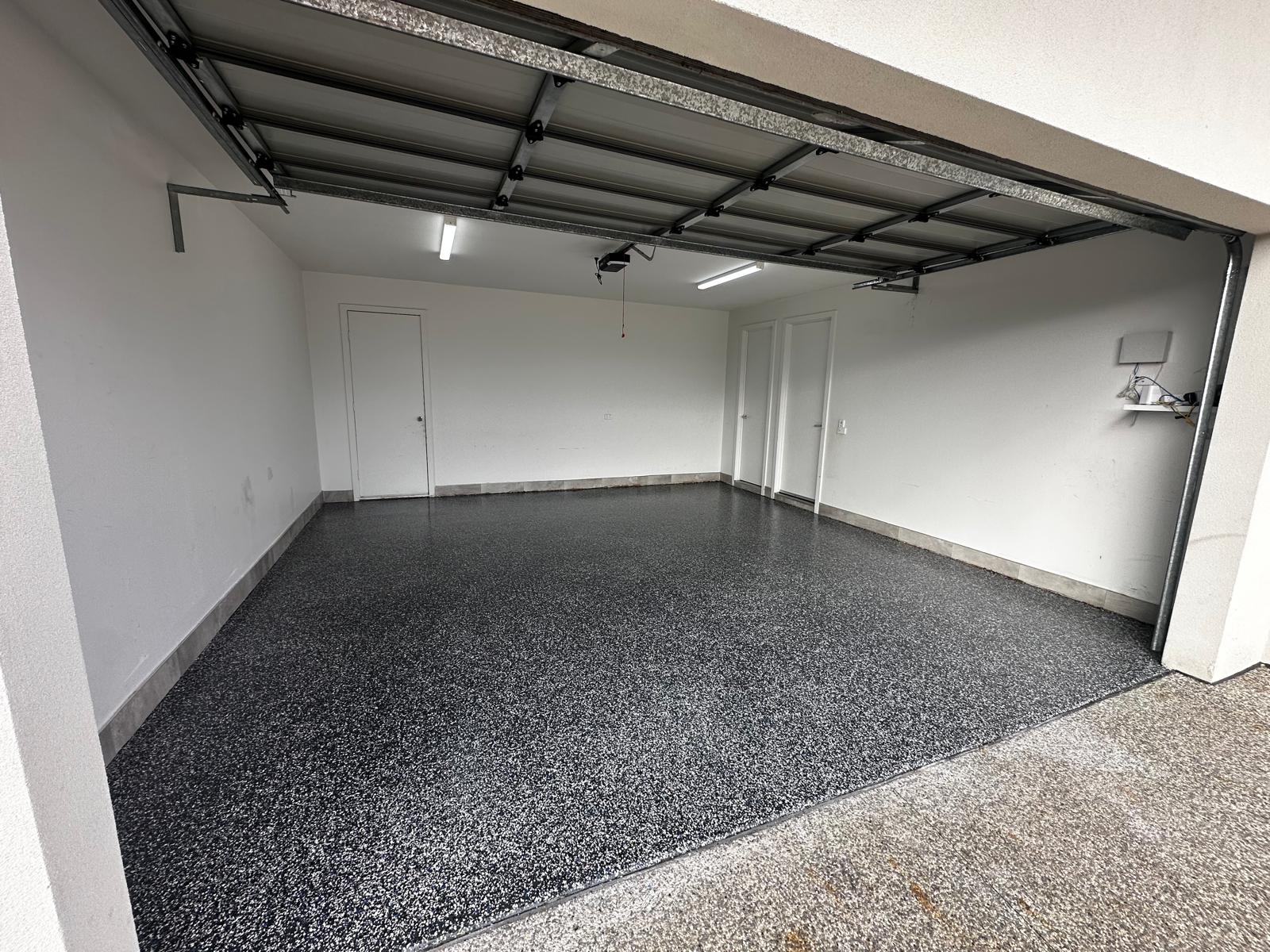
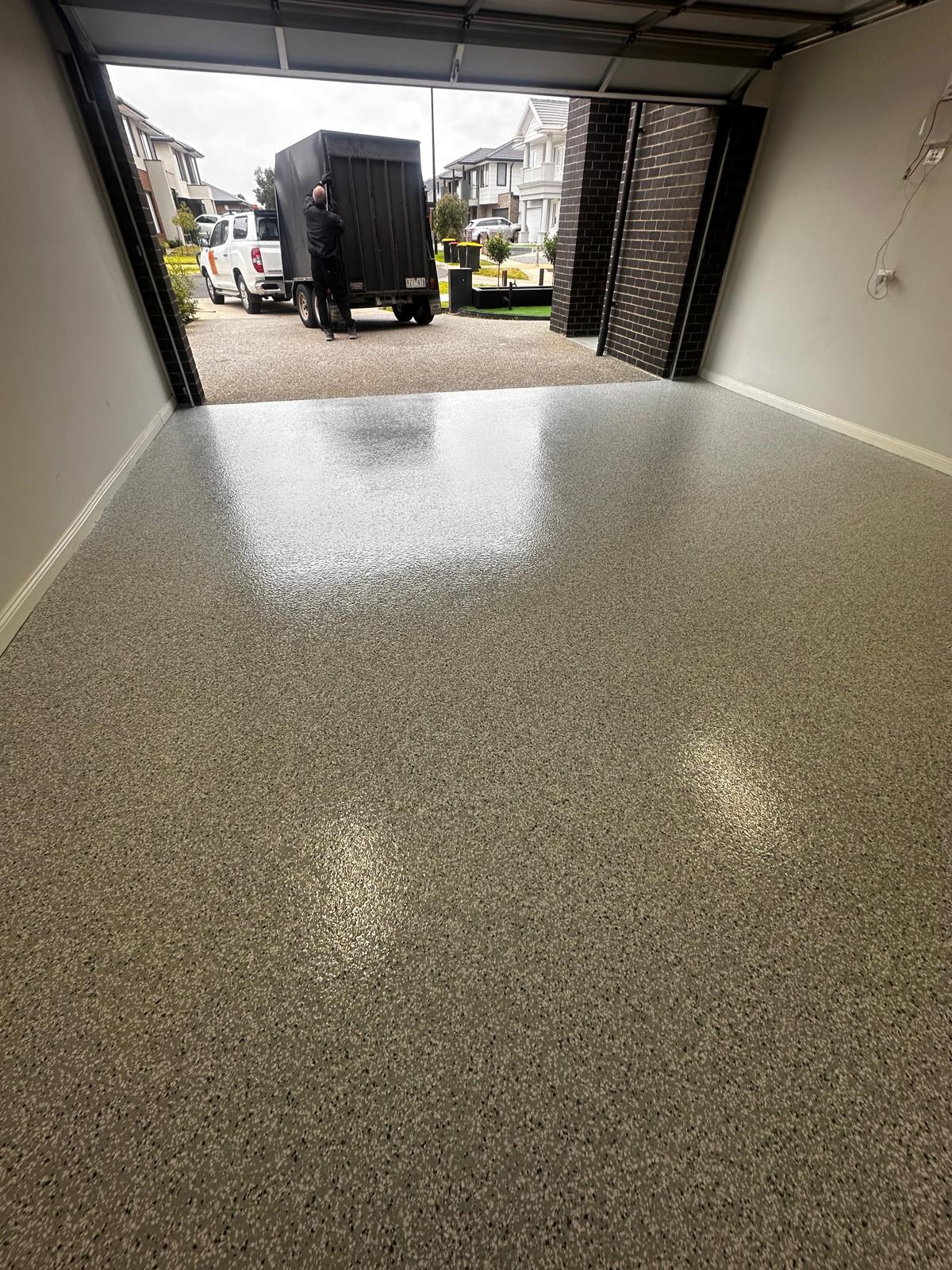
| Garage with the door open all day | Yes | Sun reaches only the first metre or so |
| Partly shaded patio | Usually | Depends on hours of direct sun — assessed on site |
| Uncovered pool surround | No | Sealing or resurfacing instead |
| Driveway | No | Full sun, tyre heat, thermal movement |
| Open paths and courtyards | No | Sealing or resurfacing instead |
| Balcony | Assess first | Waterproofing membranes underneath |
The dividing line is simple enough to apply yourself: if the area has a roof over it, epoxy with a UV-stable topcoat is on the table. If it is open to the sky, it is not.
What to use where epoxy is not the answer
Being told "no" is only useful if something follows it. For fully exposed areas we install two other systems.
| System | From | Best for |
|---|---|---|
| Concrete sealing | $25/m² | Driveways, paths and courtyards where the concrete is sound and you want protection without changing the look |
| Concrete resurfacing | $45/m² | Tired, stained or damaged exposed concrete that needs a new surface rather than a coating over the old one |
Both are built for full sun and neither has the UV vulnerability that makes bare epoxy a poor outdoor choice.
The Melbourne-specific factors
UV load
Australian UV is genuinely harsh by world standards, and product performance claims written for northern-hemisphere conditions do not translate directly. This is the main reason a UV-stable topcoat is non-negotiable here rather than an optional upgrade.
Temperature swings
Melbourne routinely delivers wide day-to-night ranges, and an outdoor slab expands and contracts through them. A coating has to move with the concrete rather than resist it — another argument for a flexible, correctly specified system over a cheap rigid one.
Reactive clay
Much of Melbourne, particularly the west and south-east, sits on clay that swells in winter and shrinks in summer. Outdoor slabs move more than protected indoor ones because they take the full moisture cycle. Cracks need routing and filling properly, not coating over.
Moisture and drainage
Outdoor slabs hold considerably more moisture than a garage floor, and moisture rising through concrete lifts a coating from underneath regardless of surface preparation. They also almost always have deliberate falls for drainage, and those falls must be preserved so water still runs away from the building.
What is already down there matters
Outdoor areas rarely present as bare concrete. Most have had something done to them, and what that something is decides whether a coating is possible at all.
Pavers
Not suitable. Pavers are individual units bedded on sand, and they move independently of one another. A coating over the top cracks along every joint within a season. The pavers have to be lifted and a slab poured, or a different surface chosen.
Outdoor tiles
Not directly. Tiles move against the slab, grout lines telegraph through, and any tile that is drummy will take the coating off with it when it lets go. Tiles come up first — from \$35/m² — and then the slab underneath is assessed properly.
Existing sealer or paint
Common on verandahs and patios, and it must come off. A previous owner's sealer is the outdoor equivalent of a builder's slab sealer: invisible in places, and specifically designed to stop things bonding.
Stencilcrete and exposed aggregate
Both are heavily textured, so a coating either fills the texture unevenly or follows it and looks poor. Resurfacing is usually the better route.
Bare, sound concrete
The ideal case, and more common than people assume under a covered alfresco added later in a build.
None of this is something you need to diagnose yourself. It is what the free site visit is for — and it is the reason we will not quote an outdoor area over the phone.
Slip resistance is the outdoor priority
Indoors, slip resistance is a sensible precaution. On a wet pool surround or a rain-blown carport it is a safety requirement.
A smooth gloss coating is slippery when wet — that is true of any hard flooring, coated or not. A flake system helps significantly because the flake itself creates surface texture. For any outdoor area that gets regularly wet we add an anti-slip aggregate to the topcoat as standard, not as an extra.
The trade-off is honest and worth knowing: more grip means a slightly more textured surface that holds a little more dirt and takes marginally more effort to sweep. Around a pool that is the right trade. More on the general question in is epoxy flooring slippery.
Preparation outdoors is not the same job
The grinding is identical. The assessment around it is not.
- Moisture testing matters more. Outdoor slabs sit in the weather and often lack a vapour barrier underneath.
- Drainage falls must be read before grinding, so the finished surface still sheds water correctly.
- Old sealers and paint are common. Previous owners seal patios and paint verandahs, and all of it has to come off — the reasoning is in diamond grinding vs acid etching.
- Edges and junctions need care where the slab meets garden beds, decking or a house wall.
- Weather windows are real. There is no roller door to close overnight while the primer cures, so exposed work needs a genuinely settled forecast. Timing is covered in the best season for epoxy flooring in Melbourne.
What it costs
Outdoor areas are priced at the same rates as indoor work — the difference is in what the area needs, not in a location loading.
| System | From | Typical outdoor use |
|---|---|---|
| Flake epoxy + UV-stable topcoat | $65/m² | Alfresco, patio, carport, covered pool surround |
| Solid colour + UV-stable topcoat | $55/m² | Utility areas, undercroft, storage |
| Metallic epoxy (covered only) | $100/m² | Feature alfresco and entertaining spaces |
| Concrete resurfacing | $45/m² | Exposed patios, courtyards, paths |
| Concrete sealing | $25/m² | Driveways and open paths |
| Tile removal, if required | $35/m² | Before any of the above |
Anti-slip additive, crack repair and fall correction are quoted after the site visit. Wider pricing sits in how much epoxy flooring costs in Melbourne.
How to spot a bad outdoor recommendation
Three answers should make you pause.
"Epoxy is fine anywhere." It is not, and anyone who says so either does not know the UV limitation or is not planning to be around when it ambers.
No mention of the topcoat product. Outdoors, the topcoat is the specification. A quote that says "2-coat epoxy system" with no UV-stable topcoat named is quoting a floor that will discolour.
No mention of slip resistance for a wet area. If someone quotes a pool surround without raising anti-slip, they have not thought about how the space is used.
The broader set of questions worth asking any contractor is in what a garage floor epoxy service provider actually does.
Looking after an outdoor floor
Less work than people expect, but not zero.
- Keep grit off it. Leaves, sand and garden grit underfoot are what abrade a surface over years. A blower or a soft broom is enough.
- Wash with water and mild detergent. No acid-based cleaners, no harsh solvents.
- Move planter pots occasionally so moisture is not permanently trapped in one spot.
- Expect a topcoat refresh around the ten-year mark in a covered outdoor area — far cheaper than a full reinstall, and it resets the UV protection.
Frequently asked questions
Is epoxy flooring suitable for Melbourne outdoor areas?
Yes for covered outdoor areas — alfresco spaces, verandahs, covered patios, pool surrounds under a roof and carports — provided the system is finished with a UV-stable polyaspartic topcoat. Bare epoxy in full sun is not suitable, because epoxy is not UV stable and will amber and chalk within a year or two.
Why does epoxy fail in direct sunlight?
Epoxy resin is not UV stable. Ultraviolet light breaks down the polymer at the surface, which shows up as ambering (a yellow-brown shift), chalking (a dusty, faded surface) and loss of gloss. The floor stays bonded but looks progressively worse.
What stops it from yellowing outdoors?
A UV-stable topcoat. Polyaspartic and polyurethane topcoats are formulated to take the UV load and protect the epoxy underneath. It is the topcoat doing the outdoor work, not the epoxy — which is why the product used on the last coat matters more outdoors than anywhere else.
Can I put epoxy on an uncovered driveway?
We would not recommend it. A driveway takes full sun, vehicle traffic, tyre heat and constant thermal movement. Concrete sealing from $25/m² or concrete resurfacing from $45/m² are the appropriate systems for fully exposed areas.
What about a pool surround?
Covered pool surrounds are a good fit, and the flake texture gives useful grip underfoot when wet. Fully exposed surrounds are better served by a sealed or resurfaced finish. Slip resistance matters more than appearance around water — ask for an anti-slip additive in the topcoat either way.
Is it slippery when wet outdoors?
A smooth gloss coating is slippery when wet, indoors or out. A flake system has texture from the flake itself, which helps considerably. For any outdoor area that will regularly get wet we add an anti-slip aggregate to the topcoat as standard rather than as an upgrade.
How long does an outdoor epoxy floor last in Melbourne?
In a covered area with a UV-stable topcoat, ten to fifteen years is a reasonable expectation, with a topcoat refresh somewhere around the ten-year mark. In full sun without UV protection you would see visible degradation within one to two years.
Does Melbourne weather cause problems?
The main issues are UV load, large day-to-night temperature swings that make slabs expand and contract, and moisture. Melbourne does not get meaningful freeze-thaw, which is a relief, but reactive clay soils move slabs seasonally and that movement has to be allowed for.
Can you coat an outdoor area in winter?
It is harder than indoors. Outdoor slabs run colder, dew point is a genuine constraint, and there is no roller door to close overnight while the primer cures. We generally schedule exposed outdoor work for spring and autumn.
What does outdoor epoxy cost in Melbourne?
The same rates as indoors — from $65/m² for a flake system with a UV-stable topcoat. Anti-slip additive and any drainage or fall correction are quoted on top after we have seen the area.
Do outdoor areas need different preparation?
The grinding is the same, but the assessment is not. Outdoor slabs carry more moisture, often have drainage falls that must be preserved, and frequently have existing sealers or paint from previous owners. Moisture testing matters more, not less.
Will it lift in the rain?
Not once cured. During installation rain is a real constraint, because moisture on the slab at the moment of coating prevents bonding. That is why exposed outdoor work needs a genuine weather window rather than an optimistic forecast.
Can it go over existing outdoor tiles?
Not directly. Tiles move independently and grout lines telegraph through. The tiles need removing first, from $35/m², then the slab underneath is assessed and prepared.
What about a balcony?
Balconies are a specialist case because waterproofing membranes sit underneath and must not be compromised. We assess them individually and will tell you honestly if the job needs a waterproofing specialist rather than a floor coater.
Is metallic epoxy suitable outdoors?
In covered areas only, and with a UV-stable topcoat. Metallic finishes show UV degradation more obviously than flake because the effect depends on clarity and depth in the coating. In full sun it is not a suitable choice.
What is the best system for a carport?
A flake system with a UV-stable polyaspartic topcoat and an anti-slip additive. Carports are covered but open-sided, so they get driven rain and some low-angle sun — flake handles both better than a smooth finish.
How do I maintain an outdoor coated floor?
Sweep or blow off leaves and grit, since grit underfoot is what abrades a surface over time. Wash with water and a mild detergent. Avoid harsh solvents and never use acid-based cleaners. Move planter pots occasionally so moisture does not sit trapped in one place.
Can you fix an outdoor floor that has already yellowed?
Usually yes. If the coating is still bonded, the surface can be abraded and recoated with a UV-stable topcoat. If it has begun delaminating, the whole system has to come off and start again — which is why the original topcoat choice matters so much.
Do you do outdoor work across all Melbourne suburbs?
Yes. We are based in Mickleham and work across Melbourne, including the northern, western and south-eastern growth corridors, for alfresco areas, patios, carports and pool surrounds.
How do I know which system my area needs?
It comes down to how much direct sun the area gets and how wet it becomes. We look at it on site, free of charge, and tell you honestly whether epoxy is the right answer or whether sealing or resurfacing would serve you better.
Find out what your area actually needs
The useful version of this advice is specific to your space — how many hours of direct sun it gets, how wet it becomes, which way the falls run and what is already on the slab. We look at all of it on site, free of charge.
If epoxy is not the right answer for your area, we will tell you that and quote sealing or resurfacing instead. It is a smaller job for us and the right outcome for you.
Call 0451 980 606 or book a free on-site assessment.
More: flake epoxy flooring, metallic epoxy flooring, concrete sealing, concrete resurfacing, how long epoxy flooring lasts.
Planning an epoxy floor in Melbourne?
Book a free on-site inspection and get a fixed written quote — no obligation.