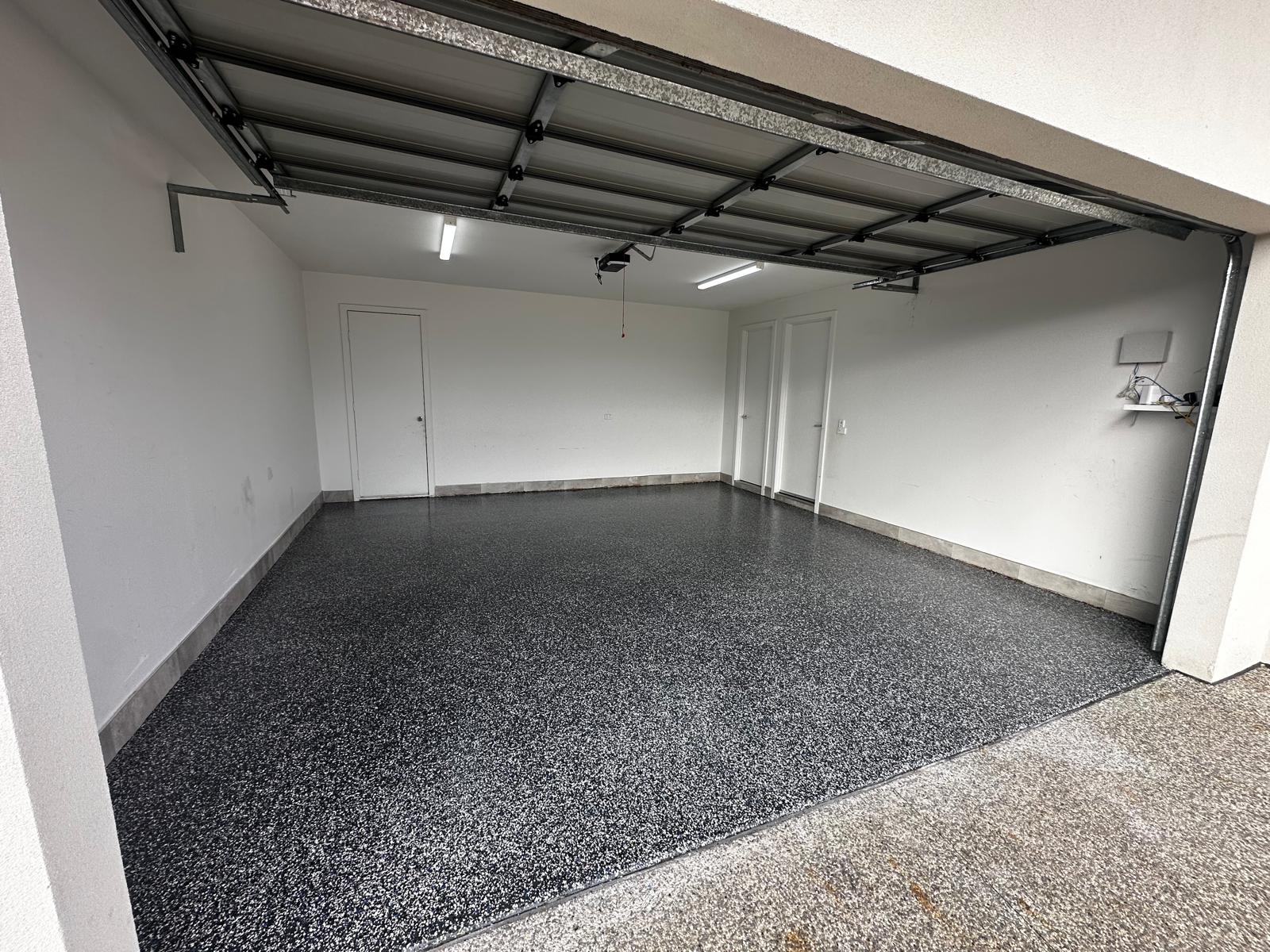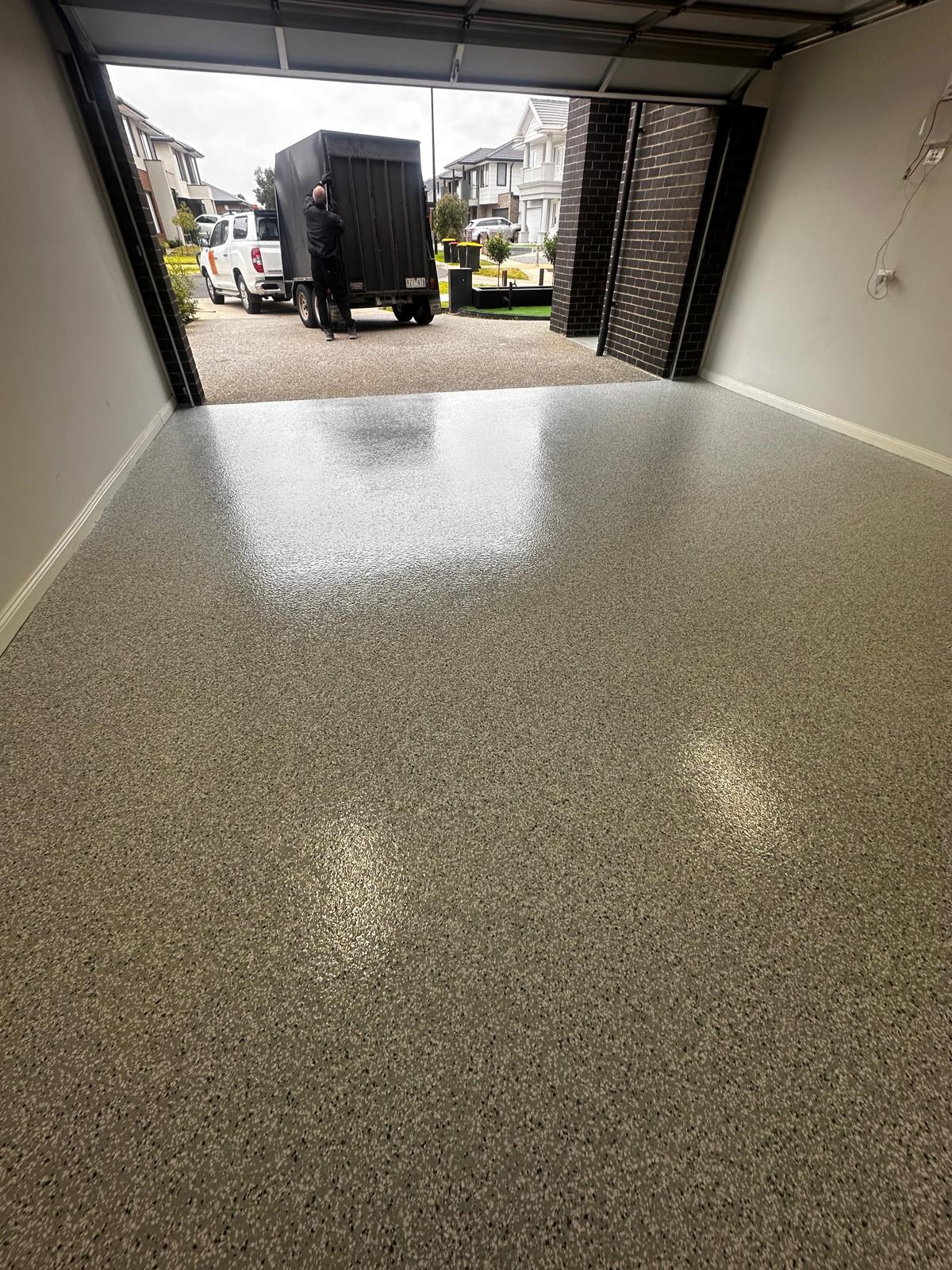

Spring and autumn are the best seasons for epoxy flooring in Melbourne. Here is the reasoning, the actual numbers, and — more usefully — why the season matters far less than most people assume.
The short answer
Spring (September–November) and autumn (March–May) are the best seasons for epoxy flooring in Melbourne. Epoxy cures reliably between 10°C and 30°C with moderate humidity, and both seasons sit inside that window consistently. Winter installation is still possible, but cure times roughly double. Summer is fine outside extreme heat days.
Why 10–30°C is the number that matters
Epoxy does not dry. It cures — a chemical reaction between resin and hardener that generates its own heat, and like every chemical reaction, its rate depends on temperature.
Below 10°C the reaction slows sharply. The floor stays soft, can remain tacky for days, and may end up permanently short of its rated hardness and chemical resistance. Some products simply will not cure at all.
Above 30°C the opposite problem appears. Pot life — the working time after mixing — collapses. A product with a comfortable 40-minute window at 20°C can give you 15 minutes at 32°C. That is not enough time to lay it off properly, so roller marks and lap lines get locked into the finish permanently.
Between those two figures the reaction runs at the rate the manufacturer designed it for, which is the entire point.
Melbourne month by month
Typical average temperature ranges, and what each month means in practice:
| Month | Typical range | Conditions |
|---|---|---|
| September | 8–17°C | Good — improving through the month |
| October | 9–20°C | Excellent |
| November | 11–22°C | Excellent |
| December | 13–24°C | Good — watch extreme days |
| January | 14–26°C | Workable — heat days need managing |
| February | 14–26°C | Workable — heat days need managing |
| March | 13–24°C | Excellent |
| April | 11–20°C | Excellent |
| May | 8–17°C | Good — cooling through the month |
| June | 6–14°C | Workable — longer cure |
| July | 6–13°C | Workable — longest cure of the year |
| August | 6–15°C | Workable — longer cure |
October, November, March and April are the four most reliable months of the Melbourne year for this work. Every one of them sits comfortably inside the window from morning to evening across both installation days.
The measurement almost everyone skips: slab temperature
Air temperature is the number people check. Slab temperature is the number that decides the outcome.
Concrete has enormous thermal mass. It holds temperature for days, not hours. On a pleasant 18°C winter afternoon following a fortnight of cold nights, the air reads fine while the slab underneath is still sitting at 8 or 9°C — below the minimum, with the coating going straight onto it.
This is the single most common reason a floor installed in "acceptable weather" cures badly. A proper installer measures the concrete with a surface thermometer, not the air with a weather app.
Humidity, and the dew point rule
Relative humidity should generally sit below about 75–85%, depending on the product. But the figure that actually governs whether you can coat is dew point.
The rule is simple: the slab must be at least 3°C above the dew point. If the concrete is at or below dew point, moisture condenses on the surface — invisibly, as a microscopically thin film — at the exact moment the coating goes down. The epoxy then bonds to water rather than to concrete, and it will fail.
This is why a still, damp Melbourne morning in May can be a worse day to coat than a cold one in July. Temperature alone does not tell you.
| Condition | Target | Why |
|---|---|---|
| Air temperature | 10–30°C | Governs cure rate and pot life |
| Slab temperature | 10–30°C | Lags air by days — measure it separately |
| Relative humidity | Below ~75–85% | High RH slows cure and can blush the surface |
| Dew point margin | Slab ≥3°C above | Prevents condensation under the coating |
| Slab moisture | Tested before quoting | Moisture from below lifts any coating |
What actually happens in a Melbourne winter
Winter installation is completely normal and we do it all year. It is worth being precise about what does and does not change.
What does not change: the two days on site. Day one is masking, diamond grinding with dust extraction, crack repair and primer. Day two is the coloured base coat, flake broadcast, scrape-back and clear topcoat. That sequence is identical in July and January.
What does change: the wait afterwards.
| Milestone | Spring / autumn | Winter |
|---|---|---|
| Walk on it | 24 hours | 48 hours |
| Storage and shelving back | 48 hours | 72 hours |
| Park a car on it | 72 hours | 5–7 days |
| Fully cured | 7 days | 10–14 days |
A garage also helps. It is an enclosed box with a roof, so conditions inside are considerably more stable than the outdoor forecast suggests — particularly with the door down overnight while the primer cures.
The honest trade-off: winter costs you a few days of not parking in the garage, and buys you shorter lead times and a calendar that is not full. Full timings are in how long epoxy flooring takes.
And in a Melbourne summer
Summer is generally fine. The problem is not the season, it is the individual day.
Above roughly 30°C, two things go wrong. Pot life collapses, as described above. And a slab that is warming — as it does through a hot morning — pushes air upward out of the concrete's pores. If that air rises through a wet coating it leaves pinholes across the surface, a defect called outgassing that cannot be fixed without recoating.
The management is straightforward: coat early in the day while the slab is still cooling or stable, never while it is heating rapidly, and reschedule genuine 35°C-plus days rather than pushing through. Any installer who tells you a 38°C February afternoon is a good time to coat your garage is telling you something useful about how they work.
So when should you actually book?
Three different answers depending on what you care about.
If you want the best conditions
October, November, March or April. Reliable temperatures, moderate humidity, standard cure times, no adjustments needed.
If you want the shortest wait for a booking
Winter — June through August. Lead times are shortest, the calendar is open, and you are not competing with the pre-Christmas rush. You pay for it in cure days, not dollars.
If you want it done before Christmas
Book in September. October to December is the busiest run of the year and lead times stretch from one to three weeks out to four or five. A quote accepted in November may not be installed before Christmas at all.
The thing that matters more than the season
Here is the part most seasonal advice leaves out: slab preparation outweighs weather by a wide margin.
A properly diamond-ground, moisture-tested, correctly primed slab coated at 15°C will outlast a poorly prepared slab coated in perfect 22°C spring conditions — every single time. Epoxy bonds mechanically into an opened concrete profile. No grinding, no bond, regardless of how pleasant the day is.
Floors fail for three reasons, in this order of frequency:
- Inadequate preparation — acid etching instead of grinding, or no preparation beyond a sweep. Covered in diamond grinding vs acid etching.
- Moisture in the slab — untested, and pushing the coating off from underneath.
- Wrong conditions on the day — the subject of this article, and a distant third.
Season is a scheduling decision. Preparation is a quality decision. If a contractor is happy to talk about weather but vague about grinding, you are being sold the wrong thing.
New builds are a different question
If your home is new, forget the calendar and look at the slab. Fresh concrete needs a minimum of 28 days before coating, and often holds moisture well beyond that. A young slab in flawless October weather will still fail if the moisture reading is high.
New slabs also carry a builder's sealer applied at handover — invisible, and specifically formulated to stop things bonding to concrete. It has to be ground off whatever the season. There is a worked example in our Officer double garage case study.
Four seasons in one day: the Melbourne problem
Melbourne is the one Australian capital where the forecast genuinely cannot be trusted across a two-day job — and epoxy is applied across exactly two days.
A spring installation can begin at 21°C and still, and finish the following afternoon at 11°C with a southerly and rain moving through. The primer went down in one set of conditions and the topcoat in another. Neither reading was wrong; the day changed underneath the job.
Two things follow, and they are the practical difference between an installer who works here and one who does not.
Check the forecast for both days, not the booking day. A perfect Tuesday followed by a cold, wet Wednesday is a worse booking than two ordinary mild days in a row. The topcoat is the coat that has to look right, and it goes down on day two.
Watch the overnight low, not just the daytime maximum. The primer cures overnight with the roller door closed. If the temperature drops to 4°C at 3am, that primer has spent the most important hours of its cure below the minimum, and the base coat goes onto a substrate that has not properly hardened. A 20°C afternoon does not undo a 4°C night.
It is also why we do not quote cure times as a fixed rule. We give you the timings for the week you are actually booked, because in Melbourne the gap between two weeks in the same month can be wider than the gap between two seasons.
A quick way to sanity-check any installer
You do not need to become an expert in coating chemistry. One question sorts it: what conditions do you need on the day, and what happens if we do not get them?
An answer worth trusting names a temperature range, mentions measuring the slab rather than the air, and — the giveaway — includes a scenario where they would reschedule. An installer who has never postponed a job for weather has either been extraordinarily lucky or is not measuring.
An answer that should concern you is any version of "we can coat in anything". That is not a claim about capability. It is a claim about not checking.
Want the real timings for your slab and your week? Book a free on-site measure or call 0451 980 606.
Frequently asked questions
What is the best season to get epoxy flooring done in Melbourne?
Spring (September to November) and autumn (March to May) are the best seasons for epoxy flooring in Melbourne. Both sit reliably inside the 10–30°C installation window with moderate humidity, so the coating cures on schedule and you can park on the floor after 72 hours.
What temperature does epoxy need to cure properly?
Between 10°C and 30°C, measured at both the air and the slab surface. Below 10°C the chemical reaction slows sharply and some products will not cure at all. Above 30°C the pot life collapses, giving the installer minutes rather than a comfortable working window.
What humidity is acceptable for epoxy installation?
Relative humidity below about 75–85%, and the slab must be at least 3°C above the dew point. If the concrete is colder than the dew point, moisture condenses on the surface as the coating goes down and the bond fails — which is why professionals measure dew point, not just humidity.
Can epoxy flooring be installed in winter in Melbourne?
Yes. Winter installation is entirely normal and the two days on site do not change. What changes is cure time: the wait before you can park stretches from about 72 hours to closer to five or seven days. Garages are enclosed, so conditions are more stable than outdoor temperatures suggest.
Can epoxy be installed in summer?
Yes, but hot days need managing. Above about 30°C the pot life shortens dramatically and a warming slab can outgas through the wet coating, leaving pinholes. On 35°C-plus days we start early or reschedule rather than force it.
Which months are best for epoxy flooring in Melbourne?
October, November, March and April are the most reliable months. Average temperatures sit comfortably in the 10–30°C band, humidity is moderate, and cure times run to the standard schedule without adjustment.
Which months are hardest?
June, July and August, when Melbourne averages roughly 6–14°C, so slabs sit at or below the minimum for a standard cure. January and February bring the opposite problem on extreme heat days. Both are workable — they just need the installer to adjust.
Does the slab temperature matter more than the air temperature?
Yes, and it is the measurement most often skipped. Concrete holds temperature far longer than air. A slab can still be 8°C at midday on a mild winter afternoon because it has been cold all week, so the air reading looks fine while the floor is not ready.
How long does epoxy take to cure in cold weather?
Expect roughly double. In good conditions it is walk-on at 24 hours, storage at 48 and vehicles at 72. In a Melbourne winter that typically becomes walk-on at 48, storage at 72 and vehicles at five to seven days.
Does the season change the price?
No. Our pricing is the same year round — from $1,400 for a single garage and $2,400 for a double. Season affects scheduling and cure time, not what the job costs.
Should I wait until spring if it is currently winter?
Only if you cannot spare the extra cure days. If you need the garage back fast, wait. If you can leave the car out for a week, winter is often the better choice because lead times are shorter and you are not competing with the pre-Christmas rush.
When is the busiest time to book?
October through December. People want the garage sorted before Christmas, so lead times stretch from one to three weeks out to four or five. Book in September for a comfortable October or November date.
Does rain affect the installation?
Not directly, since the work happens inside the garage with the door mostly closed. Rain matters indirectly by raising humidity and dew point, which is why we check the forecast rather than only the temperature.
Can you install epoxy on a cold slab with heating?
Sometimes. Space heating can lift the ambient temperature, but concrete is slow to warm and heating alone may not bring the slab into range in a day. It also risks raising the dew point in an enclosed garage. We assess it case by case rather than promising it.
What happens if epoxy is applied below 10°C?
The cure stalls. The floor stays soft, may stay tacky for days, and can end up with permanently reduced hardness and chemical resistance. In the worst case it never fully cures and has to be ground off and redone.
What happens if it is applied when too hot?
Pot life collapses, so the mixed product starts setting in the bucket. Roller marks and lap lines get locked in because there is no time to lay it off properly, and a warming slab pushes air up through the coating, leaving pinholes across the surface.
Is a new build slab different?
Yes. New concrete needs at least 28 days before coating and holds more moisture, so moisture testing matters more than season. A young slab in perfect spring weather can still fail if the moisture reading is high.
Do you install in winter across all Melbourne suburbs?
Yes — we work year round across Melbourne from our base in Mickleham, including the northern, western and south-eastern growth corridors. We tell you the realistic cure timings for the actual week you are booked.
How far ahead should I book for spring?
Two to four weeks through spring, and longer as Christmas approaches. Spring is when most people decide to do it, so the calendar fills earlier than at any other time of year.
What is the single most important condition?
The slab, not the calendar. A dry, correctly prepared, properly ground slab at 15°C will outperform a contaminated or damp slab in perfect weather every time. Season is a scheduling decision; preparation is what decides whether the floor lasts.
Get a straight answer for your slab
The genuinely useful version of this advice is specific to your garage, not to the season in general. We measure the slab, test it for moisture, check the conditions for the week you are actually booked, and tell you the real cure timings rather than the brochure ones.
We are based in Mickleham and work across Melbourne year round. The on-site measure is free and there is no obligation.
Call 0451 980 606 or book a free on-site measure.
More: epoxy flooring cost in Melbourne, double garage epoxy flooring, flake epoxy flooring, how long epoxy flooring lasts, choosing an epoxy service provider.
Planning an epoxy floor in Melbourne?
Book a free on-site inspection and get a fixed written quote — no obligation.