It is the first question every business owner asks, and most flooring quotes answer it badly. Here is what commercial epoxy installation actually costs you in downtime — and the four ways to reduce it to nearly nothing.
The short answer
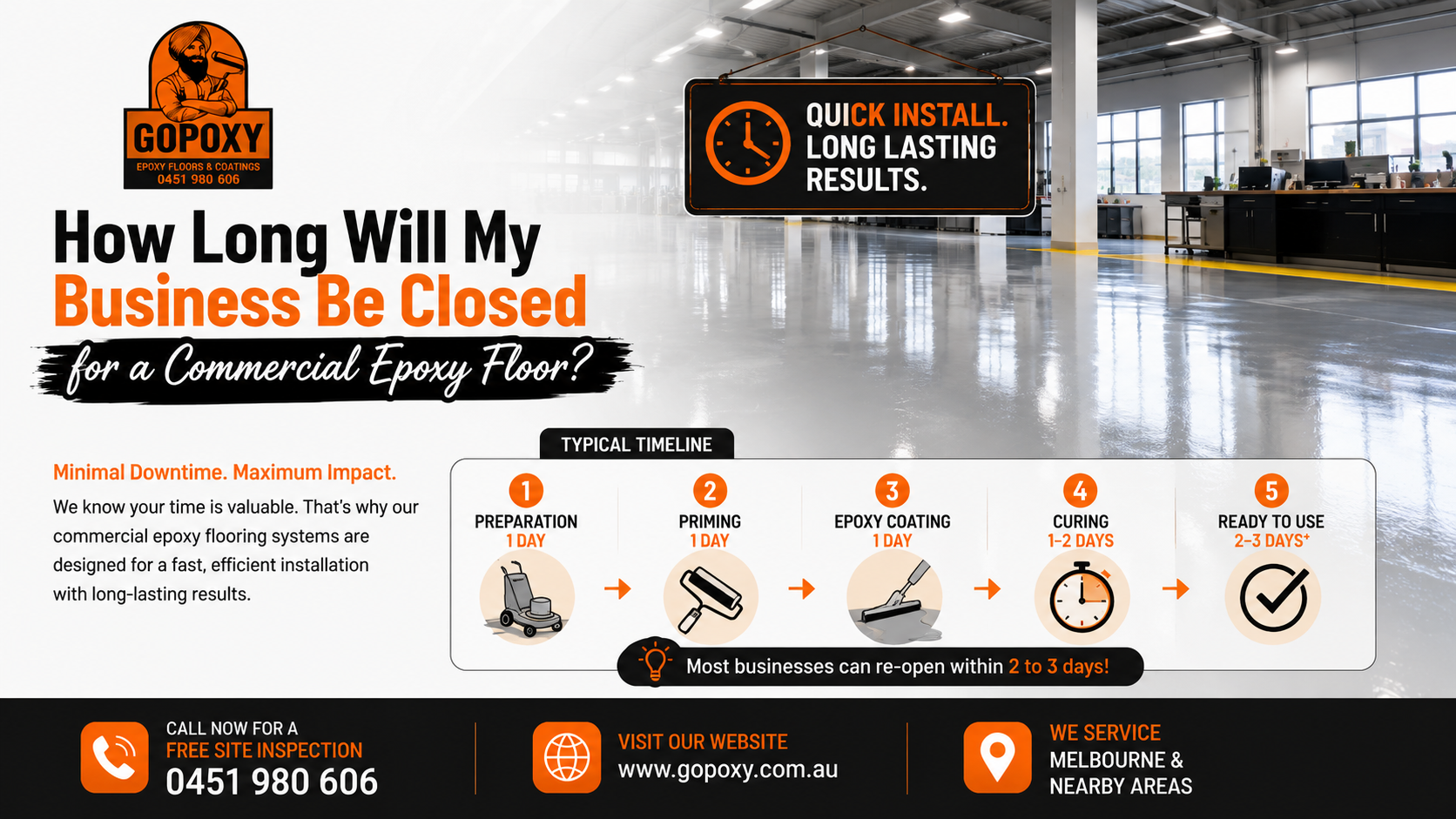
Most commercial epoxy floors take two to four days from first grind to full return to service. Many businesses lose no trading days at all, because the work can be staged half the floor at a time, run overnight, or scheduled across a weekend. Fast-cure polyaspartic systems can bring return-to-service down to the next day.
What actually drives the timeline
Business owners tend to assume the coating takes the time. It does not. Three things drive the schedule, in this order.
1. The condition of the slab
This is the variable, and it is almost always the longest phase. Bare, sound concrete prepares quickly. A slab carrying a failed coating that has to be stripped, or one with significant cracking, oil contamination or a moisture problem, can double the preparation time on its own. It is also the part a quote written without a site visit gets wrong.
2. Total area
Larger floors take longer, but not proportionally — mobilisation, masking and setup are largely fixed costs in time. A 2,000m² warehouse does not take ten times as long as a 200m² workshop.
3. The cure schedule of the system specified
This is the one you can buy your way out of, and it is where the real decision sits.
Typical timelines by space
| Space | On site | Return to service | Trading days lost |
|---|---|---|---|
| Salon or clinic | 1–2 days | 2–3 days | 0 — weekend job |
| Café or restaurant | 2 days | 3 days | 0–1 — scheduled closure |
| Retail or showroom | 2 days | 3 days | 0 — overnight, staged |
| Workshop | 2–3 days | 3–4 days | 0–2 |
| Small warehouse | 3–4 days | 4–5 days | 0 — staged in bays |
| Large warehouse | Staged over weeks | Per section | 0 — never fully closed |
| Factory / production | Assessed | Assessed | Planned around shutdown |
Note what the last column says. For most of these, the answer is zero. Downtime is a scheduling problem, not an inevitability — provided the contractor is willing to work around you rather than expecting you to work around them.
The four ways to cut downtime
Staged installation
The workhorse for warehouses and large floors. We coat one half or one bay group while you operate on the rest, then swap. Total elapsed time goes up and there is more mobilisation, but trading continues throughout.
The planning that matters is racking. Racking movement is usually the single largest cost in a warehouse floor job — larger than the coating itself. A well-sequenced stage plan moves each rack once. A badly planned one moves it three times. That conversation belongs at the quoting stage, not on day one.
Overnight installation
The right answer for retail, hospitality and anything with fixed trading hours. We start after close and are off site before you open. Multi-night jobs advance the floor in sections, and the space trades normally every day.
Weekend installation
Friday evening to Monday morning gives roughly 60 hours — enough for most single-space commercial floors including cure. Suits offices, showrooms, salons and clinics that already close Saturday and Sunday.
Fast-cure systems
Polyaspartic cures substantially faster than traditional epoxy. Where a standard system might need 72 hours before vehicles return, a fast-cure specification can bring that to 24 or 48. It costs more per square metre.
That trade is worth doing on paper. If a day of halted production or lost trade costs you more than the difference in system price — and for most operations it does — the faster system is the cheaper option, not the expensive one.
Cure milestones you can plan around
| Milestone | Standard system | Fast-cure polyaspartic |
|---|---|---|
| Foot traffic | 24 hours | 6–12 hours |
| Light equipment, trolleys | 48 hours | 24 hours |
| Racking reloaded | 72 hours | 24–48 hours |
| Forklifts and pallet jacks | 72 hours | 24–48 hours |
| Full chemical resistance | 7 days | 3–5 days |
These are planning figures. The actual numbers depend on the products specified and on conditions during the week you are booked — cold weather stretches every one of them, as covered in the best season for epoxy flooring in Melbourne.
By sector
Warehouses and distribution
Almost always staged, bay by bay or aisle by aisle, sequenced around your pick paths and racking. Line marking is applied after the topcoat cures, and re-marking is a good moment to review your WHS layout rather than simply copying the old lines. More in epoxy flooring for warehouses and on our warehouse epoxy flooring page.
Factories and production
Usually planned around an existing shutdown — Christmas, Easter, or a scheduled maintenance window. Fixed plant is coated around, with those areas revisited if the plant is ever relocated. Detail in factory epoxy flooring cost and on the factory epoxy flooring page.
Commercial kitchens and hospitality
Weekend or scheduled closure, effectively always. Coving, drainage falls and equipment removal all add time, and the floor must be genuinely cured before food service resumes — this is not a corner to cut. See the best epoxy flooring for restaurants and our restaurant and kitchen flooring page.
Retail, showrooms and salons
Overnight or weekend. These are the easiest commercial floors to do with genuinely zero trading impact, because the areas are smaller and the schedule is predictable. See our salon epoxy flooring page.
Workshops and service centres
Usually staged across bays so vehicle work continues. Hoist bases are masked and coated around. Load-related questions are covered in can commercial epoxy flooring handle heavy machinery.
What we need from you
The schedule works when both sides plan it. Four things make the difference:
- A decision-maker reachable on the day. Slabs occasionally reveal something once grinding starts, and a fast decision keeps the schedule intact.
- Clear access to the areas being coated, including anything stored against walls.
- Confirmation of what cannot be moved — fixed plant, live services, anything under warranty.
- Notice of neighbouring tenants' trading hours in shared buildings, so grinding is scheduled considerately.
What a proper commercial quote should include
Judge a commercial flooring quote on whether it engages with your operation at all. It should contain:
- A day-by-day schedule, not just a total duration
- Return-to-service times per area, so you can plan staffing and deliveries
- The delivery model stated — staged, overnight, weekend or closure
- Preparation itemised, since that is the phase that moves
- What would constitute a variation, and how it would be communicated
A quote that gives you a price and a vague "about a week" has not been thought about. The wider set of questions is in what an epoxy service provider actually does, and commercial pricing sits in commercial epoxy flooring cost in Melbourne alongside our commercial epoxy flooring page.
The false economy worth avoiding
The cheapest quote is frequently the one that assumes a single closure and standard cure times — because that is the simplest job to price and the easiest to deliver.
If that closure costs you three trading days, and a staged or overnight alternative costs a few hundred dollars more in mobilisation, the arithmetic is not close. Work out what a day of your operation is worth before you compare quotes on price per square metre. It changes which quote is actually cheapest, and it is a calculation most buyers never do.
Frequently asked questions
How long will my business be closed for an epoxy floor?
For most commercial spaces, two to four days from first grind to full return to service — and often zero trading days lost, because the work can be staged, run overnight or scheduled across a weekend. A small retail or salon floor can be done Friday night to Monday morning.
Do I have to close at all?
Frequently not. Staged installation lets us coat half the floor while you operate on the other half, then swap. It takes longer overall and costs a little more in mobilisation, but it keeps you trading throughout.
Can you work overnight?
Yes, and for retail, hospitality and anywhere with fixed trading hours it is usually the right answer. We work after close and are off site before you open. Multi-night jobs progress the floor in sections.
Can you work weekends?
Yes. A Friday-evening start gives us the whole weekend, which suits offices, showrooms, salons and clinics that close Saturday and Sunday.
What actually determines the downtime?
Three things, in order: the condition of the existing slab, the total area, and the cure schedule of the system chosen. Preparation is usually the longest phase, not coating — and an old slab with a failed coating on it takes far longer than bare concrete.
Is a fast-cure system available?
Yes. Polyaspartic systems cure considerably faster than traditional epoxy, which can bring return-to-service down to the next day rather than several days. They cost more per square metre. Where downtime is expensive, that maths usually works in their favour.
When can staff walk on it?
Typically 12 to 24 hours after the final coat with a standard system, and often much sooner with a fast-cure polyaspartic. We give you the actual figures for the products specified on your job.
When can forklifts and pallet jacks go back on?
Usually 72 hours for a standard system, sometimes 24 to 48 with a fast-cure specification. Point loading from pallet jack wheels is harder on a green floor than a forklift tyre, so do not rush it.
How long before racking can be reloaded?
Racking can generally be moved back at 48 hours and reloaded at 72. In a staged install we sequence it so racking only moves once, which is normally the biggest single cost in a warehouse job.
Can you do a warehouse in sections?
Yes, and it is how most large warehouse floors are done. We work bay by bay or aisle by aisle around your operation. It needs planning with your team, so we walk the site and agree the sequence before quoting.
What about a commercial kitchen?
Kitchens are almost always done over a weekend or a scheduled closure. The floor must be fully cured before food service resumes, and coving, drainage falls and equipment removal all add time. We plan these carefully rather than optimistically.
Does my equipment have to come out?
Anything sitting on the floor being coated, yes. In staged installs equipment moves once, to the finished side. For fixed plant we coat around it and can return later for those areas if the plant is relocated.
Is the grinding disruptive to neighbouring tenants?
Grinding is noisy and it is the noisiest part of the job. In shared buildings we schedule it outside neighbouring trading hours. Dust is controlled by industrial extraction, so it is contained rather than spreading through the building.
Do you need us to shut off power or services?
No, and in fact we need power. What we do need is clear access, a decision-maker reachable on the day, and confirmation of anything that must not be moved.
How far ahead should a commercial job be booked?
Three to six weeks for anything involving staging or out-of-hours work, because the schedule has to be built around your operation rather than ours. Straightforward single-space jobs can often be sooner.
What if the slab turns out to be worse than expected?
That is what the site assessment is for. We test for moisture, check for existing coatings and probe any suspect areas before quoting, precisely so the timeline does not change once we have started.
Does downtime cost more than the floor?
For many businesses, yes. A day of lost trade or halted production frequently exceeds the entire cost difference between a standard and a fast-cure system. It is worth calculating before choosing on price per square metre alone.
Do you provide a written schedule?
Yes. Commercial quotes include a day-by-day schedule showing what happens when and when each area returns to service, so you can plan staffing and deliveries around it.
What areas do you cover for commercial work?
All of Melbourne from our base in Mickleham, including the industrial precincts in Dandenong, Truganina, Thomastown, Broadmeadows, Campbellfield and Laverton.
How do I get an accurate timeline for my site?
We visit, measure, test the slab and talk to whoever runs the operation. The quote comes back with a schedule attached. There is no charge and no obligation.
Get a schedule, not just a price
We visit the site, measure it, test the slab and talk to whoever actually runs the operation. The quote comes back with a day-by-day schedule attached so you can see exactly when each area returns to service.
We are based in Mickleham and work across Melbourne, including the industrial precincts in Dandenong, Truganina, Thomastown, Broadmeadows, Campbellfield and Laverton.
Call 0451 980 606 or book a free site assessment.
More: commercial epoxy flooring, warehouse epoxy flooring, factory epoxy flooring, restaurant and kitchen flooring, salon epoxy flooring.
Planning an epoxy floor in Melbourne?
Book a free on-site inspection and get a fixed written quote — no obligation.