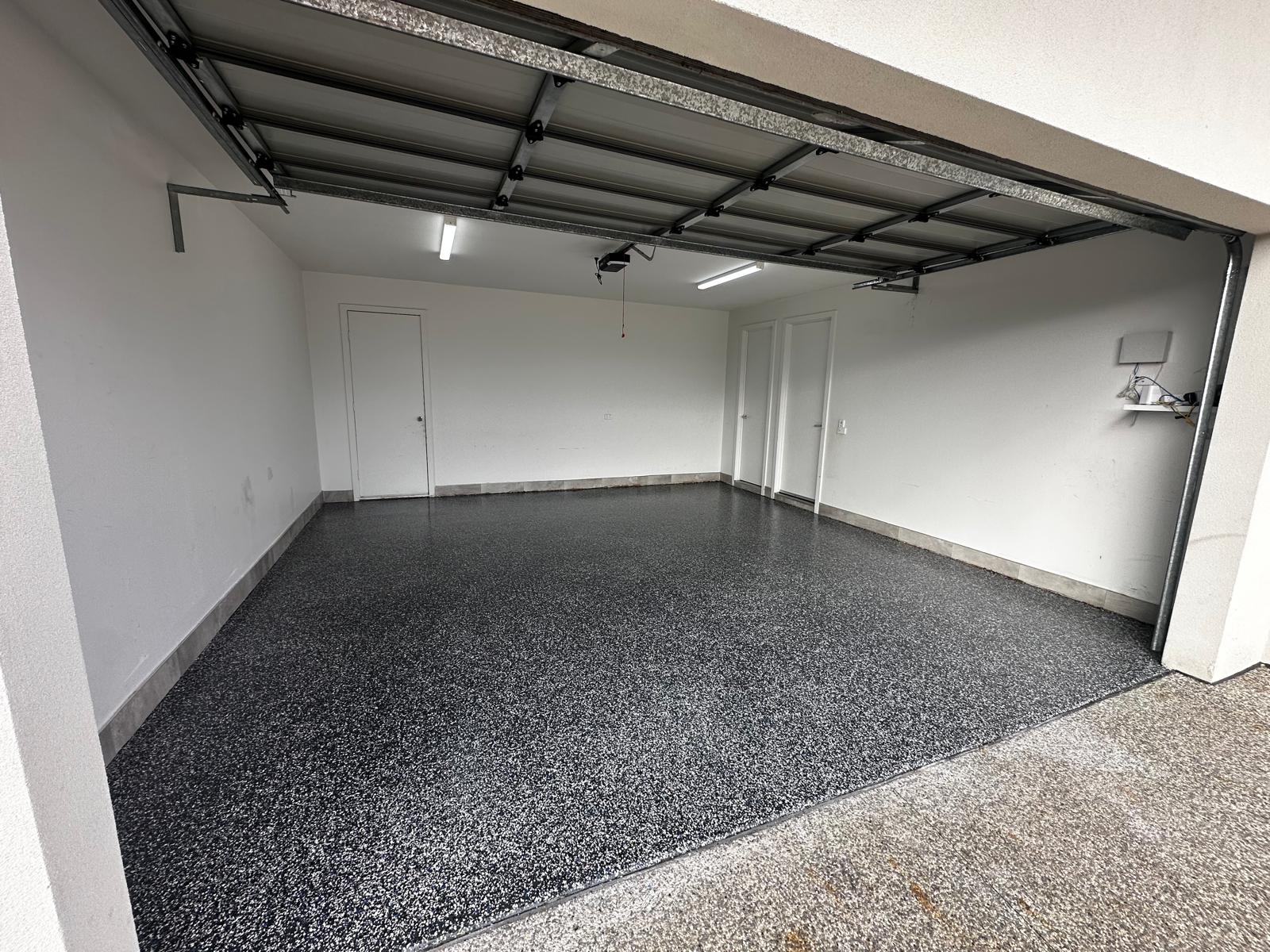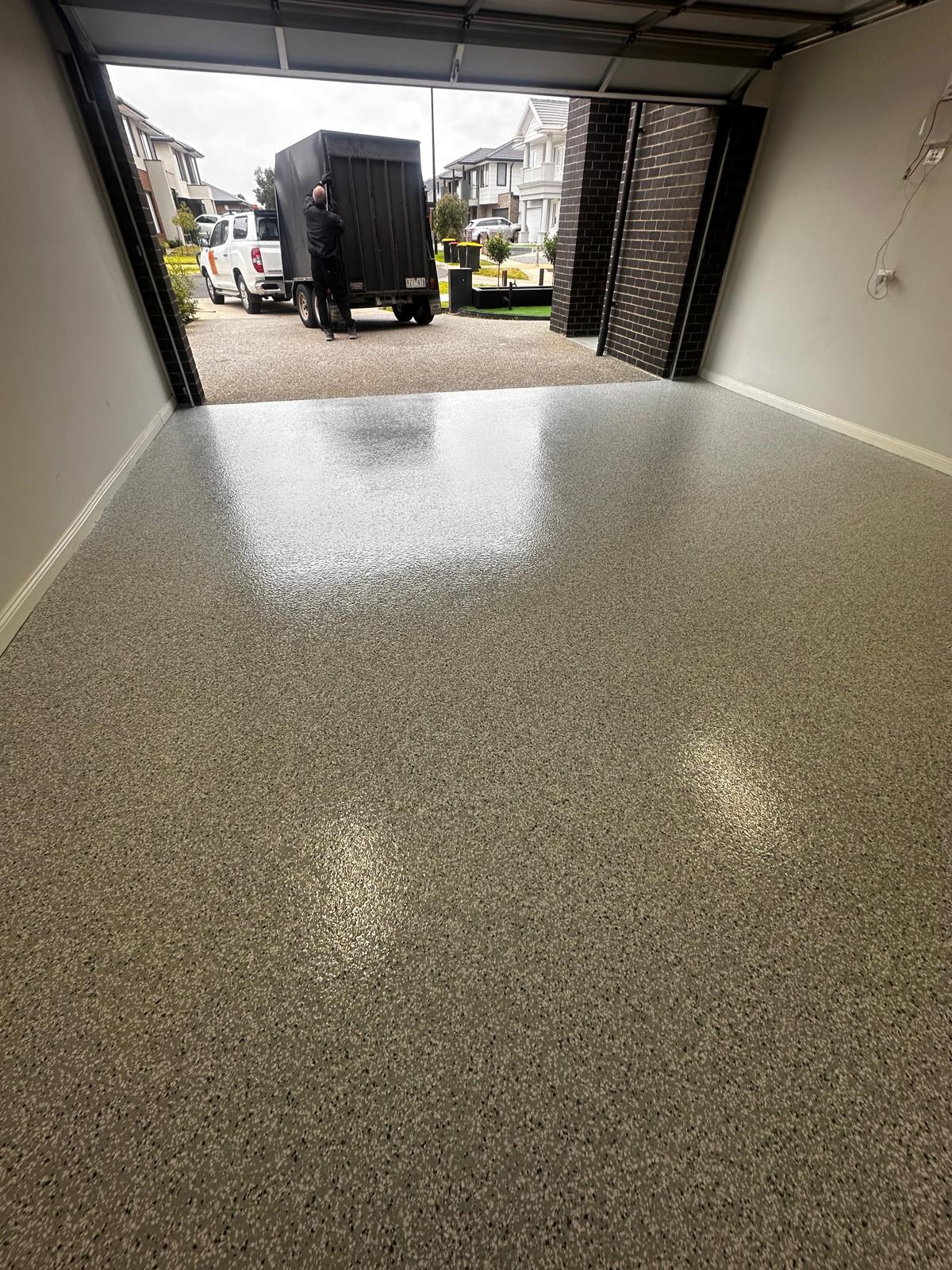
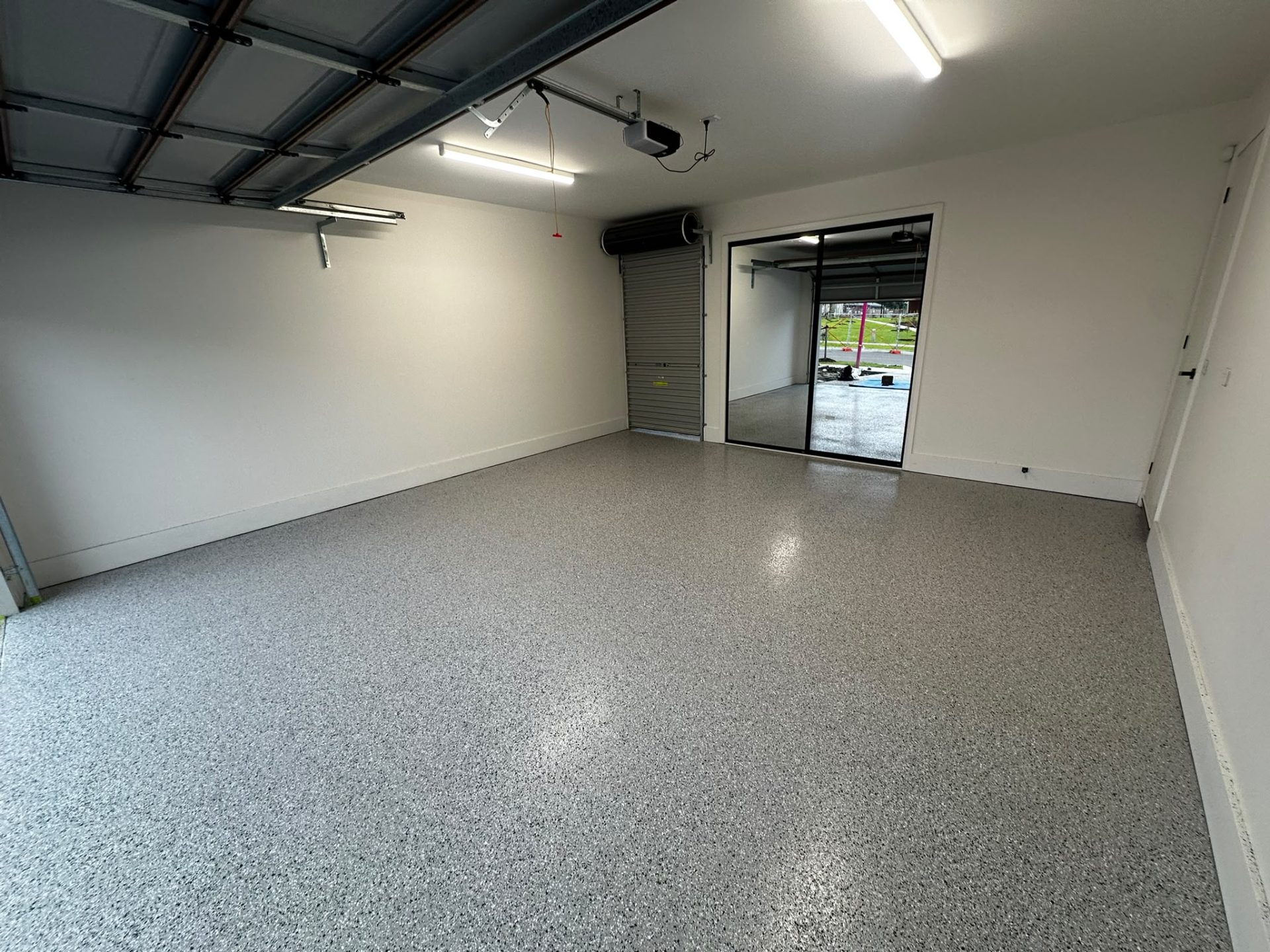
A flake epoxy floor in a standard Epping double garage starts from $2,400, takes two days on site, and should last fifteen years or more. That is the short version. If you are weighing it up, the rest of this covers what you actually get for the money, what makes Epping garages different, and how to tell a proper quote from a cheap one.
Garages in Epping and across Melbourne's northern corridor have one thing in common: the slab is almost never ready to coat as it stands. Knowing why matters more than any colour choice, because it is the difference between a floor that lasts and one that peels.
What it costs
Pricing follows floor area, and a standard double garage in the northern estates is around 36 square metres.
| Garage | Approx. area | Flake epoxy from |
|---|---|---|
| Single garage | 18 m² | $1,400 |
| Double garage | 36 m² | $2,400 |
| Large double | 42 m² | Quoted on measure |
| Triple garage | 54 m² | Quoted on measure |
That price is the complete system, not a starting point that grows:
- Diamond grinding of the whole slab, with dust extraction
- Crack and joint repair — routed out, filled, ground flush
- Moisture testing before anything is applied
- Penetrating primer
- Coloured base coat
- Full flake broadcast to refusal, in your chosen blend
- Clear polyaspartic topcoat
What is quoted separately, because not every garage needs it: tile removal, stripping an old coating, a moisture-barrier primer where readings come back high, or a garage well over 36 square metres. Those are identified at the measure, not sprung on you halfway through.
Want a firm number for your garage? Book a free on-site measure or call 0451 980 606. We measure, test the slab and give you a fixed written price.
Why Epping garages need proper preparation
This is the part most quotes skip over, and it is the part that decides whether your floor is still perfect in ten years.
The builder's sealer
Most garages in newer Epping estates are sealed at handover. It is invisible — you cannot see it, and running a hand over the slab tells you nothing. But epoxy applied over a sealer bonds to the sealer, not to the concrete. It is only ever as strong as that sealer's grip, and sealers are not designed to hold a coating.
The only way to remove it is mechanically, by grinding. Acid etching does not touch it, which is one of several reasons we never use acid — the full comparison is in diamond grinding vs acid etching.
Reactive clay soils
Melbourne's north sits largely on reactive clay that swells in winter and shrinks in summer. Slabs move with it, and hairline cracking is the result. It is normal, and it is not a reason to avoid coating your garage — but those cracks have to be opened up and filled properly. Coated over, they telegraph straight back through within a season.
Newer concrete
Estate slabs are often relatively young. New concrete needs 28 days minimum before coating, and moisture still moving through a slab will push a coating off from underneath. We test every slab before we start. If the reading is high, the fix is a moisture-barrier primer — not crossing fingers.
What the two days look like
| Stage | Time |
|---|---|
| Day one | |
| Clear and mask | 45 min |
| Diamond grinding | 2–4 hours |
| Crack and joint repair | 1–3 hours |
| Moisture test | 20 min |
| Primer, then cures overnight | 1 hour |
| Day two | |
| Base coat and flake broadcast | 2–3 hours |
| Scrape back and vacuum | 1–2 hours |
| Polyaspartic topcoat | 1 hour |
After that it is cure time, and this is where people come unstuck. The floor looks finished the moment the topcoat is rolled. It is not.
| You can… | After |
|---|---|
| Walk on it | 24 hours |
| Move shelving and storage back | 48 hours |
| Park a car on it | 72 hours |
| Treat it as fully cured | 7 days |
Through a Melbourne winter those numbers stretch — a cold slab can add a day or more before it will take a vehicle. There is a fuller breakdown, including the seasonal difference, in how long epoxy flooring takes start to finish.
Choosing your colour and flake
Two decisions: the base colour underneath and the flake blend on top.
- Charcoal or slate base with a grey blend — the most popular choice in the northern estates. Hides tyre marks and dust better than anything else.
- Silver or light grey — brightens a dark garage noticeably, which matters in a south-facing garage with one small window.
- Black and white high contrast — the boldest option, and very good at disguising a slab with visible patching.
- Sandstone and beige tones — warmer, and a common pick where the garage doubles as a workshop or gym.
We bring samples to the measure so you are choosing from something physical rather than a screen. Flake and metallic behave quite differently in the same space — flake epoxy flooring and metallic epoxy flooring both have their own pages, and flake epoxy vs garage tiles covers the clip-together alternative honestly.
How to read a garage floor quote
Prices between quotes can differ by a thousand dollars for what looks like the same job. The difference is almost always preparation. One question sorts it out:
"How will you prepare the slab?"
A good answer names diamond grinding, mentions dust extraction, and covers what happens if cracks or moisture turn up. Answers worth pausing on:
- "We'll clean and etch it." Acid will not remove a builder's sealer and cannot remove oil.
- "We'll pressure wash it first." Washing is not preparation. It removes loose dirt and adds water.
- "We can do it in a day." Not a full epoxy system. The primer alone needs overnight to cure.
- Nothing about cracks or moisture. Both are common on Epping slabs. A quote that ignores them is not quoting the same job.
There is a fuller checklist in how to choose the right epoxy flooring contractor in Melbourne.
Comparing quotes right now? Send us the details and we will give you a fixed written price with the preparation spelled out, so you can compare like with like.
Four mistakes that cost people money
- Buying on price alone. The cheapest quote has had the grinding taken out of it. Redoing a failed floor costs more than doing it once, because the failed coating has to come off first.
- Using a DIY kit on a sealed slab. Hardware kits contain no way to remove the sealer. That is why so many peel inside two years.
- Parking on it too early. Turning the wheel while stationary on a soft floor lifts the coating. Wait the 72 hours.
- Leaving the garage full. The crew ends up moving your things, which is time you pay for.
Is it worth doing?
Honestly, it depends what the garage is for. If it is pure storage and you rarely look at it, the money is better spent elsewhere.
But if you park in it daily, work in it, use it as a gym, or the garage is the first thing you walk through coming in from the car, it changes the space completely. Bare concrete sheds fine dust permanently, stains from anything dropped on it, and makes a garage feel like an unfinished part of the house. A sealed floor stops all three. We go through the numbers in is epoxy flooring worth it for residential homes, and lifespan in how long epoxy flooring lasts.
Frequently asked questions
How much does a double garage epoxy floor cost in Epping?
A standard 36 square metre double garage starts from $2,400 for a complete flake epoxy system. That includes diamond grinding, crack repair, primer, coloured base coat, full flake broadcast and a polyaspartic topcoat. Extras such as tile removal, stripping an old coating or a moisture barrier are quoted separately, because not every slab needs them.
How long does it take?
Two days on site. You can walk on the floor 24 hours after the final coat and park a car on it after 72 hours, so plan for the garage being out of use for about four days in total.
What size is a standard double garage?
Most double garages in the Epping and northern estates are around 6 metres by 6 metres, which is 36 square metres. Some builders go to 6.5 by 6.5, which is closer to 42. We measure on site because that difference matters to the price.
Is epoxy flooring worth it for a garage?
If you use the garage for anything beyond parking, yes. It seals the concrete so it stops shedding dust, it wipes clean instead of staining, it brightens a dark space considerably, and a good system lasts fifteen years or more. If the garage is purely storage and you never look at it, it is harder to justify.
What is flake epoxy?
A coloured base coat with vinyl flake chips broadcast into it while wet, sealed under a clear polyaspartic topcoat. The flake adds grip, hides marks and dust, and disguises the natural variation in a concrete slab that a flat colour would highlight.
Why is flake better than a plain colour for a garage?
Three practical reasons: more grip when a wet car comes in, far better at hiding everyday dirt and tyre scuffs between cleans, and it disguises imperfections in the slab. A solid colour looks striking on day one and shows every mark by month three.
Will it be slippery when wet?
A flake floor has more grip than sealed concrete, wet or dry, because the flake creates texture beneath the clear coat. If you want more again, for a sloped apron or a ramp, we add an anti-slip additive to the topcoat.
Can I park a car on it?
Yes, comfortably. The system is rated well beyond domestic vehicle loads. The only real risk is parking on it too early, before the coating has hardened, because turning the wheel while stationary puts enormous force on one spot.
What about hot tyre pickup?
Hot tyre pickup is when a warm tyre bonds to the coating and lifts it. It happens to thin, badly bonded coatings, especially DIY kits applied over unground concrete. A properly ground slab finished with polyaspartic is not vulnerable to it.
My garage slab has cracks. Can it still be coated?
Nearly always. Hairline and moderate cracking is normal on Melbourne slabs and is routed out, filled with a structural repair compound and ground flush before coating. A slab that is actively moving or has dropped needs assessment first.
Do you have to remove the sealer builders put on?
Yes. Most garages in newer estates are sealed at handover, and that sealer is invisible. Coating over it means bonding to the sealer instead of the concrete, and the sealer eventually lets go. Diamond grinding removes it as part of standard preparation.
Do I need to empty the garage?
Completely, including shelving, the second fridge and anything mounted low on the walls. We need clear access to the whole slab and about 300 millimetres up the wall. Emptying it the day before saves an hour of labour on the invoice.
What colours can I have?
Base colours range from charcoal and slate through to pearl white and sandstone, with flake blends from subtle greys to high-contrast black and white. Charcoal and silver blends are the most popular choice across the northern estates.
How do I clean it?
Sweep or vacuum, then mop with a pH-neutral cleaner and warm water. Avoid undiluted bleach, strong solvents and abrasive pads, which dull the topcoat over time. There is nothing to reseal or polish.
How long will it last?
Fifteen years or more in a domestic garage when it has been prepared properly. Floors that fail early almost always failed at preparation, not because the coating wore out.
Is it cheaper to do it myself with a kit?
Upfront, yes. A hardware-store kit runs a couple of hundred dollars. What it does not include is diamond grinding, and without that the coating bonds to the surface layer rather than into the concrete. Most kit floors start peeling within a year or two, and the repair costs more than the original job because the failed coating has to come off first.
Do you service Epping and the surrounding suburbs?
Yes. We are based in Mickleham, so Epping and the northern corridor are close by, alongside Wollert, Craigieburn, Mernda, South Morang, Whittlesea and Doreen.
Can it be done in winter?
Yes, we install year round. The two days on site do not change. What stretches is cure time: below about 10 degrees the wait before you can park on it goes from three days to closer to a week, and we plan the booking around that.
Do you offer a warranty?
Yes, our workmanship is warranted, with the term set out on your quote. It covers peeling, delamination and coating failure caused by our work. It does not cover impact damage, chemical spills left sitting, or driving on the floor before the cure times have passed.
How do I get a price for my garage?
Call us or send an enquiry and we will book a free on-site measure. We look at the slab, check its condition, test it for moisture and give you a fixed written price. No charge for the visit and no obligation.
Get a fixed price for your Epping garage
We are based in Mickleham, so Epping is a short run — along with Wollert, Craigieburn, Mernda, South Morang, Doreen and Whittlesea. We install garage floors across the northern corridor every week and we know what these slabs need before we arrive.
Booking a measure costs nothing and commits you to nothing. We look at the slab, test it, talk through colours, and leave you with a fixed written price and no hidden extras.
Call 0451 980 606 or request your free on-site quote.
More on the system and pricing: double garage epoxy flooring, double garage cost guide, and epoxy flooring in Epping.
Planning an epoxy floor in Melbourne?
Book a free on-site inspection and get a fixed written quote — no obligation.