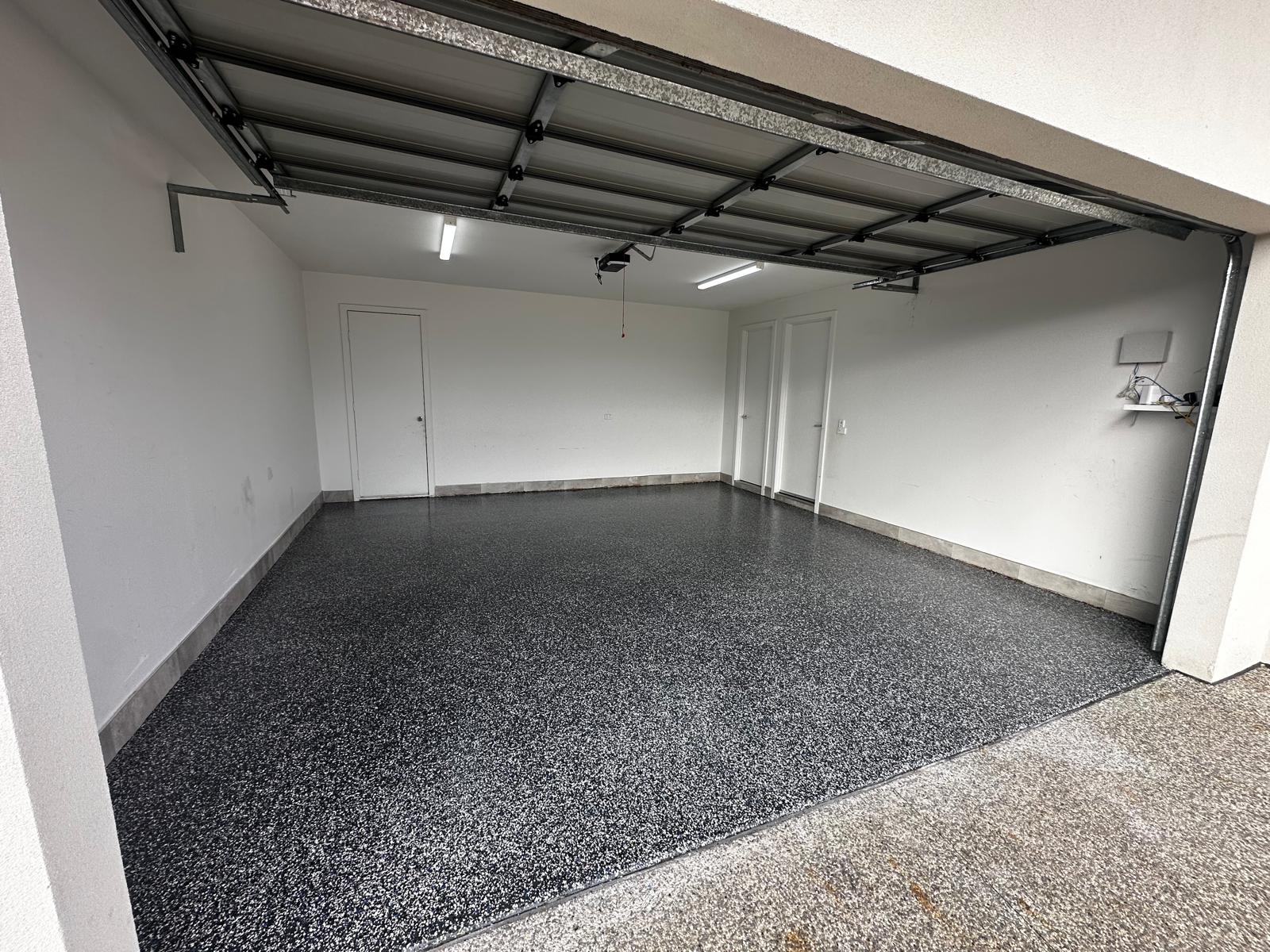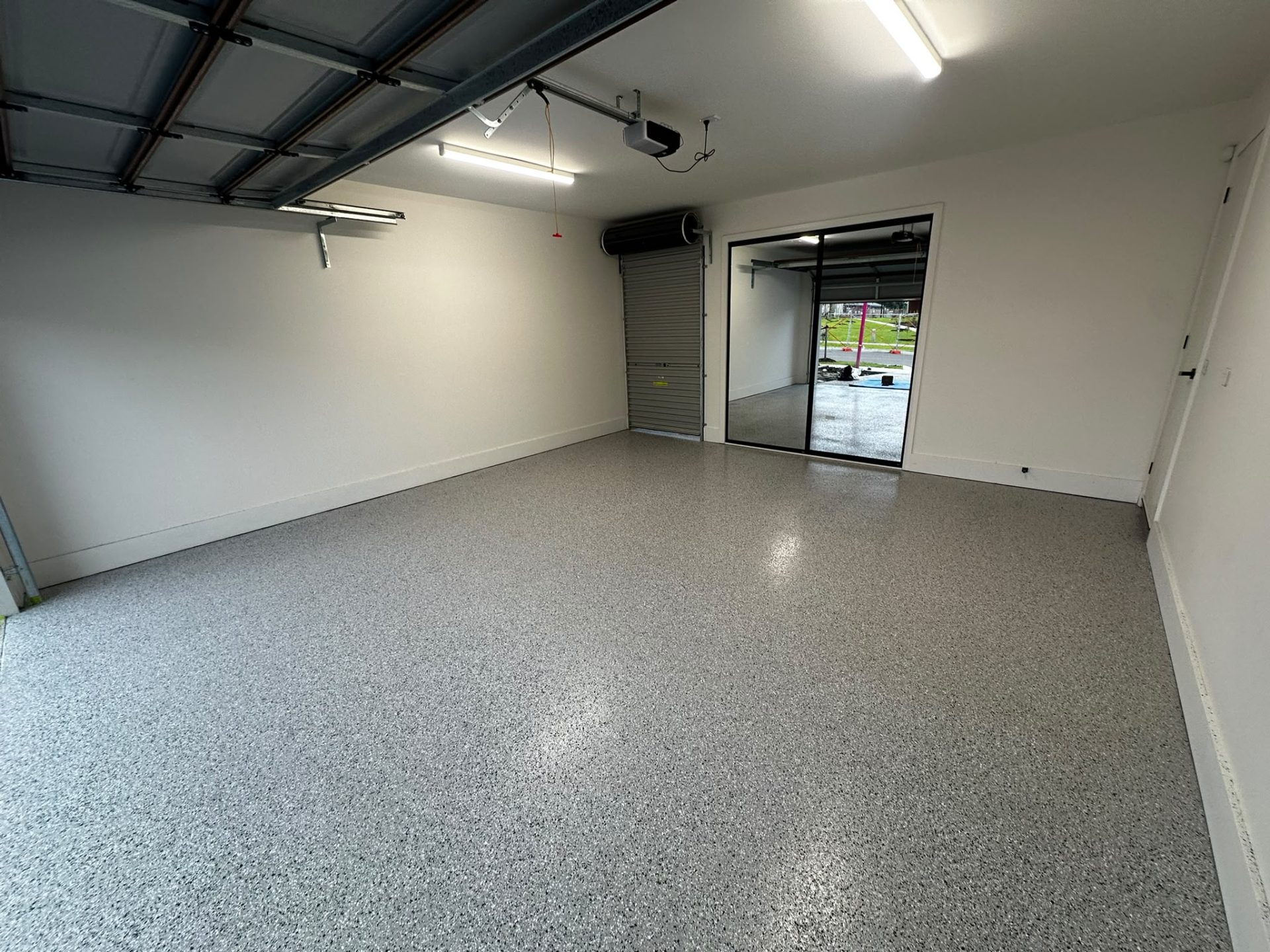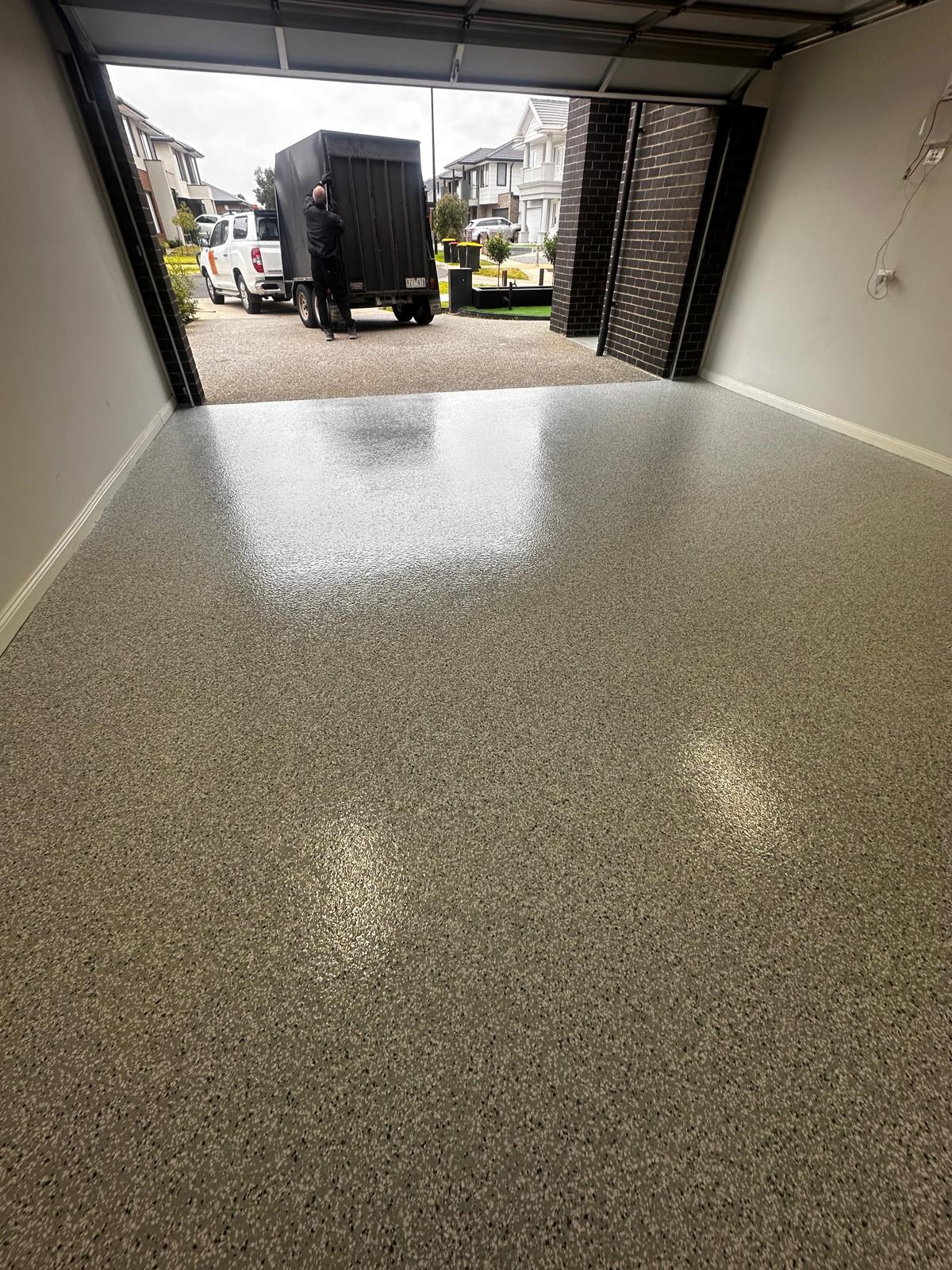
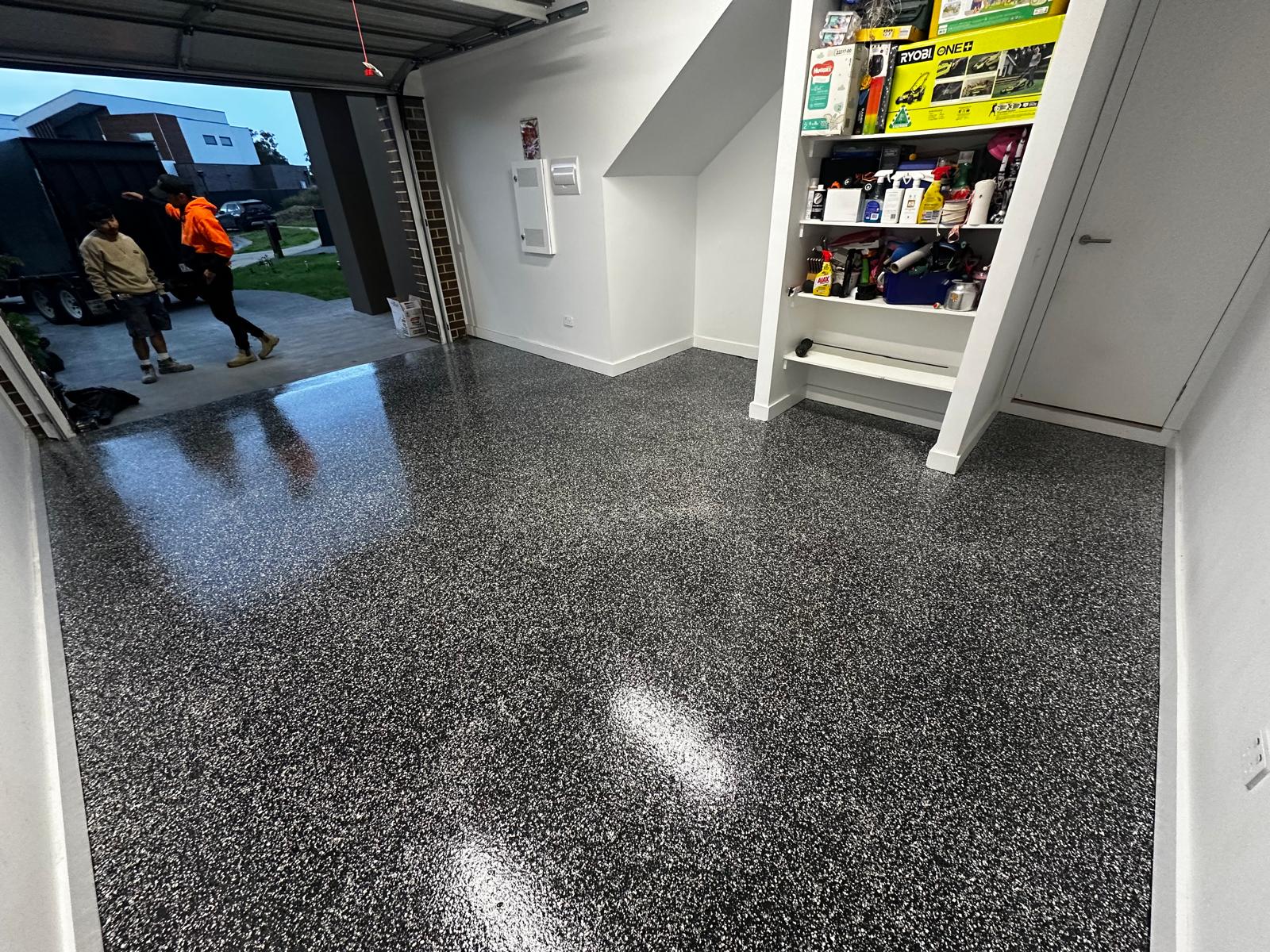
Short answer: a standard Melbourne garage takes two days on site, and about five to seven days from the day you accept the quote to the day you can park on it. The installation itself is quick. What people underestimate is cure time — the floor is finished long before it is ready to be used.
This guide breaks down exactly where the hours go, what makes a job faster or slower, and how the timeline changes across garages, warehouses, factories and hospitality fit-outs. It also covers the Melbourne-specific problem nobody mentions until it is happening to you: winter.
The quick version
| Stage | How long |
|---|---|
| Quote and site inspection | Within 48 hours of contact |
| Booking lead time | 1–3 weeks (longer Oct–Dec) |
| Day 1 — grinding, repairs, primer | 4–7 hours |
| Day 2 — base coat, flake, topcoat | 4–6 hours |
| Walk on the floor | 24 hours after final coat |
| Move furniture and shelving back | 48 hours |
| Park a vehicle | 72 hours (5–7 days in winter) |
| Full chemical cure | 7 days |
Day one: preparation is most of the job
Preparation is where a floor is won or lost, and it takes up more of the schedule than the coating does. If a contractor is quoting you a dramatically faster job than everyone else, this is almost always the stage they have shortened.
Clearing and masking (30–60 minutes)
Everything has to come out — shelving, the second fridge, bikes hanging on the wall. We mask the walls to roughly 300mm, protect door tracks and set up dust extraction. If you empty the garage the day before, you save yourself an hour of labour on the invoice.
Diamond grinding (2–4 hours)
The slab is mechanically ground with diamond tooling to open the concrete's pores. This is not a cosmetic step. Epoxy bonds mechanically, and a sealed or polished surface gives it nothing to grip. Acid etching, which some operators still use because it is quicker, does not achieve the same profile and is a common cause of peeling a year or two later.
Crack and joint repair (1–3 hours)
Cracks are routed out to create a clean channel, filled with a structural repair compound, then ground flush. Hairline and moderate cracking is standard work and sits inside the normal timeline. If you want the detail on what can and cannot be saved, we covered it in can epoxy flooring be repaired.
Moisture testing (30 minutes, and a possible extra day)
Concrete holds water, and water pushing up through a slab will lift a coating off it. We test before coating. If the reading is high, the floor needs a moisture-barrier primer, which adds roughly a day. Melbourne's older housing stock and its reactive clay soils make this more common than people expect, particularly in homes built before slab damp-proof membranes were standard.
Primer (1 hour to apply, overnight to cure)
A penetrating primer seals the ground slab and gives the base coat a consistent surface to sit on. It has to cure before anything else goes down — this overnight wait is exactly why a real epoxy floor is not a one-day job.
Day two: the coats that you actually see
Base coat and flake broadcast (2–3 hours)
The pigmented base coat is rolled out, and vinyl flake is broadcast into it by hand while it is still wet. "Broadcast to refusal" means throwing flake until the surface will not accept any more, which produces the dense, even finish you want rather than the patchy look of a light scatter. If you are still deciding on a finish, flake epoxy and metallic epoxy behave quite differently, and flake epoxy compared with garage tiles is worth reading if you are weighing up a no-cure alternative.
Scrape back and vacuum (1–2 hours)
Once the base has hardened, the loose flake is scraped off and vacuumed. This is tedious, unglamorous work and it is the difference between a floor that feels smooth underfoot and one that feels like sandpaper.
Topcoat (1 hour)
A clear polyaspartic topcoat goes on last. It carries the abrasion resistance, the UV stability and the chemical resistance, and it is why we do not finish with a concrete sealer — a point we have written about at length in why concrete sealers are not suitable for epoxy floors.
Cure times: the part people get wrong
The floor looks finished the moment the topcoat is rolled. It is not. Curing is a chemical reaction, and it keeps going for about a week.
| Milestone | At 20°C | At 10°C or below |
|---|---|---|
| Touch dry | 4–6 hours | 8–12 hours |
| Light foot traffic | 24 hours | 36 hours |
| Furniture and shelving | 48 hours | 72 hours |
| Vehicle traffic | 72 hours | 5–7 days |
| Full chemical cure | 7 days | 10–14 days |
Driving onto a floor that has not hardened is the most common way a brand new epoxy floor gets damaged. Turning the steering wheel while the car is stationary concentrates enormous shear force on one patch of coating, and on a soft floor it will lift. This is also the mechanism behind hot tyre pickup, which we explain in can hot tyres damage epoxy garage floors.
What makes a job take longer
- Old coatings or tiles. Tile removal typically adds a day, sometimes two if the bed is thick. Old paint or a failed coating has to be ground off completely.
- Slab moisture. A moisture-barrier primer adds a day, and it is not optional if the readings call for it.
- Serious cracking. Hairline cracks are routine. A slab that is moving or dropping needs assessment before anything is coated.
- Temperature. The single biggest variable in Melbourne. See below.
- Area. Larger floors add grinding and rolling hours, but not extra cure days — a triple garage is still a two-day job.
- Access. A basement car park with a tight ramp, or an upstairs salon with no lift, slows equipment movement considerably.
- Staging. Commercial sites that must keep trading get split into zones, which stretches calendar time while reducing disruption.
Melbourne winter versus summer
Epoxy cures through an exothermic reaction, and reaction rates fall as temperature drops. A slab sitting at 8°C in July behaves very differently to the same slab at 24°C in February. In practice, a winter job in Melbourne means the same two days on site, but the wait before you can park on the floor stretches from three days to closer to a week.
Winter installation is entirely normal and the finished floor is exactly as durable. What matters is that the installer adjusts for it, using cold-tolerant formulations and, where a garage is particularly cold, temporary heating to bring the slab up before coating. A contractor who quotes identical cure times in July and January either has not thought about it or is not planning to tell you.
Timeline by project type
| Project | On site | Back in use |
|---|---|---|
| Single garage (~18m²) | 2 days | 3–4 days |
| Double garage (~36m²) | 2 days | 3–4 days |
| Triple garage (~54m²) | 2 days | 3–4 days |
| Interior living space | 2–3 days | 3–5 days |
| Café or small retail (100–200m²) | 2–3 days | 3–5 days |
| Restaurant kitchen | 2–4 days | 4–6 days |
| Warehouse (500m²) | 3–5 days | 1 week |
| Warehouse (2,000m²) | 1–2 weeks | 2–3 weeks staged |
| Factory floor | Staged by zone | Quoted per site |
Commercial timelines depend far more on staging than on square metres. A warehouse that can be fully emptied is quicker than a smaller one that has to stay operational. We go into the planning side in epoxy flooring for warehouses in Melbourne and how to choose the right warehouse epoxy flooring, and the load question is covered in can commercial epoxy flooring handle heavy machinery.
Can it be done faster?
Yes, with a full polyaspartic system. Polyaspartic cures far faster than epoxy and tolerates lower temperatures, which makes a genuine one-day floor possible with vehicles back on it in around 24 hours. It costs more, and it is unforgiving to apply because the working time is short — it is not a product for a first-timer.
What you should be sceptical of is a standard epoxy floor quoted as a one-day job at a budget price. The time has to come out of somewhere, and it is nearly always the grinding or the primer. Those floors look identical on handover and start peeling within a year or two. If you are comparing quotes, how to choose the right epoxy flooring contractor in Melbourne lists the questions that separate the two.
What we need from you
- An empty space. Everything out, including wall-mounted items below waist height.
- Power and water. A standard 10A outlet and a tap.
- Parking for the crew close enough to run equipment in.
- Somewhere else for the car for about four days.
- A decision on colour before day one. Changing your mind on day two means reordering flake and losing a week.
How long will it last?
A correctly installed flake epoxy floor in a Melbourne garage should give you fifteen years or more, which puts the four-day disruption in perspective. We go through the lifespan question properly in how long does epoxy flooring last, and if you are still deciding whether the job is worth doing at all, is epoxy flooring worth it for residential homes weighs it up honestly.
For pricing, our current garage rates are set out in single garage epoxy flooring cost and double garage epoxy flooring cost, with the full picture in how much does epoxy flooring cost in Melbourne.
Frequently asked questions
How long does epoxy flooring take from start to finish?
For a typical Melbourne garage, allow two days on site and about a week overall. Installation runs across two consecutive days, you can walk on the floor 24 hours after the final coat, and you can park a car back on it after 72 hours. Counting the quote, booking and full cure, most jobs run five to seven days end to end.
How long does a single garage epoxy floor take?
A single garage of roughly 18 square metres is a two-day install. Day one covers grinding, crack repair and primer. Day two is the flake base coat and topcoat. It is walk-on ready the next morning and takes a car after three days.
How long does a double garage epoxy floor take?
A double garage of about 36 square metres is also a two-day install. The extra area adds a few hours of grinding rather than a whole extra day, because the coats still have to cure overnight regardless of size.
Can epoxy flooring be done in one day?
A genuine full-system epoxy floor cannot be done properly in one day, because the primer and base coat each need to cure before the next coat goes down. A one-day floor is possible with a fast-cure polyaspartic system, which is a different product at a higher price. Any quote offering a one-day standard epoxy floor is skipping either the grinding or a coat.
How long before I can walk on my new epoxy floor?
Around 24 hours after the final topcoat, in normal conditions. In cold weather it can be closer to 36 hours. Walking on it earlier leaves permanent footprints that cannot be buffed out.
How long before I can park a car on epoxy flooring?
Seventy-two hours after the final coat in mild weather. Through a Melbourne winter we usually ask for five to seven days. Driving on a floor that has not fully hardened causes tyre marks and can lift the coating when you turn the wheel while stationary.
How long does epoxy take to cure completely?
Full chemical cure takes about seven days at 20°C. The floor is usable well before that, but it does not reach maximum hardness and chemical resistance until the reaction finishes. Avoid harsh cleaning products and heavy dragging for the first week.
Does cold weather make epoxy take longer in Melbourne?
Yes, significantly. Epoxy cures through a chemical reaction that slows as temperature drops. Below about 10°C, a coat that would cure overnight in February can need a day and a half in July. We adjust the schedule and the product accordingly rather than rushing it.
Can epoxy flooring be installed in winter?
Yes. We install through Melbourne winters year round using cold-tolerant formulations and, where needed, temporary heating. The floor is just as durable. The only real difference is that cure times stretch, so you wait longer before parking on it.
How long does warehouse epoxy flooring take?
Warehouses are quoted by area and staging. As a guide, 500 square metres takes three to five days, and 2,000 square metres takes one to two weeks. Most warehouses are done in sections so operations continue, which extends the calendar time but avoids shutting the site.
How long does commercial epoxy flooring take?
A small retail space or café of 100 to 200 square metres is usually two to three days. Larger commercial sites are staged around trading hours, and we regularly work nights and weekends so the business does not lose a day.
Does removing old tiles add time?
Yes. Tile removal typically adds a full day for a standard garage, sometimes two if the bed is thick or the adhesive is stubborn. It also adds dust management. We quote it separately so you can see exactly what it costs in time and money.
What if my concrete slab has cracks?
Cracks are routed out and filled during the preparation stage, which is built into the standard two-day schedule for typical hairline and moderate cracking. Severe structural cracking or a failing slab needs assessment first and can add a day or more.
Does a moisture problem delay the job?
It can. If a slab tests high for moisture, we apply a moisture-barrier primer, which adds a day. Skipping that step is the single most common reason epoxy floors fail and peel within a year, so it is not a step worth saving time on.
How much notice do I need to give to book?
We are generally booking one to three weeks ahead, longer through spring and in the lead-up to Christmas, which is our busiest period. Quotes are usually done within 48 hours of you getting in touch.
Do I need to move everything out of the garage?
Yes, completely empty, including shelving, the fridge and anything mounted low on the walls. We need clear access to the whole slab and about 300 millimetres up the wall. Moving your own contents the day before saves time and keeps the cost down.
Will I have access to my garage during installation?
No. The garage is out of use from the morning of day one until the floor is walk-on ready, which is the morning of day three. Plan for the car to be parked elsewhere for roughly four days including cure time.
How long does the smell last?
The strongest odour is during application and the following 24 hours. It largely clears within two to three days with the door open. Our systems are low-VOC, and the smell is far milder than solvent-based coatings, but it is noticeable in a closed internal space.
Is a faster floor a worse floor?
Not always, but speed usually comes from somewhere. Fast polyaspartic systems are genuinely quick and genuinely good, at a higher cost. Speed that comes from skipping diamond grinding, skipping the primer or rolling a single thin coat is a floor that will peel. Ask what has been removed from the process to make it faster.
What happens if it rains on installation day?
For an enclosed garage, very little, since we work inside with the door mostly closed. Humidity does affect cure, so on very wet days we may adjust timing. For outdoor areas such as driveways and patios, rain stops work and we reschedule.
Book a floor
We install across Melbourne, from Craigieburn to Point Cook and everywhere between. Tell us the size of the space and what you use it for, and we will give you a fixed price and a firm date — usually within 48 hours.
Call 0451 980 606 or request a free on-site quote.
Planning an epoxy floor in Melbourne?
Book a free on-site inspection and get a fixed written quote — no obligation.