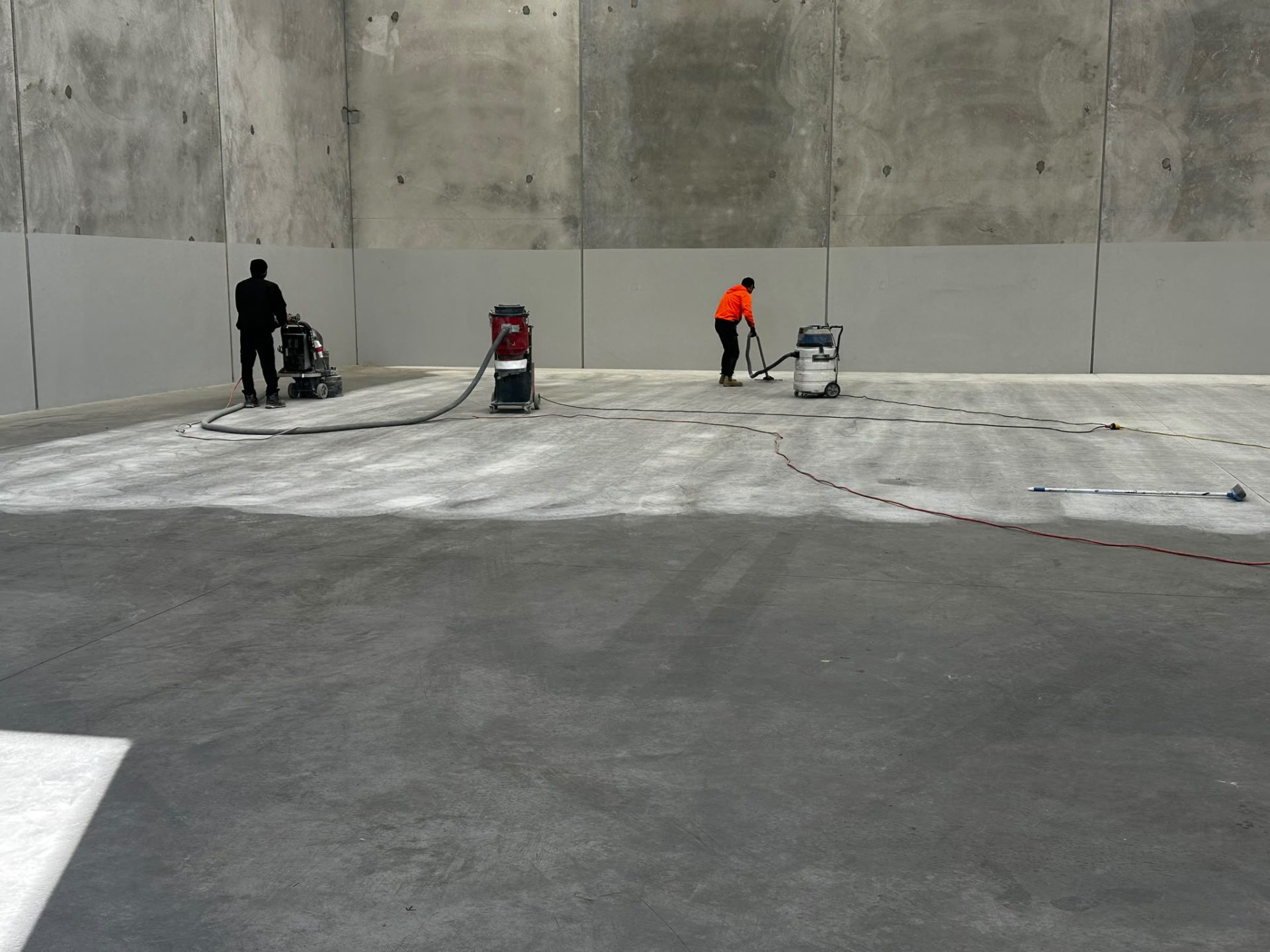
Short answer: diamond grinding is the only preparation method that reliably works, and acid etching is a shortcut that causes most of the failed epoxy floors we are called out to replace. Preparation is not the boring part before the real work — it is the work. The coating is the easy bit.
This guide explains what each method actually does to concrete, why the difference matters so much for adhesion, how to tell which one a quote includes, and what to look at on your own slab before anyone starts.
Why preparation decides everything
Epoxy does not chemically bond to concrete. It grips it mechanically. Poured onto a properly prepared slab, the resin flows down into thousands of open pores and hardens there, forming a mesh of tiny anchors that lock the coating to the substrate. Pull that floor up and lumps of concrete come with it.
Poured onto a smooth, sealed or contaminated surface, the same resin has nothing to flow into. It cures as a skin sitting on top. It looks identical on handover day. Then a hot tyre, a dropped toolbox or a season of temperature movement finds the weak point and it lifts in sheets.
Almost every failed epoxy floor failed at preparation. The coating rarely fails on its own — we go into that in can epoxy flooring be repaired, and the same theme runs through how long epoxy flooring lasts.
What diamond grinding actually does
A planetary grinder is a heavy machine — commonly 80 to 150 kilograms — with two or three counter-rotating heads carrying diamond-segmented discs. Its weight presses the tooling into the slab while the heads spin, abrading away the top one to two millimetres of concrete.
That removes three things at once:
- Laitance. The weak, cement-rich skin left on the surface when concrete is finished. It is softer than the concrete beneath and a poor thing to bond to.
- Contamination. Oil, tyre marks, curing compounds, builder's sealer, paint. Anything that has soaked into the top layer comes off with the top layer.
- Smoothness. The trowelled or burnished finish is replaced with a consistent, open texture.
What is left behind is a uniform matte surface with visible fine scratches — the profile the coating needs. Because it is a mechanical process, the result is controllable and repeatable: the operator chooses the grit and the number of passes, and gets the same outcome across the whole floor.
Dust extraction is not optional
Grinding concrete produces enormous quantities of fine silica dust, which is both a serious health hazard and a nightmare to clean up. Every grinder we run is coupled to an industrial vacuum drawing directly off the machine head, so the dust never reaches the air. If a crew is grinding your garage without extraction, that dust is going through the internal door and into the rest of your house.
What acid etching actually does
Acid etching means washing a diluted acid — usually hydrochloric, sometimes phosphoric — across the slab, letting it react, then rinsing and neutralising it. The acid attacks the cement paste between the aggregate, roughening the surface as it goes.
It exists because it is cheap and fast. There is no machine to hire, no operator skill required and no dust. On a small, bare, absorbent, uncoated slab it can produce a surface a thin domestic coating will stick to.
The problem is everything it cannot do:
- It cannot touch a coating or a sealer. Acid reacts with cement. A sealed builder's slab — which describes most newer Melbourne garages — simply repels it.
- It cannot remove oil. Contamination is untouched, and worse, it stops the acid reaching the concrete beneath, so those patches get no preparation at all.
- It cannot be controlled. The reaction depends on concrete density, temperature, dilution and dwell time. Porous areas etch deeply, dense areas barely at all. The result is patchy by nature.
- It leaves salts behind. The reaction produces residue that must be rinsed away completely. Any left behind sits between concrete and coating as a release layer.
- It soaks the slab. Everything then waits for the concrete to dry — a day or more in a Melbourne winter.
Head to head
| Diamond grinding | Acid etching | |
|---|---|---|
| Method | Mechanical abrasion | Chemical reaction |
| Surface profile | CSP 2–3, consistent | CSP 1–2 at best, patchy |
| Removes laitance | Yes | Partly |
| Removes oil and contamination | Yes | No |
| Removes old coatings or sealer | Yes | No |
| Works on dense or burnished slabs | Yes | Poorly |
| Repeatable result | Yes | No |
| Leaves residue | No | Salts, unless fully neutralised |
| Wets the slab | No | Yes, needs drying time |
| Dust | Heavy, but extracted at the head | None |
| Time, standard garage | 2–4 hours | 1–2 hours plus drying |
| Manufacturer approved | Universally | Rarely, and always with conditions |
Understanding the CSP scale
The International Concrete Repair Institute publishes a scale of Concrete Surface Profiles running from CSP 1, which is near enough smooth, to CSP 9, which is heavily scarified. It exists so a specification can say something measurable instead of "roughen the surface".
| Profile | Feels like | Suits |
|---|---|---|
| CSP 1 | Smooth, barely textured | Thin sealers only |
| CSP 2–3 | Fine to medium sandpaper | Roll-applied epoxy and polyaspartic |
| CSP 4–5 | Coarse, clearly textured | Thicker builds, self-levelling |
| CSP 6–9 | Aggressive, exposed aggregate | Heavy industrial screeds |
Almost every residential and commercial epoxy system specifies CSP 2 to 3. Diamond grinding hits that range consistently. Acid etching, done perfectly on ideal concrete, reaches the bottom of CSP 1 to 2 — and rarely gets done perfectly on ideal concrete.
What about shot blasting?
Shot blasting is the third option and a legitimate one. The machine fires steel beads at the slab and recovers them magnetically, leaving an aggressive CSP 4 to 6 profile very quickly over large areas. It is the standard choice on warehouse floors and factory floors where there are hundreds of square metres to cover.
Two limitations keep it off domestic jobs. It cannot reach edges, corners or anywhere near a wall, so a grinder has to follow it in regardless. And for a garage taking a family car, a CSP 5 profile is more aggressive than the system needs. For single and double garages, grinding alone is the right tool.
How to read a quote
Preparation is where quotes diverge, and it is almost never spelled out. Ask directly: how will you prepare the slab?
A straight answer sounds like this: "Diamond grind with dust extraction, rout and fill any cracks, vacuum, moisture test, then prime." It names the method, accounts for the mess, and says what happens if the slab throws up a surprise.
Answers worth pausing on:
- "We'll clean and etch it." Chemical preparation on a slab nobody has assessed.
- "We pressure wash first." Washing is not preparation. It removes loose dirt and adds water.
- "We'll scuff it up." Usually a sander or a wire cup brush. Neither produces a usable profile.
- Silence on cracks or moisture. Both are common on Melbourne slabs and both must be priced before work starts, not discovered halfway through.
A one-day floor at a budget price has had the time taken out of it somewhere, and preparation is the only stage long enough to be worth cutting. We walk through the rest of the questions in how to choose the right epoxy flooring contractor in Melbourne, and the schedule a proper job actually runs to in how long epoxy flooring takes start to finish.
Melbourne slabs specifically
Two local conditions make proper preparation more important here than the generic advice suggests.
Builder's sealer. Most garage slabs in newer estates across the northern and western growth corridors are sealed at handover. That sealer is invisible, and it is exactly what acid cannot get through. Coat over it and the epoxy bonds to the sealer rather than the concrete — and the sealer lets go. This is the same reasoning behind why we never finish a floor with a concrete sealer.
Reactive clay. Much of Melbourne sits on clay soils that swell and shrink with the seasons, and slabs move with them. That movement shows up as hairline cracking, which is normal and repairable — but only if it is chased open and filled during preparation rather than coated over and left to telegraph through.
Moisture is the third factor. Older slabs, and any slab without an effective damp-proof membrane, can push water up from below. We test before coating, and a high reading means a moisture-barrier primer. Skipping that test is the single most expensive shortcut in the trade.
Preparation for other floor types
The same logic applies beyond garages. Commercial floors usually carry years of contamination that only mechanical removal will shift. Where old tiles are coming up, the adhesive bed underneath has to be ground back to sound concrete — see tile removal. And a slab too damaged to be ground flat is a candidate for concrete resurfacing instead.
What it means for cost
Grinding is machine hire plus hours of skilled labour, so it costs more than a drum of diluted acid. It is also the reason a floor reaches fifteen years instead of two. Measured over the life of the floor it is the cheapest thing on the invoice — and re-doing a failed floor means paying for grinding anyway, on top of removing the coating that failed.
Current pricing is set out in how much epoxy flooring costs in Melbourne, and preparation is included in every quote we issue rather than listed as an optional extra.
Frequently asked questions
What is the difference between diamond grinding and acid etching?
Diamond grinding is mechanical: a weighted machine with diamond-segmented discs abrades the top layer off the concrete, opening its pores and leaving a consistent texture. Acid etching is chemical: a diluted acid is washed over the slab to eat into the surface. Grinding removes material and controls the result; etching reacts with whatever it happens to touch and controls very little.
Which one is better for epoxy flooring?
Diamond grinding, without qualification. It is the method every reputable coating manufacturer specifies, and the only one that reliably produces the surface profile epoxy needs to bond to. Acid etching is a compromise that exists because it is cheap and quick, not because it works better.
Why does surface preparation matter so much?
Epoxy does not glue itself to concrete chemically. It grips mechanically, flowing into the open pores and hardening there like thousands of tiny anchors. A smooth, sealed or contaminated surface gives it nothing to grip, so the coating sits on top rather than keying in. That is why nearly every failed epoxy floor failed at the preparation stage, not the coating stage.
What is a CSP profile?
CSP stands for Concrete Surface Profile, a scale from CSP 1 (almost smooth) to CSP 9 (heavily scarified) published by the International Concrete Repair Institute. Most roll-applied epoxy systems call for CSP 2 to CSP 3. Diamond grinding lands in that range predictably. Acid etching, at best, reaches the very bottom of it and often falls short.
Can acid etching ever be acceptable?
On a small, clean, bare, absorbent slab with no previous coating and no sealer, a thorough etch can produce a serviceable result for a thin domestic coating. That is a narrow set of conditions. On a Melbourne garage slab that has been sealed by the builder, or has a decade of oil and tyre marks in it, etching will not deliver.
How can I tell if my slab was ground or etched?
A ground slab has a uniform, matte, faintly scratched appearance, and swirl marks from the grinder head are usually visible in raking light. An etched slab looks patchy, with lighter and darker areas where the acid reacted unevenly, and may still feel smooth to the palm. If you can run your hand across it and it feels like polished stone, it is not ready to coat.
Does grinding create a lot of dust?
It creates a great deal of dust, which is exactly why the grinder is paired with an industrial vacuum drawing directly off the machine head. Done properly the work is close to dust-free and there is no fine grey film through the rest of the house. A crew grinding without extraction is cutting a corner you will be cleaning up for weeks.
How long does grinding take?
Two to four hours for a standard single or double garage, longer if there is an old coating, adhesive or sealer to take off. It is the single biggest block of time in the installation, which is precisely why it is the first thing a rushed quote shortens.
Is acid etching dangerous?
It uses hydrochloric or phosphoric acid, so yes, it demands care: eye protection, gloves, ventilation and correct disposal. The rinse water is acidic and cannot simply be washed into a stormwater drain. Grinding has its own hazards, chiefly silica dust, but those are controlled with extraction rather than with chemistry that has to be neutralised afterwards.
Does acid etching leave residue in the concrete?
It can. The reaction produces salts that must be rinsed away completely and the slab neutralised. Any residue left behind sits between the concrete and the coating and becomes a release layer. This is one of the most common reasons an etched floor lifts in sheets a year later.
Do I have to dry the slab after etching?
Yes, and thoroughly. Etching is a wet process, and the slab has to return to an acceptable moisture level before anything is applied. In a Melbourne winter that can add a day or more. Grinding is dry, so there is no drying delay at all.
What if my garage floor already has a coating on it?
Then etching is not an option. Acid does not touch an existing coating, it just runs over it. The old system has to be mechanically removed, which means grinding, and sometimes shot blasting for a thick industrial coating. The same applies to tile adhesive left behind after a tile lift.
What is shot blasting, and is it better than grinding?
Shot blasting fires steel beads at the slab and vacuums them back, leaving an aggressive CSP 4 to CSP 6 profile. It is faster than grinding over large areas and is the usual choice for warehouse and factory floors. For a domestic garage it is more aggressive than necessary, and it cannot reach edges and corners, so grinding still has to finish the job.
Does grinding fix cracks in the slab?
No. Grinding prepares the surface; cracks are a separate repair. They are routed out to create a clean channel, filled with a structural repair compound and then ground flush so the patch disappears under the coating. A quote that mentions neither grinding nor crack repair is quoting for paint, not a floor system.
Will grinding make my floor level?
It removes high spots and can take the edge off a lip between slabs, but it is not a levelling process. A slab that falls away badly, or has a step in it, needs a self-levelling underlayment or resurfacing before coating.
Is grinding more expensive?
Per square metre, yes, because it is machine hire and hours of labour rather than a drum of diluted acid. It is also the difference between a floor that lasts fifteen years and one that peels within two. Spread across the life of the floor, it is the cheapest part of the job.
Can I grind the slab myself before you arrive?
Please do not. Hire-shop grinders are usually underweight, come with worn tooling and no dust extraction, and produce an inconsistent profile that we then have to correct. If you want to help, empty the space completely and leave the concrete to us.
Does the concrete need to cure before it can be ground?
New concrete needs to cure for at least 28 days before coating, and we test for moisture before starting regardless of age. Grinding a green slab tears the surface rather than abrading it, and the moisture still trapped inside will push a coating off later.
What preparation does GoPoxy use?
Diamond grinding with dust extraction on every job, without exception, followed by crack and joint repair and a moisture test before any product goes down. Where an old coating, sealer or tile adhesive has to come off first, that is quoted as part of the preparation rather than discovered halfway through.
How do I make sure my quote includes proper preparation?
Ask one question: how will you prepare the slab? A straight answer names diamond grinding, describes dust extraction, and covers what happens if cracks or moisture are found. Vague answers about cleaning, pressure washing or etching tell you what you need to know about the rest of the quote.
Get it prepared properly
We diamond grind every floor we install, with dust extraction, on every job — garages, warehouses, factories, shops and salons across Melbourne. No etching, no shortcuts, and the preparation is written into the quote so you can see exactly what you are paying for.
Call 0451 980 606 or request a free on-site inspection. We will look at your slab, test it, and tell you honestly what it needs.
Planning an epoxy floor in Melbourne?
Book a free on-site inspection and get a fixed written quote — no obligation.