Industry Knowledge Guide 2026
The single most important thing to know before hiring an epoxy flooring contractor in Melbourne — and the difference that separates a floor that lasts 20 years from one that fails in 12 months.
Polyaspartic Only
GoPoxy standard — every job
5–10 Yrs
Warranty — every installation
< 2 Hrs
Polyaspartic cure time
10–20 Yrs
Floor lifespan with correct topcoat
If you have ever received two quotes for epoxy flooring in Melbourne and wondered why one is significantly cheaper than the other, there is a very good chance the answer is in the topcoat. Specifically: whether the contractor is applying a professional polyaspartic topcoat sealer over the epoxy base — or cutting costs by using a cheaper concrete sealer instead.
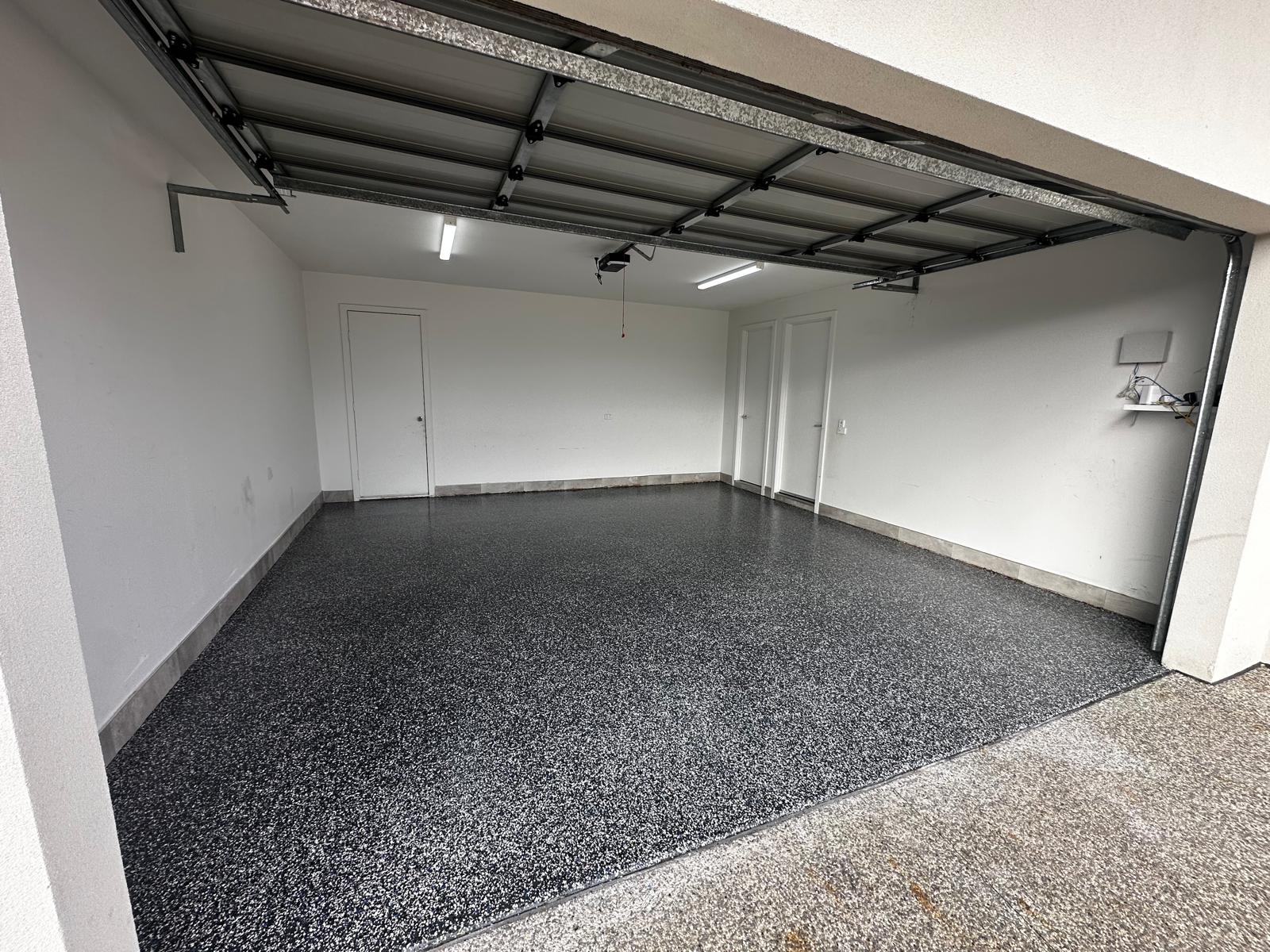
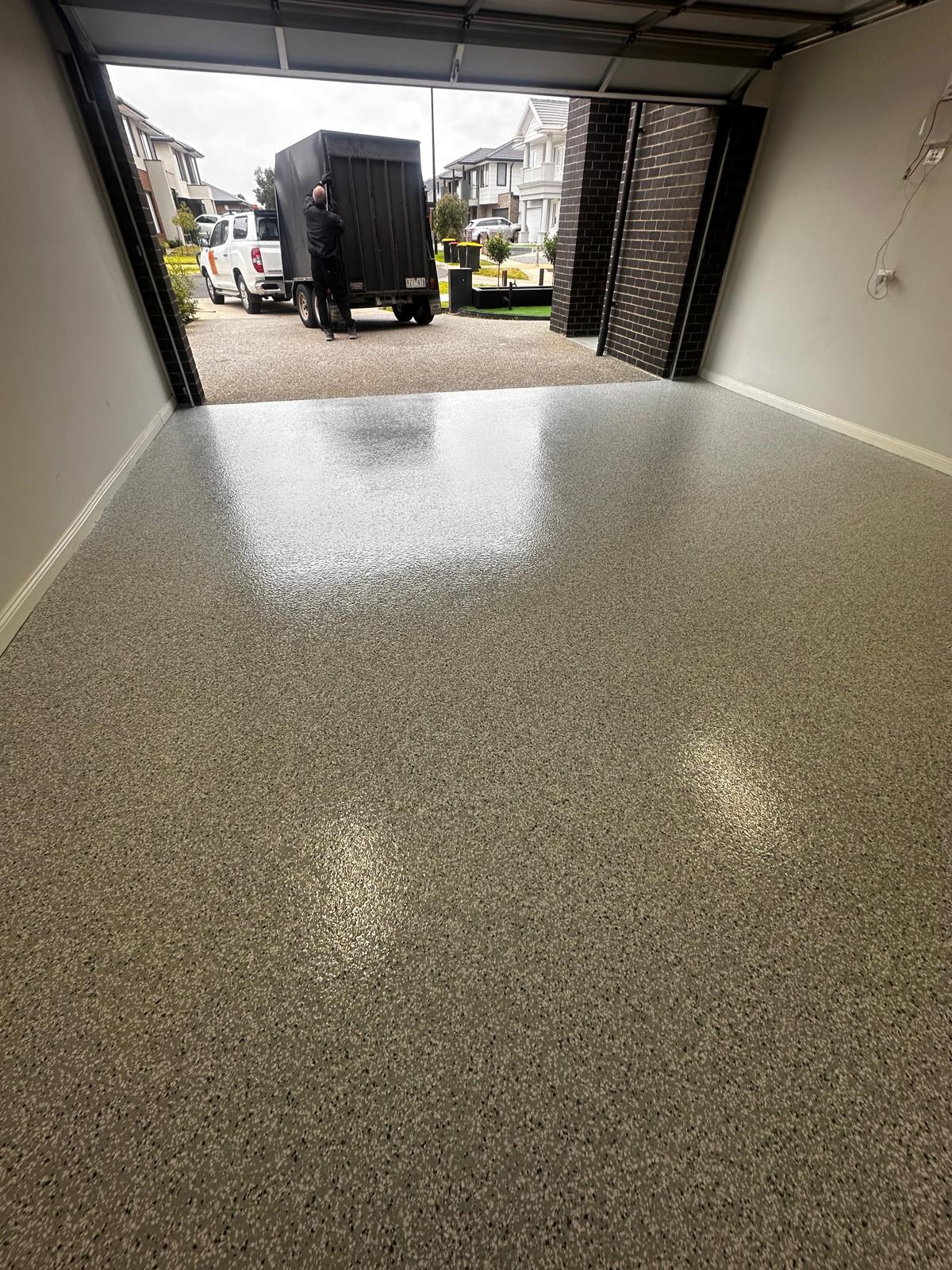
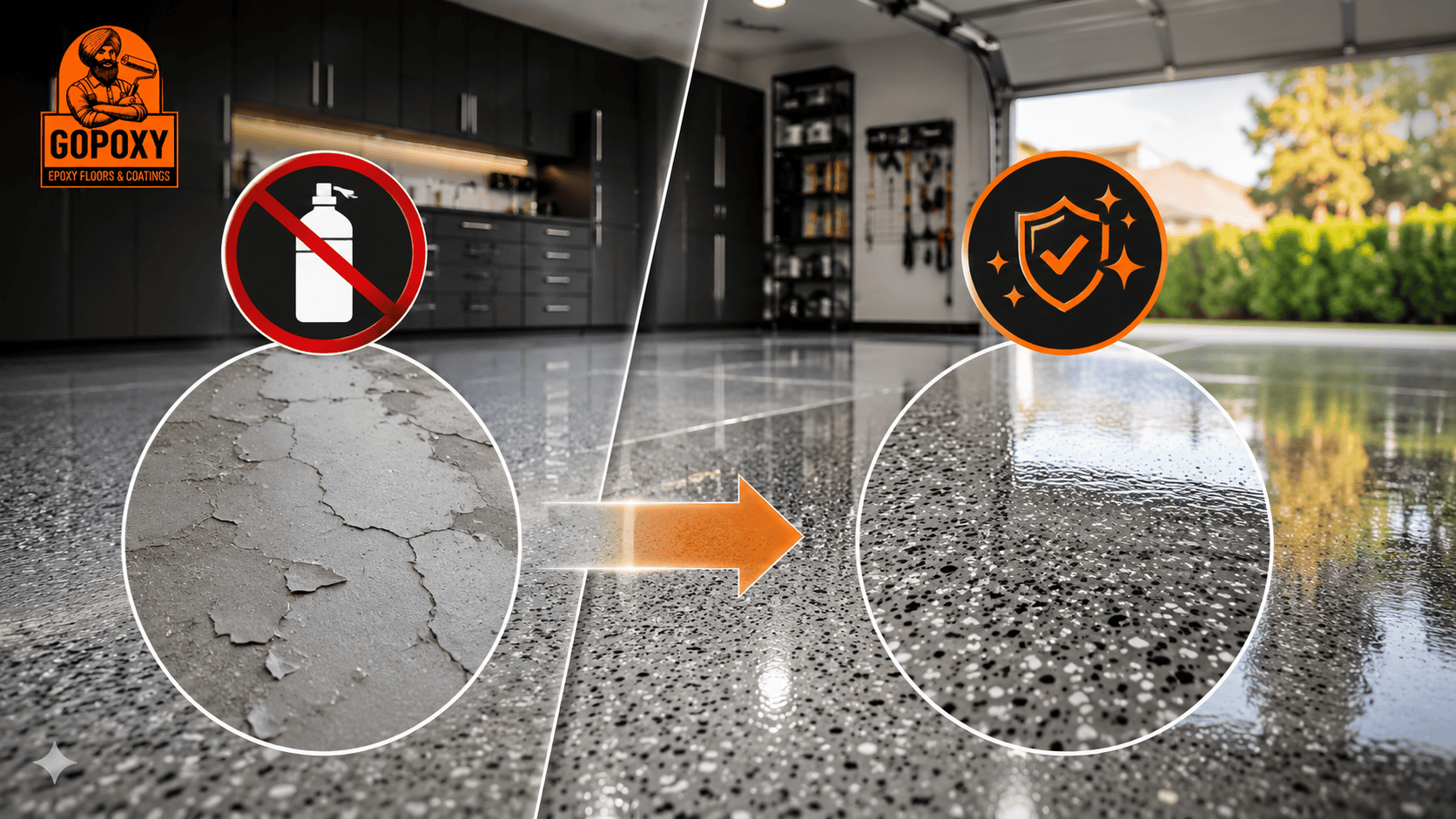
On the day of installation, both floors look identical. The flake broadcast is the same. The gloss level looks similar. The customer has no way of knowing what was applied as the final coat — and the contractor knows this. But within 12 to 24 months, the difference becomes impossible to ignore. The cheaper floor begins to dull, yellow, pick up tyre marks, and peel. The properly installed floor looks exactly as it did on day one and continues to do so for years afterward.
This is not a minor industry detail. It is the single most important distinction between a quality epoxy flooring installation and a cheap one — and it is the reason GoPoxy uses a professional polyaspartic topcoat sealer on every single job, without exception, from residential garages in Point Cook to commercial kitchens in Melbourne’s CBD and industrial warehouses in Melbourne’s western corridor.
This guide explains exactly what concrete sealers are, why they fail on epoxy floors, what polyaspartic topcoats do differently, and how to protect yourself from an operator who is cutting corners where you will never see it — until it is too late.
What Is a Concrete Sealer — and What Is It Actually Designed For?
A concrete sealer is a product designed to penetrate into, or form a thin protective film over, bare concrete surfaces. Its primary purpose is to reduce moisture absorption, light dusting, and surface staining on uncoated concrete — driveways, concrete paths, plain slab areas, and concrete paving.
Concrete sealers come in several types — acrylic sealers, penetrating sealers, and epoxy sealers — but they share common characteristics that make them fundamentally unsuitable for use as a topcoat over a decorative epoxy floor system:
Low Abrasion Resistance
Concrete sealers are thin-film products with minimal resistance to abrasion. Under vehicle tyre traffic, foot traffic with grit underfoot, and the scraping of heavy equipment, they wear through rapidly — leaving the underlying epoxy base coat exposed and unprotected.
No UV Stability
Most acrylic concrete sealers are not UV stable — they yellow, amber, and chalk under sunlight and UV exposure. For garage floors exposed to sunlight through the garage door, or any epoxy floor near windows or glass, this yellowing begins within months of installation and permanently discolours the finish.
Hot Tyre Vulnerability
When a vehicle is parked on a concrete sealer-topped floor, the heat from the tyres softens the sealer film and causes it to bond momentarily with the rubber. When the vehicle is moved, sections of the topcoat lift away with the tyre — a phenomenon known as hot tyre pick-up that destroys the floor’s appearance rapidly.
Poor Chemical Resistance
Concrete sealers offer minimal resistance to the oils, fuel, brake fluid, degreasers, and cleaning chemicals that regularly contact a garage or commercial floor. These substances penetrate or chemically attack the sealer film, stripping it away and leaving the epoxy base coat directly exposed to contamination.
Wrong Application Surface
Concrete sealers are chemically designed to bond with porous concrete — not with a cured, non-porous epoxy surface. Applied over epoxy, they sit on top of the coating rather than bonding into it, creating a weak adhesion that fails faster than the same product would even on bare concrete.
Short Effective Lifespan
Even on bare concrete (where it is the correct product), an acrylic sealer typically lasts 1–3 years before reapplication is needed. On a cured epoxy surface under vehicle and foot traffic, it fails significantly faster — often within 12 months of installation.
In short: a concrete sealer is the right product for its intended purpose on bare concrete — and completely the wrong product to use as a protective topcoat on a decorative epoxy floor system. It does not matter how good the epoxy base coat beneath it is. If the topcoat fails, the floor fails.
Industry Warning — Read Before Getting a Quote
A growing number of budget epoxy flooring operators in Melbourne are using concrete sealers as the topcoat on their installations to reduce materials costs and undercut professional competitors on price. The difference in materials cost between a professional polyaspartic topcoat and a concrete sealer can be $8–$20 per square metre — a saving that goes directly into the contractor’s margin at the customer’s expense.
The customer cannot tell the difference on the day of installation. The floor looks great. But within 12–24 months, the failure pattern becomes undeniable — yellowing, hot tyre marks, topcoat peeling, and rapid loss of gloss — and the customer is left with a floor that needs to be stripped and recoated at their own cost, with no recourse because the warranty (if one was even offered) was never backed by a quality product in the first place.
Always ask your contractor: “What specific topcoat product are you using — is it polyaspartic, polyurethane, or a concrete sealer?” Any professional operator will answer clearly. If they cannot or will not, that is your answer.
What Is a Polyaspartic Topcoat — and Why Is It the Right Choice?
A polyaspartic topcoat (technically classified as an aliphatic polyurea) is a two-component, fast-curing protective coating engineered specifically for application over cured epoxy floor systems. It was developed as a significant advancement over both standard polyurethane and acrylic topcoats, delivering a combination of performance properties that no other single topcoat product achieves simultaneously.
Here is what a professional polyaspartic topcoat delivers that a concrete sealer simply cannot:
Outstanding UV Stability
Polyaspartic topcoats are inherently UV stable — they do not yellow, amber, or chalk under prolonged UV or sunlight exposure. For Melbourne garages where sunlight enters through the garage door, this is critical. The floor maintains its colour and gloss for the full life of the installation — never yellowing regardless of light exposure.
Superior Abrasion Resistance
Polyaspartic coatings have dramatically higher abrasion resistance than concrete sealers. In standardised abrasion resistance tests, polyaspartic products consistently outperform acrylic sealers by a factor of 5–10 times. This translates directly into a topcoat that looks great under years of foot traffic, vehicle tyres, and abrasive grit.
Hot Tyre Resistance
The crosslinked polymer structure of a polyaspartic topcoat does not soften under tyre heat — making hot tyre pick-up virtually impossible. This is the single most impactful performance advantage for residential garage floors in Melbourne, where vehicles are parked daily and hot tyre contact is constant.
Chemical Resistance
Polyaspartic topcoats resist oils, fuels, brake fluid, hydraulic fluid, household cleaning products, and most commercial chemical cleaners. Spills that would strip a concrete sealer in hours sit safely on the polyaspartic surface and clean up with simple mopping.
Fast Cure — Under 2 Hours
A polyaspartic topcoat cures in under two hours — significantly faster than polyurethane (24 hours) or additional epoxy coats. This means the floor can accept foot traffic within two hours of the final coat and vehicles within 24 hours — minimising disruption for both residential and commercial projects.
Application in a Wide Temperature Range
Polyaspartic coatings can be applied in temperatures from as low as -10°C to over 40°C without compromising cure quality. This makes them practical for Melbourne’s unpredictable weather and for installation scheduling year-round — something that standard epoxy products struggle with in extreme temperature conditions.
GoPoxy’s Commitment — Polyaspartic Topcoat on Every Single Job
This is not optional at GoPoxy. It is not a premium upgrade. It is not an add-on you have to ask for. Every GoPoxy epoxy flooring installation — from a single garage in Point Cook to a 2,000 m² industrial warehouse — receives a professional-grade polyaspartic topcoat as a standard, non-negotiable part of the system.
We do not offer a “budget” version of our service that uses a cheaper topcoat. We do not substitute concrete sealers to lower our price. We do not vary the topcoat specification based on what we think a customer will notice — because we know exactly what a customer will notice: in 18 months, when the cheap floor starts failing, they will notice everything.
The reason GoPoxy can offer a 5–10 year warranty on every installation is precisely because we use the right topcoat every time. A warranty is only meaningful if the floor can actually last the warranty period — and a floor sealed with a concrete sealer cannot.
GoPoxy is committed to being the Melbourne epoxy flooring contractor that does the job correctly — not the cheapest quote in your inbox. Our polyaspartic topcoat standard, our diamond grinding preparation, and our 5–10 year warranty are the proof of that commitment on every single job we complete.
How Budget Epoxy Operators Use Concrete Sealers to Cut Costs
The Melbourne epoxy flooring market has seen rapid growth in recent years — driven by genuinely increasing consumer demand, but also attracting operators who have entered the market with a business model built on cost cutting rather than quality. One of the most common and least visible cost-cutting substitutions is the replacement of polyaspartic topcoat with a concrete sealer.
Here is how the economics work from a budget operator’s perspective:
| Topcoat Product | Approximate Cost (per m²) | UV Stable? | Hot Tyre Resistant? | Expected Lifespan on Epoxy |
|---|---|---|---|---|
| Polyaspartic Topcoat | $12–$22 per m² | Yes | Yes | 10–20 years |
| Polyurethane Topcoat | $8–$18 per m² | Yes (aliphatic grade) | Yes | 8–15 years |
| Concrete Sealer (acrylic) | $2–$6 per m² | No | No | 1–2 years |
On a standard double garage of 40 m², the materials cost difference between a polyaspartic topcoat and a concrete sealer is approximately $400–$640. That is the saving the budget operator pockets — or uses to undercut professional competitors on price — while delivering a topcoat that will fail in a fraction of the time.
This practice is particularly prevalent in the residential garage market in Melbourne’s outer growth suburbs — areas like Point Cook, Craigieburn, Tarneit, Fraser Rise, and Wollert — where competitive pricing pressure is high and homeowners are evaluating quotes primarily on headline price. If you are in one of these areas and have received a quote significantly below GoPoxy’s fixed pricing, the topcoat is the first place to investigate.
For the complete guide on how to evaluate epoxy flooring contractors in Melbourne, see how to choose the right epoxy flooring contractor in Melbourne.
How to Identify Concrete Sealer Failure on an Epoxy Floor
If you suspect that your existing epoxy floor was sealed with a concrete sealer rather than a polyaspartic or polyurethane topcoat, these are the signs to look for:
Yellowing or ambering in areas near sunlight
If any section of your floor exposed to natural light has developed a yellowish or amber tint, this is a strong indicator of a non-UV-stable topcoat — which describes virtually every concrete sealer on the market. A polyaspartic topcoat does not yellow under UV exposure.
Tyre marks or lifted sections where vehicles park
Dark tyre marks that will not clean off, or sections of topcoat that have visibly lifted around tyre contact zones, are the classic sign of hot tyre pick-up through a concrete sealer. This does not happen with a proper polyaspartic topcoat.
Surface dulling within months of installation
A properly polyaspartic-topcoated floor maintains its gloss for years. If your floor lost its shine noticeably within the first 6–12 months under normal use, the topcoat does not have the abrasion resistance of a professional-grade product.
Topcoat peeling or flaking at edges and joints
Concrete sealer peeling from the edges of a garage floor — particularly at the garage door threshold and along wall edges — is a typical failure pattern. The lack of proper adhesion to the epoxy surface means peeling begins at the most exposed points first and works inward.
Chemical staining that penetrates the topcoat
If oil or chemical spills have stained through your topcoat into the base coat or flake layer beneath, the topcoat has insufficient chemical resistance. A polyaspartic topcoat prevents this penetration for the full life of the installation.
If your floor is showing any of these signs and it is less than five years old, it was almost certainly sealed with a concrete sealer or another low-grade product rather than a professional polyaspartic or polyurethane topcoat. GoPoxy can assess your floor and advise on whether a topcoat refresh or full recoat is the right solution. Read the full repair guide at can epoxy flooring be repaired.
For more on what a correctly installed floor looks like — and how long it should last — see how long does epoxy flooring last — the complete 2026 answer.
Polyaspartic Topcoat vs Concrete Sealer — Complete Performance Comparison
| Performance Factor | Polyaspartic Topcoat | Concrete Sealer |
|---|---|---|
| UV Stability | Fully UV stable — no yellowing | Yellows within months |
| Hot Tyre Resistance | Excellent | Fails rapidly |
| Abrasion Resistance | Very high | Very low |
| Chemical Resistance | Excellent (oils, fuels, acids) | Poor |
| Cure Time | Under 2 hours | 2–4 hours (acrylic) |
| Adhesion to Epoxy | Chemically compatible | No chemical bond |
| Temperature Range (application) | -10°C to 40°C+ | 10°C to 30°C (acrylic) |
| Expected Lifespan on Epoxy | 10–20 years | 1–2 years |
| Suitable for Garage Floors | Yes — designed for it | No |
| Materials Cost | $12–$22 per m² | $2–$6 per m² |
Further Reading from GoPoxy
Lifespan
How Long Does Epoxy Flooring Last?
Repair
Can Epoxy Flooring Be Repaired?
Hot Tyres
Can Hot Tyres Damage Epoxy Floors?
Hiring
Choose the Right Epoxy Contractor
Safety
Is Epoxy Flooring Slippery?
Flake
Why Flake Epoxy Is Top Choice
Value
Is Epoxy Flooring Worth It?
Best
Best Garage Epoxy Service Melbourne
Get a GoPoxy Installation — Polyaspartic Topcoat Included on Every Job
Every GoPoxy installation includes a professional-grade polyaspartic topcoat as standard — not as an upgrade, not as an extra. It is simply how we do every job. Backed by a 5–10 year warranty on workmanship and materials.
Frequently Asked Questions
Everything you need to know about polyaspartic topcoats, concrete sealers, and why the difference matters for your epoxy floor.
Polyaspartic Standard — Every GoPoxy Job
The Right Products. The Right Process. Every Time.
Planning an epoxy floor in Melbourne?
Book a free on-site inspection and get a fixed written quote — no obligation.