The good news is that almost nothing you spill in a garage will permanently stain a properly installed epoxy floor. The bad news is that half the products people reach for will damage it. Here is what actually works, what to keep well away, and how to tell a stain from a floor that is starting to fail.
The short answer
Blot the spill, then clean with warm water and a pH-neutral degreaser using a soft-bristled brush. For tyre marks, a melamine foam pad or citrus-based cleaner lifts stubborn plasticiser transfer. Never use acid-based cleaners, bleach, acetone or abrasive pads — acids etch the topcoat, solvents soften it, and abrasives dull the gloss permanently.
Why epoxy cleans so much more easily than concrete
Bare concrete is porous. Spill oil on it and the oil travels down into the slab, which is why an old garage floor has dark shadows that no amount of scrubbing removes — the stain is not on the surface, it is in the concrete.
A cured epoxy floor finished with a polyaspartic topcoat is non-porous. There is nowhere for oil to go. It sits on top, in a thin film, waiting to be wiped up. That single property is the reason garage floor coatings exist at all, and the reason this article is short on heroic stain-removal techniques — you mostly do not need them.
It is also why the topcoat matters so much, and why we do not substitute a concrete sealer for a proper polyaspartic finish. The reasoning is set out in why concrete sealers are not suitable for epoxy floors.
Engine oil
Fresh spills
Deal with it now and it is a two-minute job.
- Blot, do not wipe. Wiping spreads a small spill into a large one. Drop cat litter, sawdust or an oil pad onto the pool and let it absorb.
- Sweep up the absorbent once it has done its work.
- Apply a pH-neutral degreaser diluted per the label. Let it dwell three to five minutes — but do not let it dry on the floor.
- Agitate with a soft-bristled deck brush in small circles.
- Rinse and dry. Leaving detergent film behind makes the floor slippery, which matters — see is epoxy flooring slippery.
Old, walked-in oil
A spill that has been driven over and walked through for a month takes a second pass, not a stronger chemical. Repeat the degreaser step with a longer dwell time, then reassess. Two gentle rounds beat one aggressive one every time.
If a mark survives two proper attempts, stop scrubbing. It is very likely no longer a stain — more on that below.
Petrol, diesel and other fluids
Fuel worries people more than it should. A cured floor with a polyaspartic topcoat shrugs off a quick spill. Fuel is a solvent though, so the rule is about time, not quantity: wipe it, do not leave it.
| Substance | Risk level | What to do |
|---|---|---|
| Petrol / diesel | Low if wiped promptly | Absorb, then wash with detergent. Ventilate. |
| Brake fluid | Highest of anything common | Wipe immediately, then wash. Do not let it sit. |
| Coolant | Low, but stains | Wash promptly — the coloured varieties mark if left. |
| Battery acid | High | Neutralise with bicarb solution, rinse thoroughly. |
| Paint (water-based) | Low | Wipe while wet. Dried paint lifts with a plastic scraper. |
| Paint (solvent-based) | Moderate | Wipe while wet. Never attack dried paint with thinners. |
Tyre marks — and what they actually are
Those brown-black smudges where your tyres sit are not damage, and they are not dirt. They are plasticiser migration.
Tyres contain softening compounds that keep the rubber flexible. When a tyre is warm those compounds leach out and transfer onto whatever the tyre is resting on. Heat drives the process, which is why marks appear most after a long summer drive and barely at all in winter.
It is a deposit from the tyre, sitting on top of your coating. It is not your floor breaking down.
Removing them
- Warm water and degreaser with a soft brush shifts most marks.
- Citrus-based cleaner for anything stubborn — spray, let it dwell a few minutes, then agitate.
- Melamine foam pad (sold as a "magic eraser") for the last of it. Use it damp and with light pressure. It works by micro-abrasion, so leaning on it will dull the gloss in that spot.
- Rinse thoroughly so no residue is left.
Reducing them
- Let the car cool before parking it in, when that is practical.
- Move the car occasionally rather than leaving it on the same four patches for months.
- Skip rubber mats. This surprises people: rubber mats contain the same plasticisers as tyres and can leave their own rectangular outline on the floor. If you want protection under a parked car, use a vinyl or PVC parking mat.
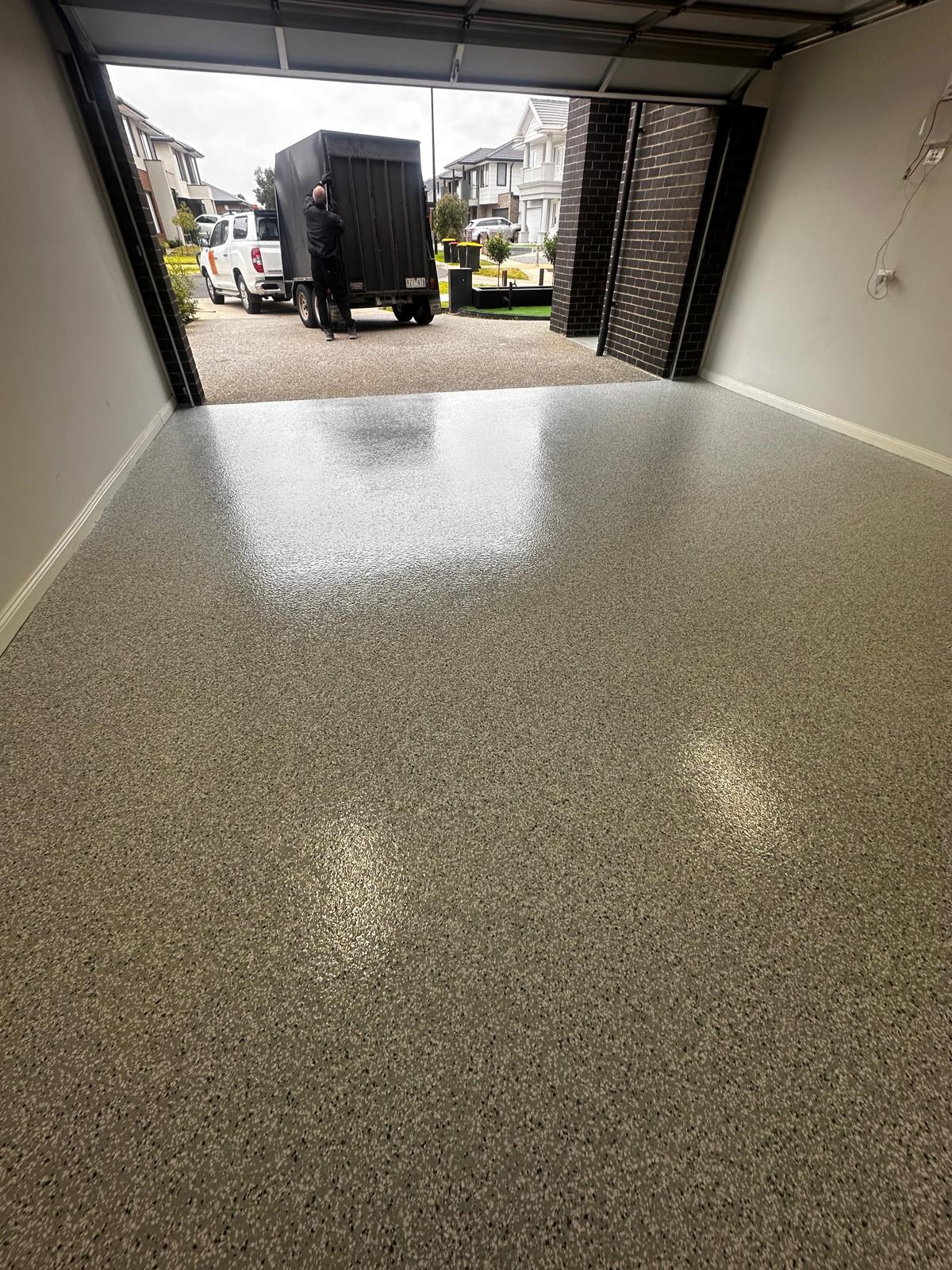
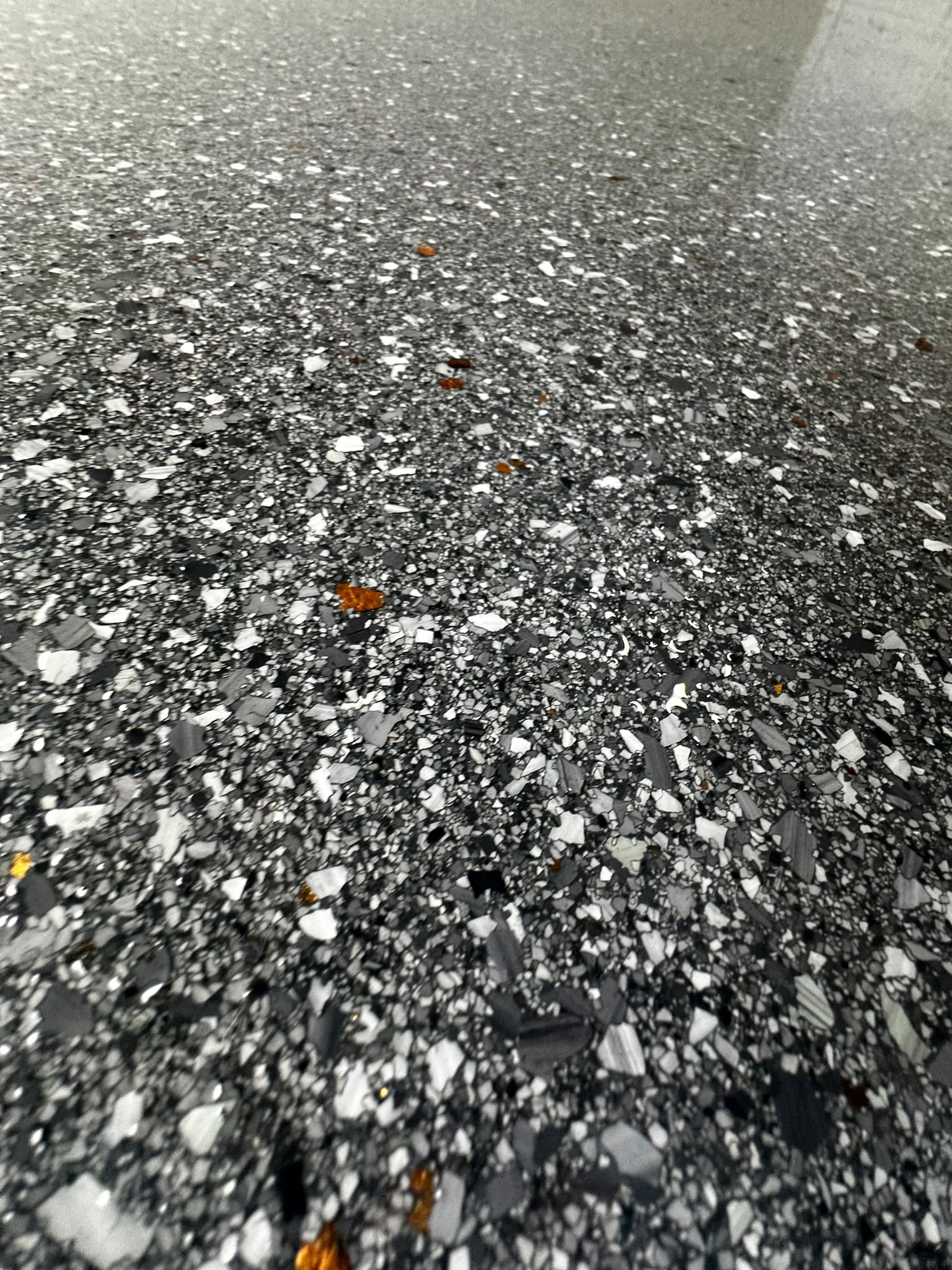
- Choose a forgiving colour. A charcoal or mid-grey flake blend hides marks dramatically better than a light solid colour — one reason it is the most requested finish we install. See flake epoxy flooring.
The two-minute cleaning kit
Everything on this list is cheap, available at any hardware store, and enough for any domestic garage.
| Item | Used for |
|---|---|
| Soft-bristled deck brush | General agitation, never a wire brush |
| pH-neutral degreaser | Oil, grease and general grime |
| Citrus-based cleaner | Stubborn tyre marks |
| Melamine foam pads | Last-resort spot work, light pressure only |
| Cat litter or oil pads | Absorbing spills before they spread |
| Microfibre mop | Routine cleaning and final drying |
| Rubber-bladed squeegee | Drying quickly after washing |
What never to use
This list matters more than the one above, because these are the things that cause the damage people then ask us to repair.
| Never use | Why |
|---|---|
| Acid-based cleaners | Etch the topcoat and permanently dull the finish |
| Vinegar | Still an acid. Mild, but repeated use dulls the gloss |
| Bleach | Can discolour the coating, particularly lighter blends |
| Acetone, MEK, paint thinner | Strong solvents that soften the topcoat |
| Steel wool or wire brushes | Scratch through the topcoat immediately |
| Abrasive scouring pads | Leave a permanent dull patch you cannot polish out |
| Close-range pressure jets on edges | Water finds a weak edge and lifts it |
The pattern is consistent: acids etch, solvents soften, abrasives dull. If a product falls into one of those three families, leave it on the shelf.
When it is not a stain
This is the part worth reading carefully, because it is the difference between a cleaning problem and a repair.
If a mark resists a degreaser and gentle agitation across two attempts, you are probably not looking at a stain any more. Three things to check:
Has the topcoat worn through?
Compare the gloss of the marked area against a corner of the garage nothing ever touches. If the marked area is noticeably flatter, the topcoat has thinned — the mark is sitting in exposed base coat. That area needs abrading and recoating, not more scrubbing.
Is the coating lifting rather than staining?
If your tyres are taking coating off and leaving bare concrete behind, that is hot tyre pickup, not a mark. It is a failure mode of cheap single-part coatings and DIY kits without a polyaspartic topcoat — covered in can hot tyres damage epoxy garage floors.
Is the surface powdery or flaking?
A chalky residue on your hand, or edges lifting, points to a bond problem — almost always inadequate preparation at installation. Coating over a builder's sealer or acid etching instead of diamond grinding produces exactly this, as set out in diamond grinding vs acid etching.
Any of these three is a repair question. The encouraging part is that most are fixable without redoing the entire floor — see can epoxy flooring be repaired.
A maintenance routine that actually gets followed
| How often | What |
|---|---|
| As it happens | Blot and wash any oil, fuel or chemical spill |
| Weekly | Sweep or dust-mop to keep grit off the surface |
| Monthly or so | Mop with warm water and pH-neutral detergent |
| Every few months | Spot-treat tyre marks before they build up |
| Annually | Check gloss levels and edges for early wear |
If you only do one of these, make it the weekly sweep. Grit is what actually wears a floor out — dragged under tyres and underfoot, it abrades the topcoat far more effectively than any spill. Keeping it swept does more for the life of your floor than any product you can buy, and it is a large part of why a properly installed floor runs fifteen years or more. See how long epoxy flooring lasts.
Frequently asked questions
How do you remove oil stains from an epoxy floor?
Blot up the pooled oil first, then clean with warm water and a degreaser or mild detergent using a soft-bristled brush. Rinse and dry. Because cured epoxy is non-porous the oil sits on the surface rather than soaking in, so fresh spills lift with almost no effort.
Will oil permanently stain epoxy?
Very rarely. A properly cured epoxy floor with a polyaspartic topcoat is non-porous, so oil has nothing to soak into. Marks that will not shift are usually old spills that have been walked through repeatedly, or a sign the topcoat has already worn thin in that spot.
What removes tyre marks from an epoxy garage floor?
Warm water with a degreaser and a soft brush handles most. For stubborn marks, a melamine foam pad (a "magic eraser") used with light pressure works well, as does a citrus-based cleaner left to dwell for a few minutes before scrubbing.
What actually causes tyre marks?
Plasticiser migration. Tyres contain softening compounds that leach out when warm and transfer onto the floor as a brown or black smudge. It is a surface deposit from the tyre, not damage to your coating.
What is the difference between a tyre mark and hot tyre pickup?
A tyre mark is a stain that cleans off. Hot tyre pickup is when the coating itself lifts away and sticks to the tyre, leaving bare concrete. The first is routine maintenance; the second is coating failure and needs repair.
Can petrol or diesel damage an epoxy floor?
Not from a quick spill on a cured floor with a polyaspartic topcoat. Fuel is a solvent, so the rule is simple: wipe it rather than leave it. Prolonged contact over hours or days can soften weaker coatings.
What about brake fluid and coolant?
Brake fluid is the harshest thing most people spill in a garage and should be wiped immediately, then washed with detergent. Coolant is far gentler but stains if left, particularly the bright green and pink varieties.
What should I never use on an epoxy flooring?
Acid-based cleaners, bleach, acetone, paint thinner, methylated spirits in quantity, steel wool, wire brushes and abrasive scouring pads. Acids etch, strong solvents soften, and abrasives dull the gloss permanently.
Is vinegar safe on epoxy floors?
No. Vinegar is acetic acid, and while it is mild it is still an acid. Used regularly it dulls the topcoat. Warm water with a pH-neutral detergent does everything vinegar would, without the risk.
Can I use a pressure washer?
On a sound floor, yes, at moderate pressure and a sensible distance. Do not hold a narrow jet close to edges, coved sections or any spot where the coating already looks marginal, because high-pressure water will find a weak edge and lift it.
How often should I clean an epoxy garage floor?
Sweep or dust-mop weekly to keep grit off, since grit underfoot is what abrades a floor over years. A proper wash every month or two is plenty for a domestic garage. Spills get dealt with as they happen rather than on a schedule.
Do rubber mats prevent tyre marks?
Not always, and some make it worse. Rubber mats contain the same plasticisers as tyres and can leave their own outline on the floor. If you want protection under a parked car, use a vinyl or PVC parking mat rather than rubber.
Why do tyre marks appear more in summer?
Heat drives plasticiser migration. A tyre that has been on hot bitumen releases far more than one driven a few cold kilometres, which is why marks show up most after a long summer drive.
Can I get tyre marks out of a light-coloured floor?
Yes, though they show more against light flake blends and need attention sooner. It is one reason charcoal and mid-grey blends are our most requested garage colours.
What if the mark will not come off at all?
It is probably no longer a stain. A mark that resists degreaser and gentle abrasion usually means the topcoat has worn through in that area, or the coating is starting to fail. At that point it is a repair question, not a cleaning one.
Can a worn patch be fixed without redoing the whole floor?
Often, yes. If the coating is still bonded, the area can be abraded and recoated. If it has begun delaminating, that section has to come off and be rebuilt properly.
Does flake make marks harder to see?
Considerably. The speckled pattern breaks up the eye, so a flake floor hides dust, tyre marks and general garage grime far better than a solid colour — particularly in charcoal or mid-grey.
Is a sealed concrete floor easier to clean than epoxy?
No. A sealed slab is still porous concrete underneath with a thin film over it, so oil can reach the substrate. Epoxy with a polyaspartic topcoat gives you a genuinely non-porous surface, which is exactly why it cleans so easily.
Will cleaning wear out the topcoat?
Normal washing with mild detergent does nothing to a polyaspartic topcoat. What wears it is abrasion — grit dragged underfoot and under tyres. Regular sweeping does more to extend the life of your floor than any cleaning product.
Can you clean or repair my floor for me?
Yes. We assess floors across Melbourne, including ones we did not install. If it is cleanable we will tell you and often show you how. If the coating has failed, we will quote the repair honestly rather than sell you a whole new floor you may not need.
Not sure whether it is a stain or a problem?
Send us a photo. We assess floors right across Melbourne — including ones we did not install — and we will tell you honestly whether it needs a scrub, a spot repair or a recoat. If it is cleanable, we will say so and tell you how rather than quoting you for work you do not need.
Call 0451 980 606, message us on WhatsApp, or send an enquiry.
See more of our work
We post finished floors, before-and-afters and job progress across our channels — a good way to see how these finishes actually wear over time:
- Google Business Profile — photos, reviews and our current availability
- Facebook — completed jobs and customer feedback
- Instagram — install days, flake blends and close-up finishes
If we have done your floor and you are happy with it, a short review on our Google profile genuinely helps other Melbourne homeowners find us.
More reading: garage floor coating in Melbourne, double garage epoxy flooring, single garage epoxy flooring, metallic epoxy flooring, flake epoxy vs garage tiles.
Planning an epoxy floor in Melbourne?
Book a free on-site inspection and get a fixed written quote — no obligation.