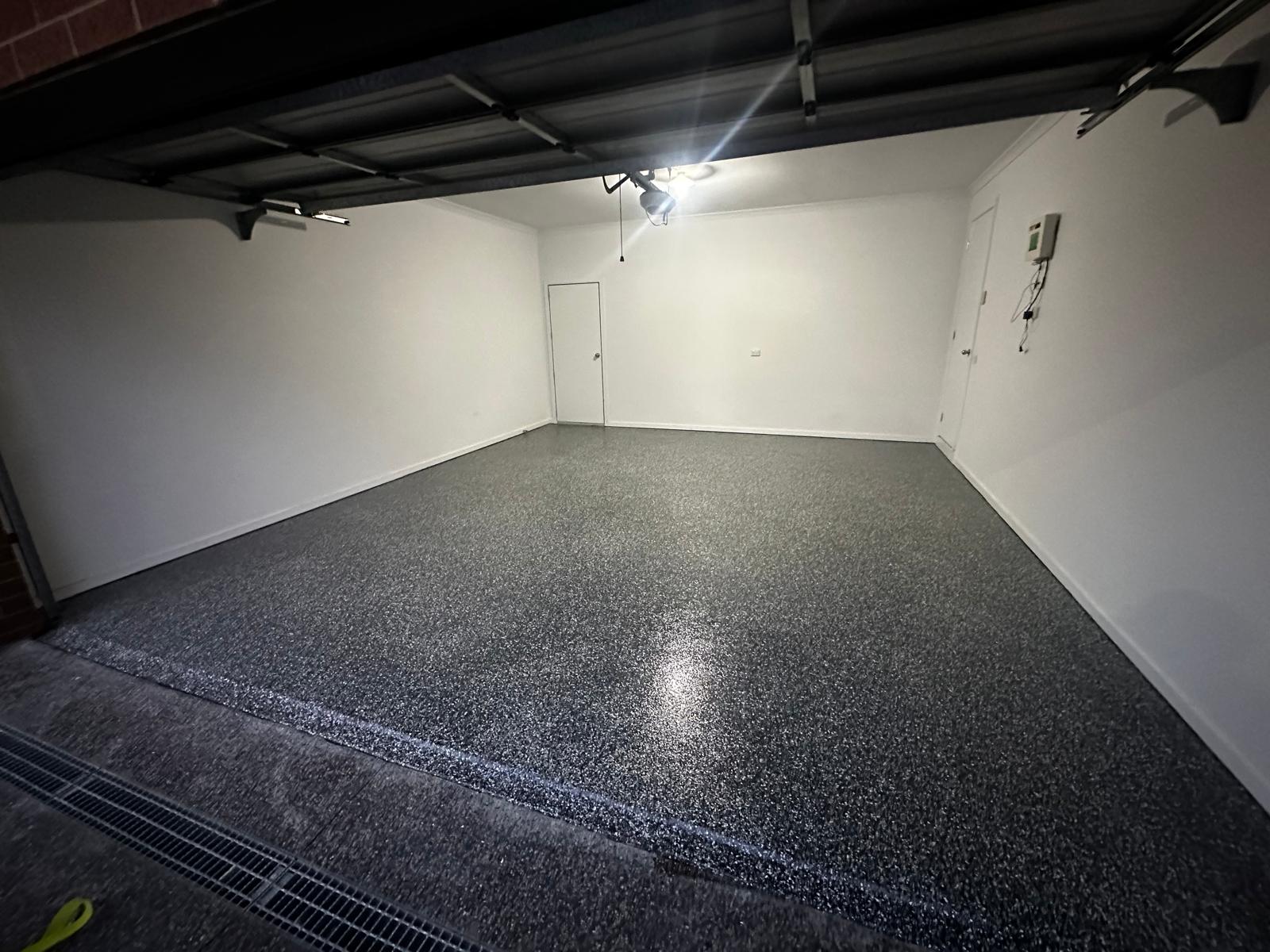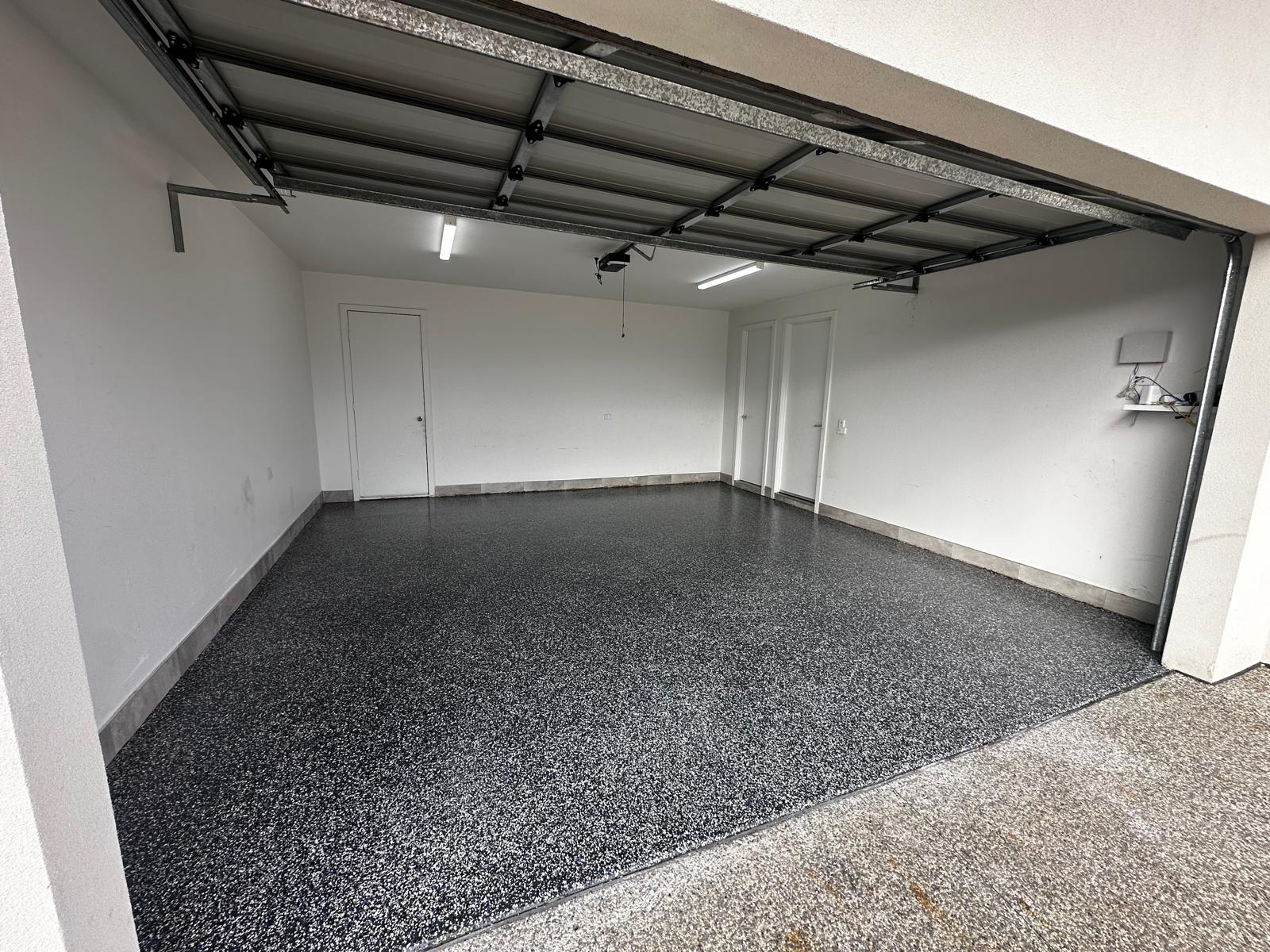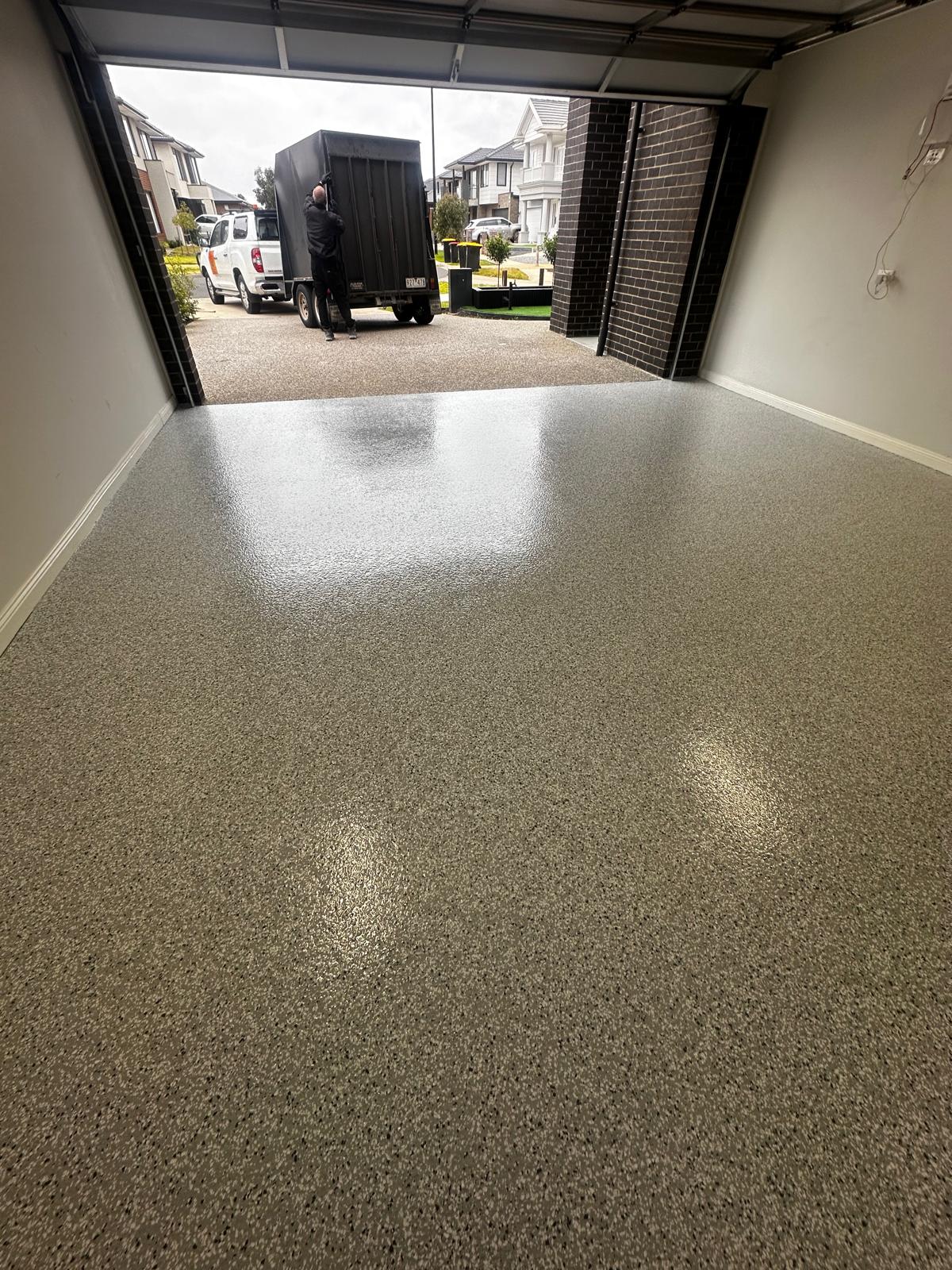
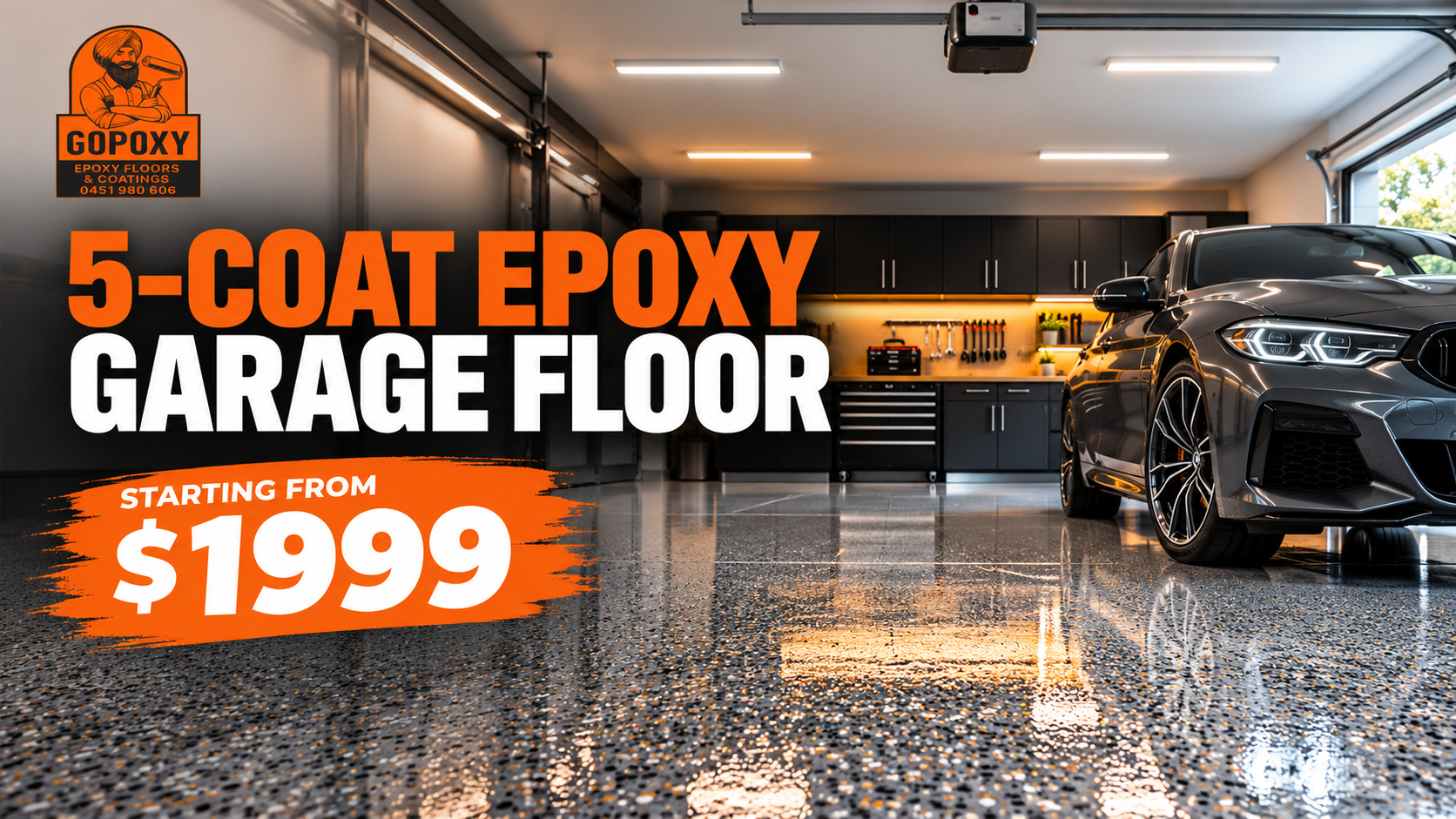
Ask three companies to quote a garage floor and you will get three very different numbers with almost no explanation of what separates them. One says $900. One says $1,999. One says $4,000. All three describe it as an "epoxy flake floor".
The difference is rarely the brand of resin. It is almost always how many coats go down, and what the final one is made of.
A five-coat system sits at the top end of what is normally installed in a domestic garage. Below is what the five layers actually are, why the build takes three days rather than two, what it costs in Melbourne, and — the part most articles on this subject skip — when a cheaper floor is the more sensible purchase.
The short answer
A 5-coat epoxy garage floor is a five-layer flake system: penetrating primer, pigmented base coat with flake broadcast into it, clear lock coat, clear build coat, and a UV-stable polyaspartic topcoat. It finishes around 1.5–2mm thick against roughly 0.3mm for a DIY kit, takes about three days, and starts from $1,999 in Melbourne. Preparation still matters more than coat count.
What the five coats actually are
"Five coats" only means something if the five layers do five different jobs. In a properly specified system, they do.
Coat 1 — penetrating epoxy primer
A thin, low-viscosity primer that soaks into freshly ground concrete rather than sitting on top of it. Everything above depends on this layer, because this is where the floor is mechanically locked to the slab. A system with no dedicated primer is asking its colour coat to do two jobs at once, and it does neither as well.
Coat 2 — pigmented epoxy base coat, with flake broadcast in
The body of the floor: a thick, coloured epoxy, rolled on and then immediately broadcast with vinyl flake while still wet, so the chips key into the resin instead of resting on the surface. The term to listen for is broadcast to rejection — chips thrown until the surface will not take any more. Partial broadcast is cheaper, and it shows as thin or patchy areas once the floor is finished.
Coat 3 — clear lock coat
Once the base has cured, the floor is scraped back to knock down flake edges standing proud, then a clear epoxy lock coat encapsulates the chips and fills the gaps between them. Skipping this stage produces a floor that feels like coarse sandpaper and traps dirt in every crevice.
Coat 4 — clear build coat
A second clear epoxy layer, there purely for thickness. It levels the flake texture into a smooth, continuous surface and gives the floor its depth.
This is also the coat most commonly dropped to reach a cheaper price, and it is the one that determines how much abrasion the floor takes before wearing through to the colour beneath. A quote that jumps from "base coat" straight to "topcoat" is a four-coat system at best.
Coat 5 — polyaspartic topcoat
The wear layer, and the most consequential of the five. Polyaspartic is a different chemistry from epoxy: harder, more chemical resistant, and crucially UV-stable. Epoxy left as a final coat ambers and yellows wherever sunlight reaches it, which in a garage means the strip just inside the door.
The logic is straightforward — the layer absorbing all the wear should be the toughest material in the system rather than the cheapest. The reasoning is set out in detail in why concrete sealers are not suitable as epoxy topcoats.
Why coat count changes the floor
Thickness is not a marketing abstraction. It is measurable, and it decides how long a floor survives real use.
| System | Coats | Typical build | Realistic life |
|---|---|---|---|
| DIY roll-on kit | 1–2 | 0.2–0.3mm | 1–3 years |
| Budget trade floor | 2–3 | 0.5–0.8mm | 3–6 years |
| 5-coat flake system | 5 | 1.5–2mm | 10+ years |
A floor five to eight times thicker does not merely last proportionally longer — it behaves differently. It bridges minor imperfections in the slab, resists point loads from jack stands and dropped tools, and takes far longer to abrade through the clear layers into the pigment.
But preparation beats coat count every time
This is the part a company selling a premium system has little incentive to mention.
Five coats over a badly prepared slab will still fail. It will fail more expensively, and it will take sheets of resin with it when it goes.
Adhesion is binary. A floor is either bonded to sound concrete or it is not, and no quantity of material on top changes that. A well-prepared two-coat floor will comfortably outlive a five-coat floor laid over a slab that was dirty, sealed or never ground.
Which is why the preparation question matters more than the coat count question. Diamond grinding removes the weak laitance layer at the top of the slab and opens the pores so primer can key in. Acid etching — what most DIY kits supply — roughens the surface slightly, leaves residue behind, and cannot remove oil contamination at all. The comparison is covered in diamond grinding vs acid etching.
So the honest hierarchy runs: preparation first, topcoat second, coat count third. With the first two right, five coats is a genuine upgrade. With them wrong, it is an expensive mistake.
How cheaper systems fail
Every shortcut in a garage floor eventually announces itself, and each one fails in a recognisable way. Anyone who has had a floor go bad will probably recognise theirs here.
Peeling in sheets
The coating lifts in large flakes, usually starting at the door or around a stain, with bare concrete visible underneath and resin curling away from it. This is always an adhesion failure: the slab was not ground, or was coated over a sealer, or had oil in it. There is no meaningful repair — the floor has to come off.
Hot tyre pickup
Circular patches lift where the tyres sit. Warm rubber grips a coating that is too thin or not fully cured and pulls it away as the car moves. Near-universal with DIY kits, and the most common reason a floor gets redone.
Yellowing and ambering
A white or light grey floor turns a dirty cream, worst in the strip where sun comes through the door. This is epoxy used as a final coat reacting to UV. Cosmetic rather than structural, but it cannot be cleaned off — the only fix is recoating with a UV-stable product.
Wearing through to colour
The clear coats abrade away in the traffic lane until the pigmented layer is exposed and the flake begins to shed. This is what a missing build coat looks like two or three years in.
Rough, dirt-holding texture
Flake edges left standing proud because the floor was never scraped back and locked properly. It feels like coarse sandpaper, traps dirt in every gap, and is miserable to sweep.
A five-coat build with a polyaspartic topcoat over a properly ground slab addresses all five — though it is worth repeating that grinding prevents the first two, not the coat count.
Why it takes three days
A five-coat system cannot be compressed, because each layer has to cure before the next goes on. Applied too early, solvent gets trapped and the whole build is weakened.
Day one — preparation. The garage is cleared, the slab moisture tested and checked for existing coatings and contamination, then diamond ground. Cracks are cut out and filled, pitting and spalling patched, repairs ground flush. The floor looks worse at the end of day one than at the start, which is normal.
Day two — primer, base coat and flake. Primer into clean concrete. Once it has taken, the pigmented base coat is rolled on and flake broadcast to rejection while it is wet.
Day three — lock, build and topcoat. The floor is scraped back, then the clear lock coat, the clear build coat, and finally the polyaspartic topcoat.
Then the wait. Foot traffic at roughly 24 hours after the final coat, vehicles at roughly 72. Driving on a resin floor before it has cured is the most common way a good floor gets ruined, and it is entirely avoidable. Timings for other systems are in how long epoxy flooring takes.
What a proper quote is based on
A price given over the phone is a guess. Six things have to be established on site, because any of them can change the scope.
- Moisture. Slabs without an effective vapour barrier push moisture up through the concrete, which will eventually debond a coating from underneath however well it was applied.
- Existing coatings. Many garages have had something applied before, sometimes decades ago. Whether it stays or comes off changes the job substantially.
- Oil and fuel contamination. Resin will not bond through oil, and a stain that looks superficial has often soaked several millimetres deep.
- Cracks, and whether they are still moving. A static hairline crack is a simple fill. One that is still opening needs a different approach, because it will telegraph through anything laid over it.
- Pitting and spalling. Usually worst in the first metre inside the door, where water, grit and road salt get dragged in.
- The door threshold and fall. Where the coating terminates and which way water runs both affect how the edge looks and lasts.
On a new-build slab the list is shorter but not empty. Fresh concrete usually carries a curing compound that has to be ground off, and a slab under roughly 28 days old is generally too green to coat.
What a 5-coat epoxy garage floor costs in Melbourne
From $1,999 for a full five-coat flake system — not a stripped-back version of one.
| Garage | 5-coat system from | Time |
|---|---|---|
| Single garage | $1,999 | 3 days |
| Double garage | Quoted on site | 3 days |
| Triple / oversized | Quoted on site | 3–4 days |
What moves the figure is slab condition more than anything else: significant oil contamination, widespread spalling, an old coating that has to come off, or a slab that has moved and needs levelling. That is why the assessment happens before the price is fixed rather than after — a number agreed on site and put in writing should not change halfway through the job.
Costs for the standard build are in garage floor coating in Melbourne.
5-Coat Epoxy Garage Floor
From $1,999
Diamond grinding, crack repair, primer, pigmented base coat, flake broadcast to rejection, clear lock and build coats, and a UV-stable polyaspartic topcoat. Fixed price in writing. 5–10 year warranty.
Get a Free Quote — 0451 980 606
Mon – Sat, 7:00am – 6:00pm · Free on-site measure, no obligation
How it compares to the alternatives
A five-coat floor is not the only option, and it helps to see it against the others honestly.
| Option | Upfront | Durability | Worth knowing |
|---|---|---|---|
| 5-coat flake epoxy | From $1,999 | 10+ years | Seamless, repairable, UV-stable top |
| 2-coat trade floor | Lower | 3–6 years | Fine for light use, thinner build |
| DIY roll-on kit | $150–400 | 1–3 years | Acid etch only; hot tyre pickup common |
| Interlocking tiles | Mid | Varies | No prep needed, but dirt and water get underneath |
| Polished concrete | Higher | Very long | Needs a good slab; stains without sealing |
| Sealed bare concrete | Lowest | 2–5 years | Cheapest tidy-up; still dusts and stains |
Tiles are the honest competitor for a storage garage — no preparation, no cure time, and they can be laid in an afternoon. The trade-off is that anything spilled runs underneath and stays there. Flake epoxy vs garage tiles goes through it properly.
Polished concrete is genuinely excellent where the slab suits it, but most suburban garage slabs were never poured with polishing in mind, and aggregate exposure can be unpredictable.
When a five-coat floor is overkill
The extra spend earns its place in some garages and not others.
It makes sense when:
- The garage gets daily vehicle use, particularly with heavier cars or utes
- It is a working space — tools, jack stands, a bench, a project car
- Sunlight reaches the floor through the door for part of the day, where UV stability genuinely matters
- It doubles as a gym, workshop or storage that gets used rather than filled
- The intention is to do the job once and not revisit it
It is probably not worth it when:
- The garage is used purely for storage with little or no vehicle traffic
- The house is being prepared for sale and the goal is a clean, presentable floor at sensible cost
- The slab is badly deteriorated — in which case resurfacing comes first, and spending more on coats is the wrong order of operations
A floor matched to how the garage is actually used is a better outcome than the most expensive option on the list.
Choosing flake colour and size
Flake does more than decorate. The chips create texture beneath the topcoat, which means grip, and they break up the visual field so dust, tyre marks and minor slab imperfections stop announcing themselves.
Charcoal, silver, black and white, and natural earth blends are the usual choices. Flake size changes the character too — larger chips read bolder and more textured, smaller chips finer and more uniform. Samples are worth seeing against your own walls and light rather than on a screen, since garage lighting flattens everything. More on flake epoxy flooring.
For a display space rather than a working garage, metallic epoxy is worth considering — though in a garage that sees actual use, flake is almost always the better call.
What a warranty actually covers
A warranty is worth exactly what it covers, so it pays to read the scope rather than the number of years.
A 5–10 year warranty on a system like this covers adhesion and product failure — delamination, peeling, hot tyre pickup and premature breakdown of the coating. That is the part within the installer's control, and the part that comes down to preparation and specification.
What no warranty covers is physical damage and misuse: dragging steel across the surface, welding or grinding sparks, strong acids or solvents, or driving on the floor before it has cured. Those are impact and chemical events rather than coating failures.
Slab movement sits in between. A slab that cracks structurally after installation is a concrete problem rather than a coating one — which is precisely why moisture and existing cracking should be assessed before a price is given. If an installer will not put the warranty in writing alongside the price, that in itself is informative.
Living with the floor
Maintenance is genuinely minimal. Sweep or blow it out, then mop with warm water and a pH-neutral detergent. No acids, no aggressive solvents, no close-range pressure washing.
Oil, fuel and tyre marks sit on the polyaspartic rather than soaking in, so they lift with a cloth and a mild degreaser instead of becoming permanent — the detail is in removing oil, fuel and tyre marks from epoxy.
And if something does get damaged years later, resin floors are repairable rather than replaceable: can epoxy flooring be repaired.
Where these floors are going in around Melbourne
Five-coat systems turn up most often in two situations: new estates where owners are finishing the garage before moving in, and established homes where a thirty-year-old slab is finally being dealt with properly.
Northern suburbs — Mickleham, Craigieburn, Kalkallo, Donnybrook, Beveridge, Wallan, Greenvale, Broadmeadows, Epping, Wollert, Essendon and Sunbury. Local write-ups: Mickleham, Craigieburn and Epping.
South eastern suburbs — Narre Warren, Berwick, Clyde, Clyde North, Cranbourne, Officer, Pakenham, Dandenong, Rowville and Springvale. See Narre Warren, Clyde, Officer and this Officer double garage case study.
Western suburbs — Point Cook, Tarneit, Truganina, Werribee, Melton, Caroline Springs, Taylors Hill, Rockbank and Woodlea. See Point Cook and Tarneit.
Eastern suburbs — Heidelberg, Templestowe, Doncaster, Box Hill, Glen Waverley, Mount Waverley, Kew and Bulleen. See this three-car garage case study in Heidelberg.
The same systems scale up into commercial spaces, and driveways and alfresco areas are usually a concrete sealing job rather than an epoxy one.
Five questions worth asking any installer
Whoever ends up doing the work, these separate a real quote from a cheap one:
- Will the slab be diamond ground or acid etched? If the answer is etched, or vague, stop there.
- How many coats, and what is each one? A real answer names the primer, the base, the clears and the topcoat.
- What is the topcoat? Epoxy will yellow in sunlight. Polyaspartic will not.
- Is the flake broadcast to rejection? Partial broadcast is cheaper and it shows.
- What happens if the slab is worse than expected? It should be assessed before the price is fixed, not after.
A longer version of this checklist is in 7 signs your garage floor needs epoxy flooring.
Frequently asked questions
What is a 5-coat epoxy garage floor?
A five-layer flake system: a penetrating epoxy primer, a pigmented epoxy base coat with vinyl flake broadcast into it, a clear lock coat that encapsulates the flake, a clear build coat for thickness, and a polyaspartic topcoat as the final wear layer. Each layer does a different job.
How much does a 5-coat epoxy garage floor cost in Melbourne?
From $1,999. The final figure depends on garage size and the condition of the slab, and is fixed in writing before we start.
Why is it more expensive than a standard epoxy floor?
Because there is more material and more labour in it. Five coats means five separate application stages with cure time between them, a total build several times thicker than a roll-on kit, and a polyaspartic wear layer that costs considerably more than epoxy.
Is a 5-coat system actually better, or is it just marketing?
The thickness and the topcoat are real differences you can measure. A thicker build takes more abrasion before it reaches colour, and a polyaspartic topcoat resists UV and chemicals better than epoxy. That said, coat count alone guarantees nothing — five coats over an unprepared slab will still fail.
Does coat count matter more than preparation?
No, and this is the most important thing on this page. Preparation decides whether a floor lasts. Coat count decides how much wear it takes once it is bonded properly. A two-coat floor on a correctly ground slab will outlive a five-coat floor on a dirty one.
How thick is the finished floor?
A five-coat flake build typically finishes around 1.5mm to 2mm, depending on flake size and how much the lock and build coats are loaded. A DIY roll-on kit is usually around 0.2mm to 0.3mm.
How long does the job take?
Usually three days for a five-coat system, because each layer needs to cure before the next goes on. Foot traffic around 24 hours after the final coat, vehicles around 72.
Why does it take longer than a standard floor?
Cure time between coats. You cannot rush it — applying the next layer before the one beneath has set properly traps solvent and weakens the whole build.
What is polyaspartic and why use it on top?
Polyaspartic is a resin related to polyurethane. It is more UV-stable than epoxy, so it does not yellow, and it is harder and more chemical-resistant. Using it as the final coat means the layer taking all the wear is the toughest one in the system.
Will it yellow in sunlight?
The polyaspartic topcoat is UV-stable, so no. Epoxy used as a final coat will amber over time where sun reaches it, which is one of the main reasons the topcoat is a different product.
Will hot tyres lift it?
Not on a correctly prepared and fully cured five-coat floor. Hot tyre pickup comes from poor preparation, thin build or driving on the floor before it has cured.
Does the slab still need grinding?
Always. Diamond grinding removes the weak top layer of the slab and opens the pores so the primer can bond. No number of coats compensates for skipping it.
Can you put it over an existing coating?
Sometimes, but it has to be assessed. If the existing coating is sound and compatible it can be mechanically abraded and coated over. If it is lifting or unknown, it comes off first.
Can I choose the flake colour?
Yes. Charcoal, silver, black and white, and earth blends are the most common. Flake size also affects the look and the final texture, and we bring samples to the quote.
Is it slippery?
Flake creates texture under the topcoat, so it has more grip than smooth sealed concrete. If slip resistance matters, a fine aggregate can be added to the final coat.
How long will a 5-coat floor last?
In domestic use, well over a decade, and the extra build means it takes longer to wear through to colour. It carries a 5 to 10 year warranty depending on specification.
How do I clean it?
Sweep, then mop with warm water and a pH-neutral detergent. No acids, no strong solvents, no close-range pressure washing. Oil and tyre marks lift easily off the topcoat.
Does the garage need to be empty?
Yes, completely clear, including shelving and anything mounted low on the walls. You will need to park elsewhere for about three days after the final coat.
Which areas do you cover?
All of Melbourne from our base in Mickleham — Craigieburn, Kalkallo, Donnybrook, Greenvale, Epping and Wollert in the north; Narre Warren, Berwick, Clyde, Cranbourne, Officer and Pakenham in the south east; Point Cook, Tarneit, Werribee and Melton in the west; and Heidelberg, Doncaster, Box Hill and Glen Waverley in the east.
How do I get a quote?
Call 0451 980 606 or use the contact form. We measure the garage, test the slab for moisture, check for staining and cracking, show you flake samples and give you a fixed price. Free, with no obligation.
Seeing the work before you commit
Worth judging any contractor on finished floors and on what the slab looked like beforehand, rather than on stock photography:
- Google Business Profile — customer reviews and recent jobs
- Facebook — completed garages across Melbourne
- Instagram — work in progress, including grinding and repair stages
- WhatsApp — send a photo of a slab for a rough idea
The grinding photos are the useful ones. Anyone can photograph a finished floor; far fewer will show the slab it started as.
GoPoxy has completed 2,000+ projects across Melbourne since 2020. More about GoPoxy, or background on epoxy flooring in Melbourne.
Planning an epoxy floor in Melbourne?
Book a free on-site inspection and get a fixed written quote — no obligation.