
Pakenham sits at the far end of the south-east corridor, and that one fact shapes almost everything about getting a garage floor done here.
It is far enough out that a lot of Melbourne flooring contractors treat it as the edge of the map. Quotes take a week to arrive. Travel gets quietly folded into the price. Second visits turn into phone calls and photos. Plenty of Pakenham homeowners end up buying a DIY kit from Bunnings instead, and then calling someone properly two years later when it peels.
This covers what garage epoxy flooring in Pakenham actually involves — what it costs, why the township and the estates need different preparation, and how to tell a real quote from a cheap one.
The short answer
Garage epoxy flooring in Pakenham starts around $1,400 for a single garage and $2,400 for a double, including diamond grinding, crack repair, flake broadcast and a clear topcoat. It is a two-day job, with foot traffic at 24 hours and vehicles at 72. Pakenham has both new estate slabs and older township slabs, and the two need quite different preparation — but every slab gets ground either way.
Two kinds of slab in one suburb
Pakenham has large newer estates sitting alongside a much older township, which means a flooring contractor working here sees both ends of the spectrum, often in the same week.
Estate slabs
Newer garages look immaculate, and that is exactly what causes the problem. People assume a clean slab needs little preparation. In fact almost every new slab carries a curing compound or sealer applied during construction, and resin will not bond through it. It looks like a perfect surface and behaves like a sheet of plastic.
There is also a timing issue. Concrete under roughly 28 days old is still releasing moisture and is generally too green to coat. On a brand-new build it is worth asking when the slab was poured before anyone books a date.
Township slabs
Older Pakenham garages bring the opposite set of issues: oil staining where the engine has sat for twenty years, hairline cracking, pitting inside the roller door, and a surface that has worn down to a layer that dusts constantly.
None of that rules out a coating. It is simply work that has to happen first — and it is the work that gets skipped when someone quotes from a photo. The upside is that a properly ground older slab often bonds better than a new one, because there is no curing compound left to interfere.
Different problems, same answer: the slab gets diamond ground either way.
What goes wrong out here specifically
Because Pakenham is at the end of the line, two patterns show up more than they should.
DIY kits. When getting a trade quote feels like hard work, a $300 roll-on kit looks reasonable. Those kits rely on acid etching rather than grinding, and they go down at roughly 0.2–0.3mm. The usual result is hot tyre pickup within a couple of summers — circular patches lifting where the tyres sit, because warm rubber grips a thin, under-cured coating and pulls it off. Redoing a failed DIY floor costs more than doing it properly the first time, because the old coating has to come off before anything else can happen.
Whoever turned up. The second pattern is accepting the only contractor who returned a call, without asking what the system actually is. The questions further down this page take about two minutes and will tell you most of what you need to know.
Why the slab has to be ground
If there is one technical point worth taking from this, it is this one.
The top couple of millimetres of any concrete slab is the weakest part of it — fine particles and water that rose to the surface during the pour, known as laitance. Coat over that and the floor is only as strong as the crumbly layer it is stuck to. Diamond grinding removes it mechanically and opens the pores so primer can key into sound concrete underneath.
Acid etching, which is what DIY kits supply, does not do this reliably. It roughens the surface slightly, leaves residue behind, and cannot remove oil contamination at all. The full comparison is in diamond grinding vs acid etching.
Grinding runs with industrial dust extraction attached, which matters in an attached garage where the door into the house is right there.
Which finish suits a Pakenham garage
Flake — the usual answer
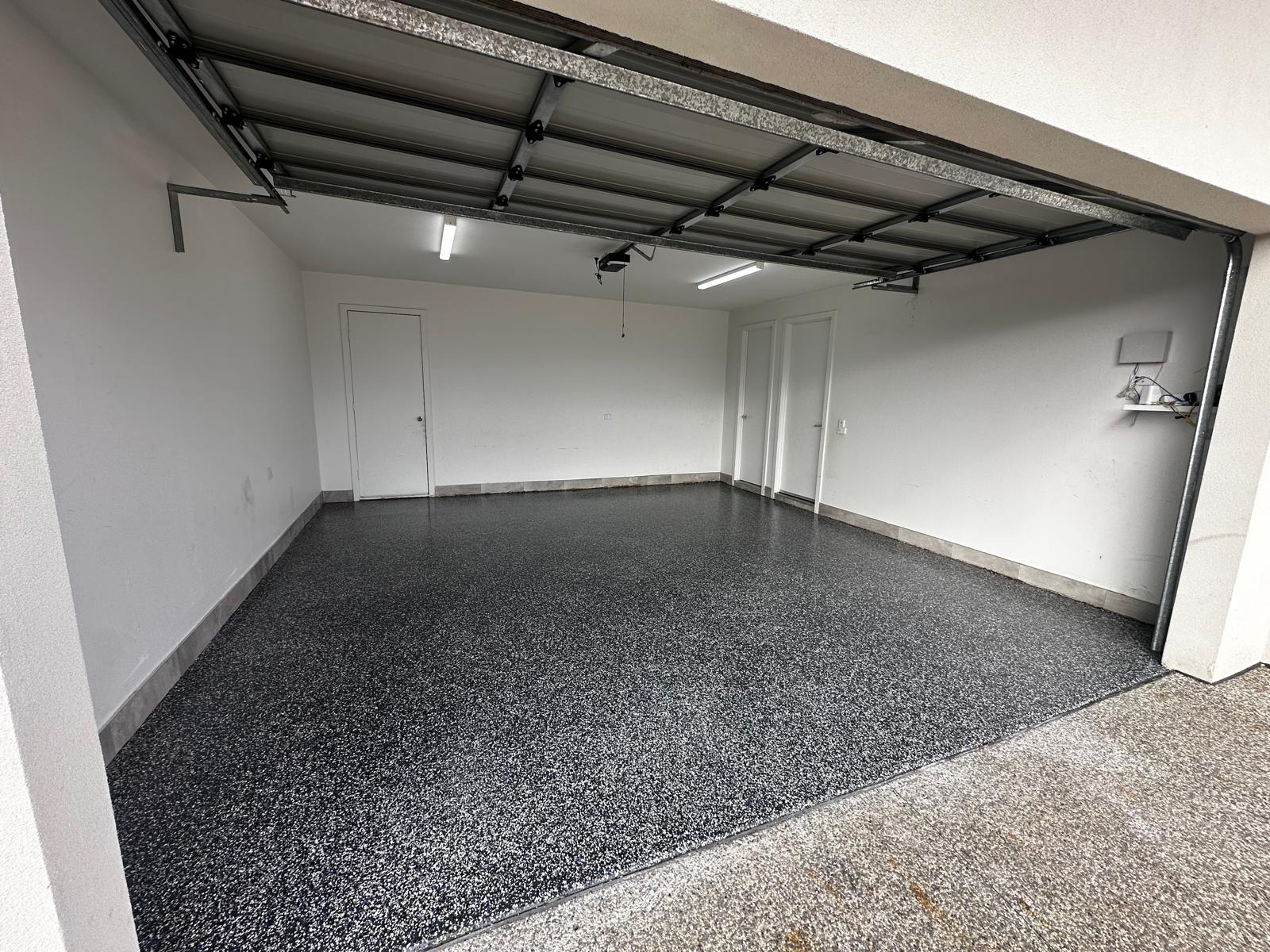
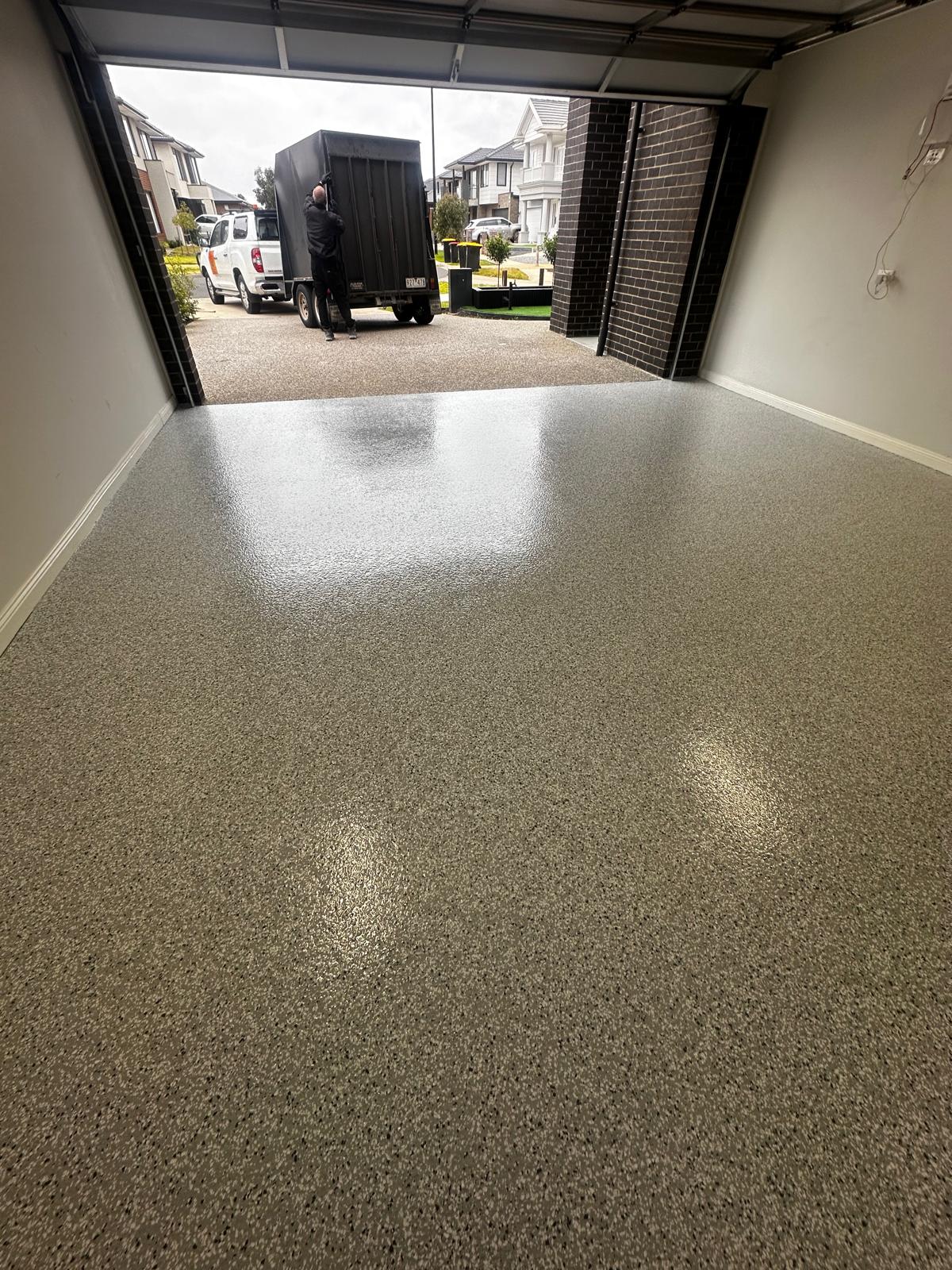
Coloured vinyl chips broadcast into the base coat while it is wet, then sealed under a clear topcoat. Flake hides dust and tyre marks, adds grip underfoot, and disguises minor imperfections in the slab beneath — which is why it suits the older township garages particularly well. Charcoal and silver blends are the most common choices. More on flake epoxy flooring, and if you are weighing up clip-together tiles instead, flake epoxy vs garage tiles sets out the trade-offs.
Metallic — for display rather than work
Metallic epoxy gives a deep, marbled, high-gloss finish. It looks superb in a display garage or an interior space, but in a garage that gets used it shows every speck of dust and is less forgiving when wet.
Solid colour
Clean and simple, and the least forgiving of the three — it shows dust and any unevenness in the slab. Reasonable on a newer estate floor, rarely the right call on an older township slab.
What it costs in Pakenham
| Garage | From | Typical time |
|---|---|---|
| Single garage | $1,400 | 2 days |
| Double garage | $2,400 | 2 days |
| Triple / oversized | Quoted on site | 2–3 days |
Those figures include diamond grinding, crack repair, primer, base coat, full flake broadcast and the clear topcoat. What moves the price is slab condition rather than postcode — significant oil contamination, widespread spalling, an old coating that has to come off, or a slab that has moved and needs levelling.
All of that gets assessed before the price is fixed, so nothing appears on the invoice that was not on the quote. For comparable worked examples nearby, see epoxy flooring costs in Officer and this double garage case study in Officer — the suburb immediately up the highway.
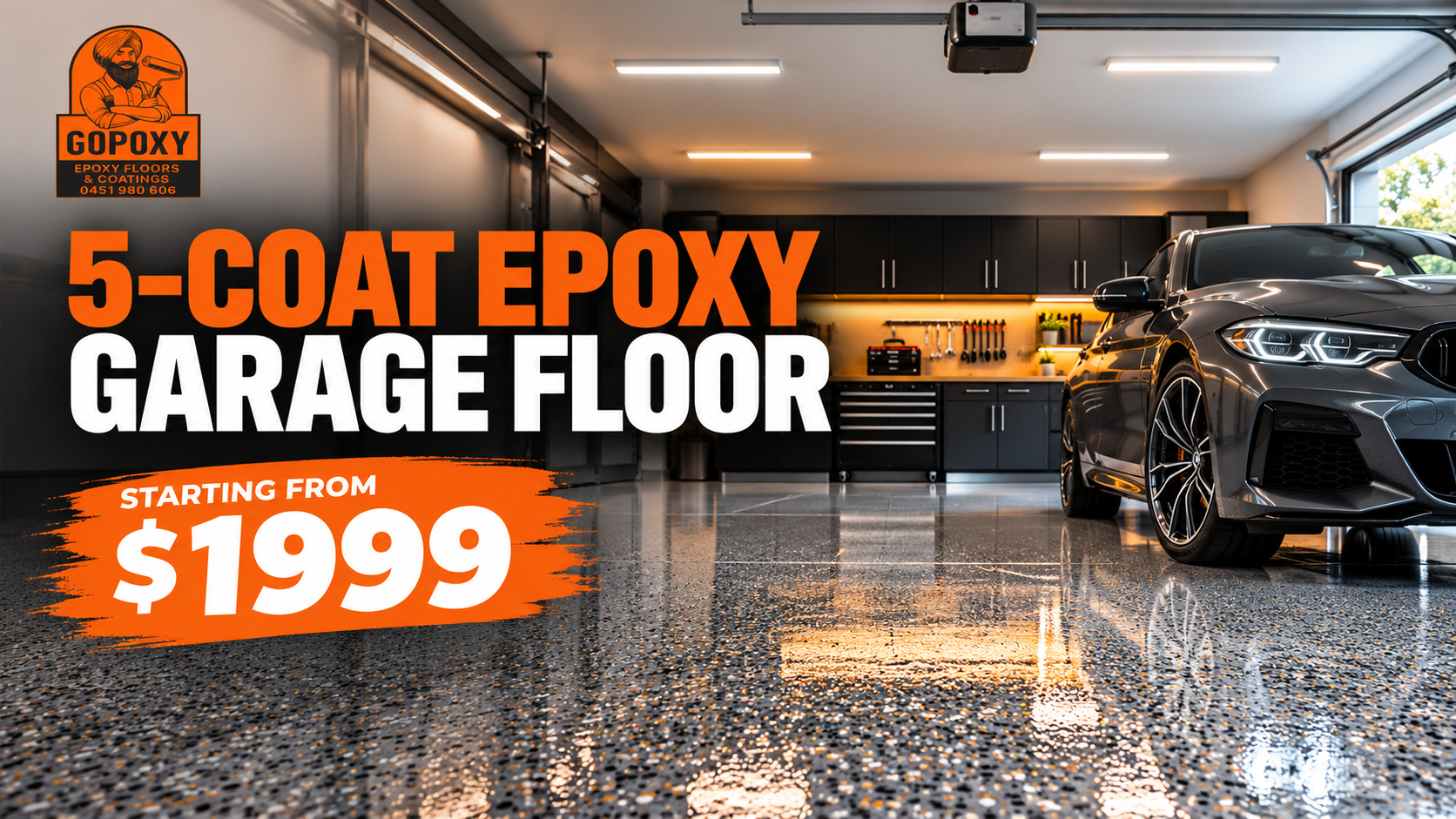
A five-coat premium build is also available from $1,999 if the garage is a working space rather than storage: the 5-coat system explained.
The two days
Day one — preparation. Garage cleared, slab moisture tested and checked for existing coatings and contamination. Diamond grinding with extraction. Cracks cut out into a V, filled with resin repair compound and ground flush. Pitting and spalling patched. The floor looks worse at the end of day one than at the start, which is entirely normal.
Day two — coating. Primer into clean concrete, then the pigmented base coat with flake broadcast into it while wet. Once set, the floor is scraped back smooth and the clear topcoat goes on.
Then the wait. Foot traffic at roughly 24 hours. Vehicles at roughly 72. Driving on a resin floor before it has cured is the most common way a good floor gets ruined, and it is completely avoidable. Timings for other systems are in how long epoxy flooring takes.
Weather matters at this end of the corridor — resin cures more slowly in cold, damp conditions, so winter jobs get scheduled with that in mind. There is more on this in the best season for epoxy flooring in Melbourne.
The industrial side of Pakenham
Pakenham is no longer only estates and a township. The industrial precinct along the highway has grown steadily, and commercial enquiries from this area have been rising year on year.
That brings a different class of work:
- Warehouse epoxy flooring — forklift and racking duty, line marking
- Factory floor coatings — production areas, chemical exposure, safety colours
- Commercial epoxy flooring — retail, workshops and offices
Specification is the whole game in commercial work. A floor that suits a showroom will not survive a distribution centre, which is covered in parking heavy vehicles on epoxy floors. And the reasons industrial floors fail are almost always preparation reasons: why factory floors fail.
Looking after it
Maintenance is minimal. Sweep or blow it out, then mop with warm water and a pH-neutral detergent. No acids, no harsh solvents, no close-range pressure washing.
Oil, fuel and tyre marks sit on the topcoat rather than soaking in, so they lift with a cloth and a mild degreaser instead of becoming permanent — the detail is in removing oil, fuel and tyre marks from epoxy.
Hot tyre pickup, the failure people worry about most, comes down to preparation, build thickness and cure time rather than being an inherent property of resin floors: can hot tyres damage epoxy garage floors. And if something does get damaged years later, these floors are repairable rather than replaceable: can epoxy flooring be repaired.
Beyond the garage
Properties out here tend to have more outdoor concrete than inner-suburban homes, and a garage visit is a sensible moment to look at the rest of it:
- Concrete sealing — driveways, paths and alfresco areas
- Outdoor coatings — what works outside and what does not
- Concrete resurfacing — where a slab is past coating
- Concreting — new slabs, paths and extensions
- Residential painting — interiors and exteriors
- Tile removal — before a new interior floor
Everywhere else we cover
Pakenham sits on a regular south-eastern run, so there is usually a job in the area anyway — which is what keeps travel out of the price.
The south-east corridor — Pakenham, Officer, Beaconsfield, Berwick, Clyde, Clyde North, Cranbourne, Narre Warren, Dandenong, Rowville, Springvale, Clayton, Chelsea and Brighton. Local write-ups: Officer, Clyde and Narre Warren.
Northern Suburbs — Essendon, Pascoe Vale, Broadmeadows, Greenvale, Craigieburn, Mickleham, Kalkallo, Donnybrook, Beveridge, Wallan, Kilmore, Epping, Wollert, South Morang, Doreen, Thomastown, Bundoora, Plenty, Greensborough, Sunbury
Eastern Suburbs — Kew, Heidelberg, Templestowe, Bulleen, Doncaster, Box Hill, Warrandyte, Wantirna, Glen Waverley, Mount Waverley, Rowville, Malvern
Western Suburbs — Melbourne CBD, Port Melbourne, West Footscray, Melton, Caroline Springs, Taylors Hill, Taylors Lakes, Deanside, Deer Park, Fraser Rise, Rockbank, Woodlea, Aintree, Tarneit, Truganina, Point Cook, Werribee
Full details for this suburb are on the Pakenham epoxy flooring page, and there is background on epoxy flooring in Melbourne generally.
If a neighbour is considering the same work, it is worth having both quoted together — one site setup across two garages is cheaper for everyone, and that matters more the further out you are.
Five questions worth asking any installer
- Will the slab be diamond ground or acid etched? If the answer is etched, or vague, stop there.
- How many coats, and what is each one? A real answer names the primer, the base, the clears and the topcoat.
- What is the topcoat? Epoxy used as a final coat yellows in sunlight. Polyaspartic does not.
- Is the flake broadcast to rejection? Partial broadcast is cheaper and it shows.
- Is travel included, and is the price fixed? Worth asking directly at this end of the corridor.
A longer version of this checklist is in 7 signs your garage floor needs epoxy flooring, and costs across the board are in garage floor coating in Melbourne.
Frequently asked questions
Do you provide garage epoxy flooring in Pakenham?
Yes. Pakenham is part of our regular south-eastern run, along with Officer, Beaconsfield, Berwick, Clyde, Cranbourne and Narre Warren. Quotes are free, travel is included in the price, and we come to you.
How much does garage epoxy flooring cost in Pakenham?
A single garage starts around $1,400 and a double around $2,400, including diamond grinding, crack repair, flake broadcast and the clear topcoat. A premium five-coat build starts from $1,999. Slab condition is what moves the figure, not the postcode.
Do you charge extra for travelling out to Pakenham?
No. Pakenham sits on a run we do regularly, so travel is included rather than loaded onto the quote. Being at the far end of the corridor should not cost you more.
How long does the job take?
Two days for a standard single or double garage: grinding and repairs on day one, coating on day two. Foot traffic at around 24 hours and vehicles at around 72.
My garage is in one of the newer estates. Does it still need grinding?
Yes. New slabs almost always carry a curing compound or sealer from construction, and resin will not bond through it. A clean-looking slab is not a prepared slab.
How new is too new to coat?
Concrete under roughly 28 days old is still releasing moisture and is generally too green. On a new build it is worth checking when the slab was poured before booking a date.
My garage is in the older township and the slab looks rough. Can it be coated?
Almost always yes. Oil staining, hairline cracking, pitting and a dusty worn surface are all dealt with during preparation. An older slab that has been properly ground often bonds better than a new one.
Can oil stains be removed?
They have to be, because resin will not bond through oil. Contaminated areas are degreased and ground back, and deeply soaked patches sometimes need localised removal. This gets checked at the quote.
Will you fix cracks and pitting?
Yes. Cracks are cut out into a V, filled with resin repair compound and ground flush. Pitted and spalled areas are patched. On an older slab this is normal work rather than an extra.
I had a DIY kit fail. Can you go over it?
The old coating has to come off first, which is why redoing a failed DIY floor costs more than doing it properly the first time. We assess what is there before quoting.
Will hot tyres lift the coating?
Not on a correctly prepared and fully cured floor. Hot tyre pickup comes from thin build, poor preparation or driving on the floor too early — which is why DIY kits fail that way so often.
Flake or metallic for a garage?
Flake, in almost every case. Metallic looks superb but is a smooth high-gloss finish better suited to display spaces. In a working garage flake handles grit, water and tyre heat far better.
Does the garage need to be empty?
Yes, completely clear including shelving, the fridge and anything mounted low on the walls. You will also need to park elsewhere for about three days.
Do you do commercial and warehouse floors in Pakenham?
Yes. The industrial precinct along the highway has grown a lot, and warehouse, factory and commercial floor coatings are an increasing share of the work out here.
Is epoxy slippery when wet?
A flake finish under a clear topcoat has noticeably more grip than smooth sealed concrete, because the chips create texture. A fine aggregate can be added if slip resistance is a particular concern.
How do I clean it?
Sweep, then mop with warm water and a pH-neutral detergent. No acids, no strong solvents, no close-range pressure washing. That is the whole routine.
How long will it last?
A properly installed garage floor gives well over a decade of domestic use, and carries a 5 to 10 year warranty depending on the system. Preparation determines lifespan far more than the resin does.
Can you do the driveway too?
A driveway is a different job — it is UV exposed and better suited to sealing or resurfacing than standard epoxy. Both can be looked at during the same visit.
What if the slab turns out to be too far gone?
It happens occasionally. In that case resurfacing is the better answer, and that should be said at the quote rather than coating over a problem and leaving you with it.
How do I get a quote?
Call 0451 980 606 or use the contact form. We measure the garage, test the slab for moisture, check staining and cracking, show flake samples and give a fixed price in writing. Free, with no obligation.
Seeing the work before you commit
Judge any contractor on finished floors and on what the slab looked like beforehand, rather than on stock photography:
- Google Business Profile — customer reviews and recent jobs
- Facebook — completed garages across Melbourne
- Instagram — work in progress, including grinding and repair stages
- WhatsApp — send a photo of a slab for a rough idea
The grinding photos are the useful ones. Anyone can photograph a finished floor; far fewer will show the slab it started as.
Garage Epoxy Flooring in Pakenham
From $1,400
Diamond grinding, crack repair, primer, base coat, full flake broadcast and clear topcoat. Fixed price in writing, travel included, 5–10 year warranty.
Get a Free Quote — 0451 980 606
Mon – Sat, 7:00am – 6:00pm · Free on-site measure, no obligation
GoPoxy has completed 2,000+ projects across Melbourne since 2020. More about GoPoxy, or get in touch.
Planning an epoxy floor in Melbourne?
Book a free on-site inspection and get a fixed written quote — no obligation.