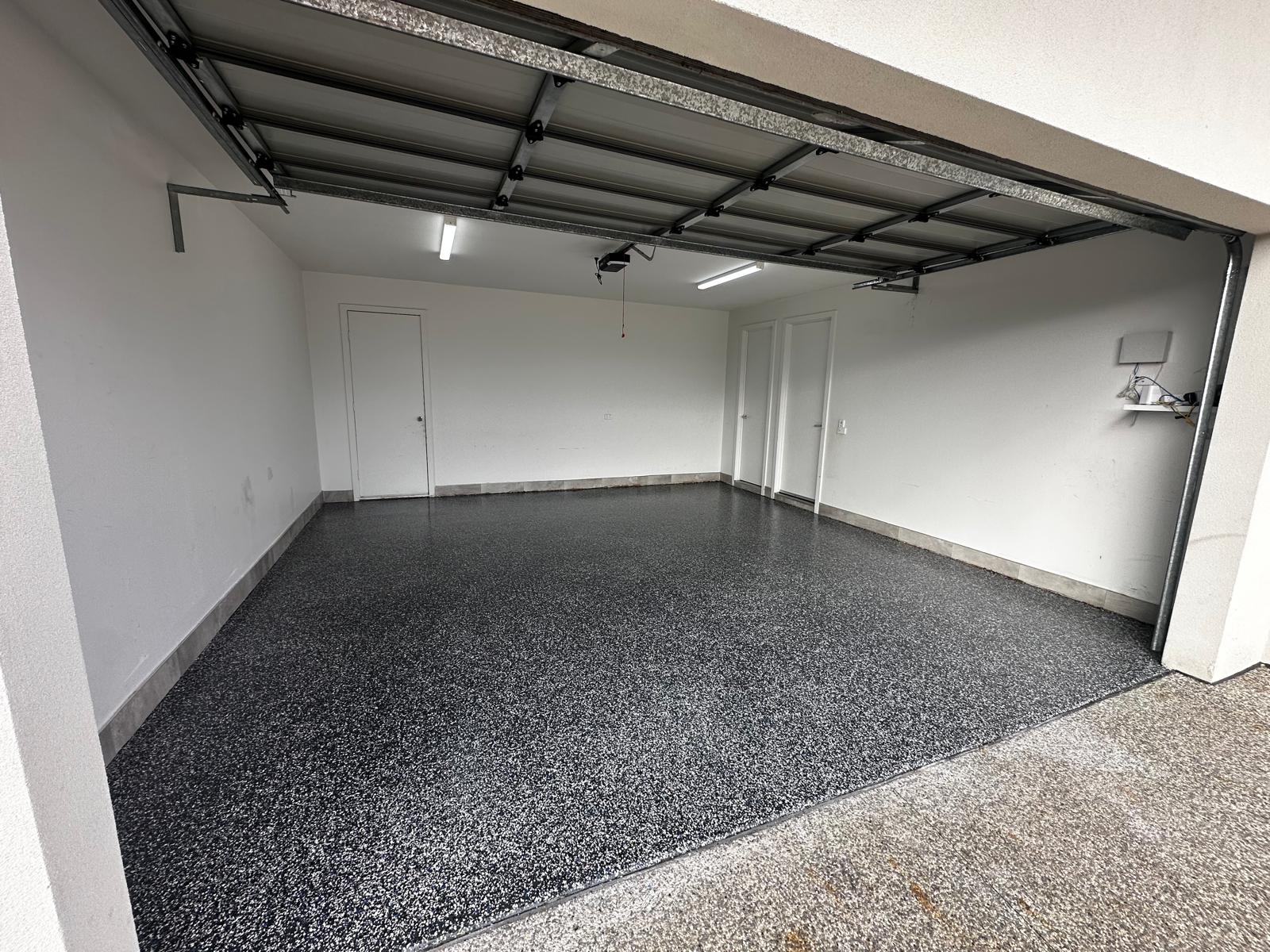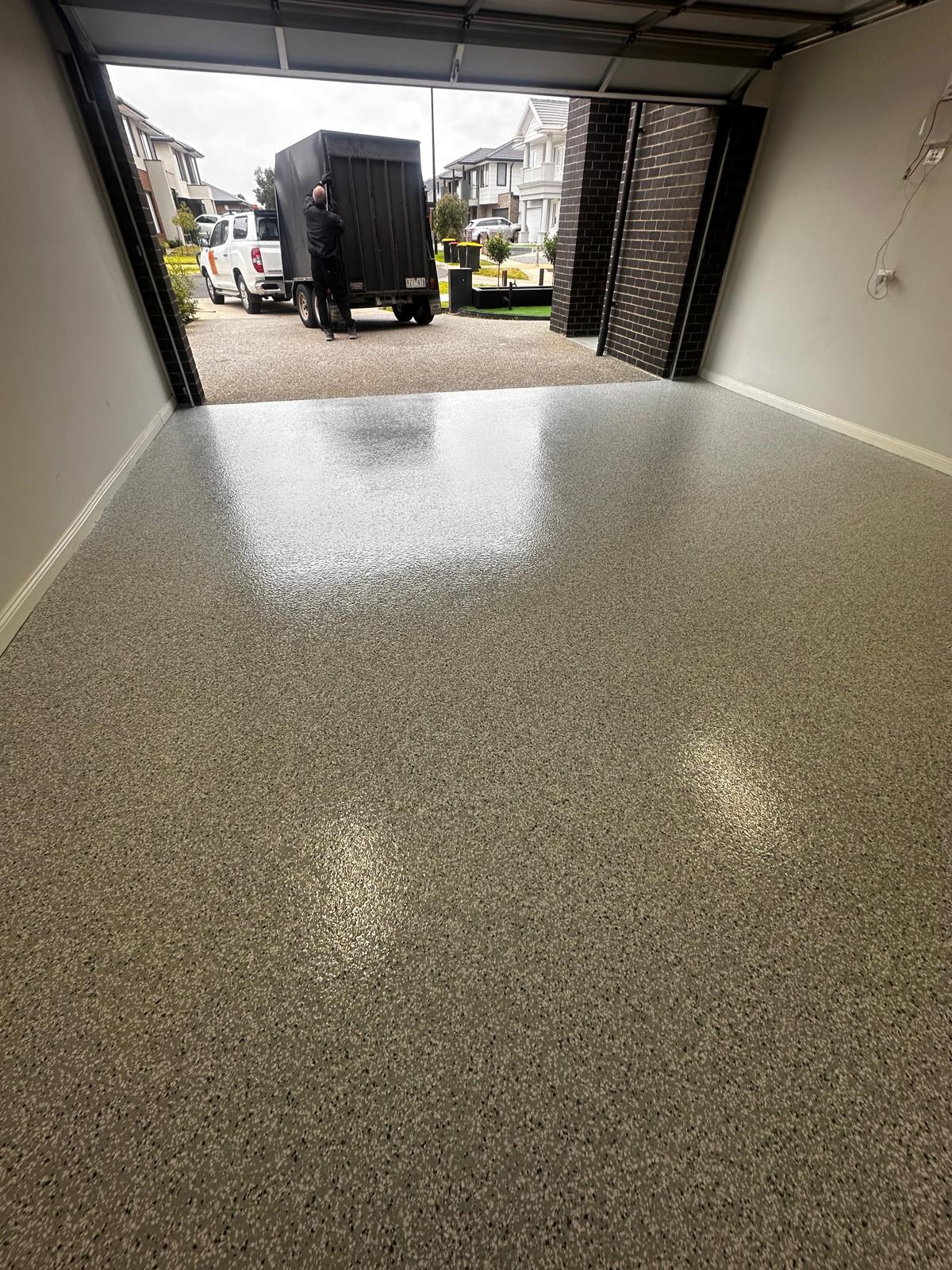
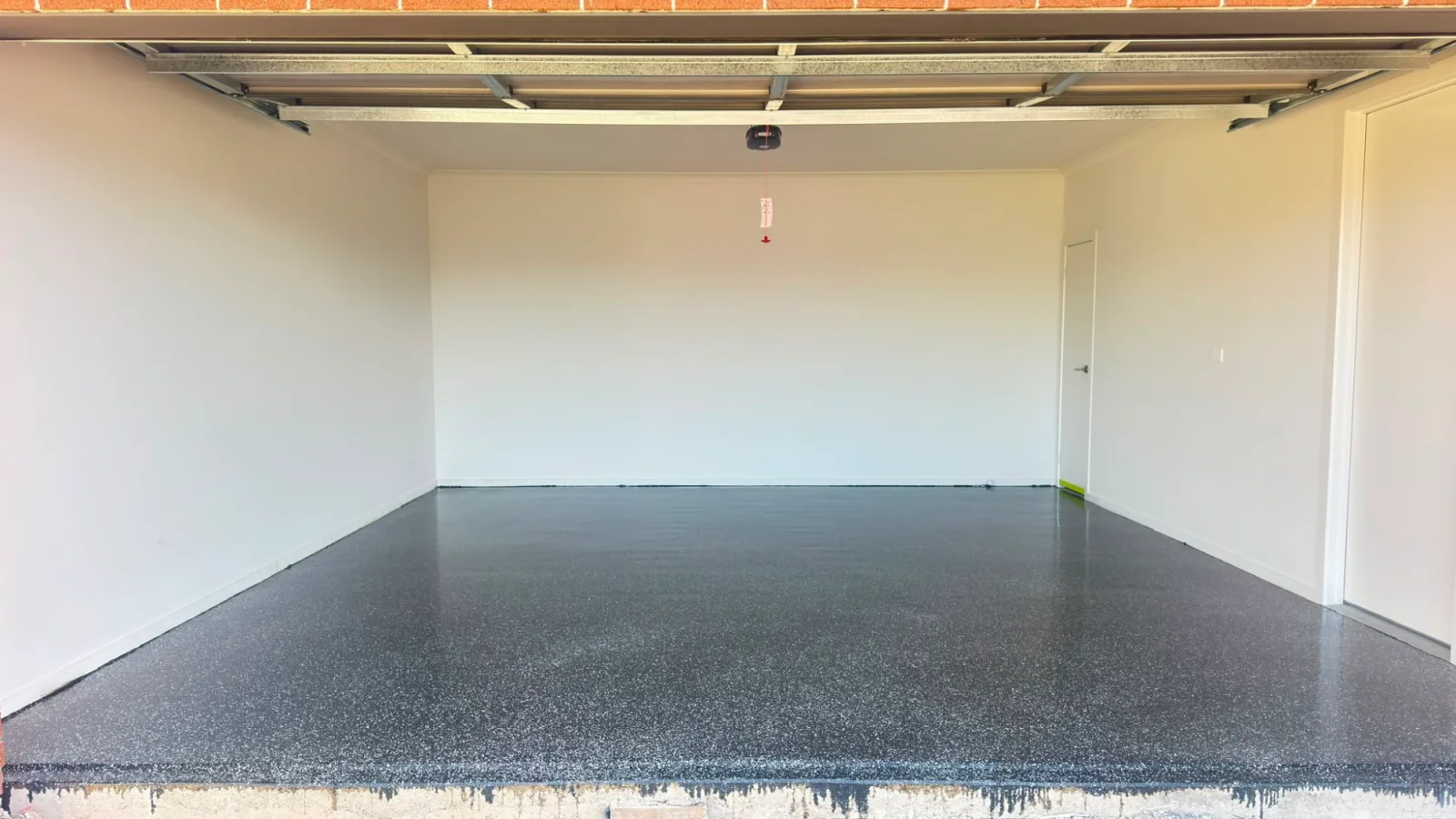
A new-build double garage in Officer, handed over with the slab in the state most builders leave it: sealed, splattered with paint, dusted with plaster and stained in a dozen places. Two days later it was a charcoal flake epoxy floor. Here is the whole job, including the parts that are usually left out of the photos.
The job at a glance
| Location | Officer, VIC 3809 (Cardinia Shire) |
|---|---|
| Space | Standard double garage, new build |
| System | Full flake epoxy — primer, base coat, flake broadcast, clear polyaspartic topcoat |
| Colour | Charcoal base, black / white / grey flake blend |
| Preparation | Diamond grinding with dust extraction, edge grinding, crack and joint repair |
| Time on site | Two days |
| Full cure | 72 hours before a car goes on it |
| Investment | From $2,400 for a standard double garage |
The brief
This was a new home in one of Officer's growth-corridor estates, still in that window between handover and moving in. The driveway had not been poured, the landscaping was bare dirt, and the garage was completely empty.
The owners wanted the floor done before the cars, the shelving and the boxes arrived — which is exactly the right instinct. A garage floor is one of the very few jobs on a new home that is genuinely easier, cheaper and less disruptive to do before you move in than after. Nothing has to be shifted, nothing has to be stored elsewhere for three days, and the crew has clear access to every square metre including the edges.
What we found at the measure
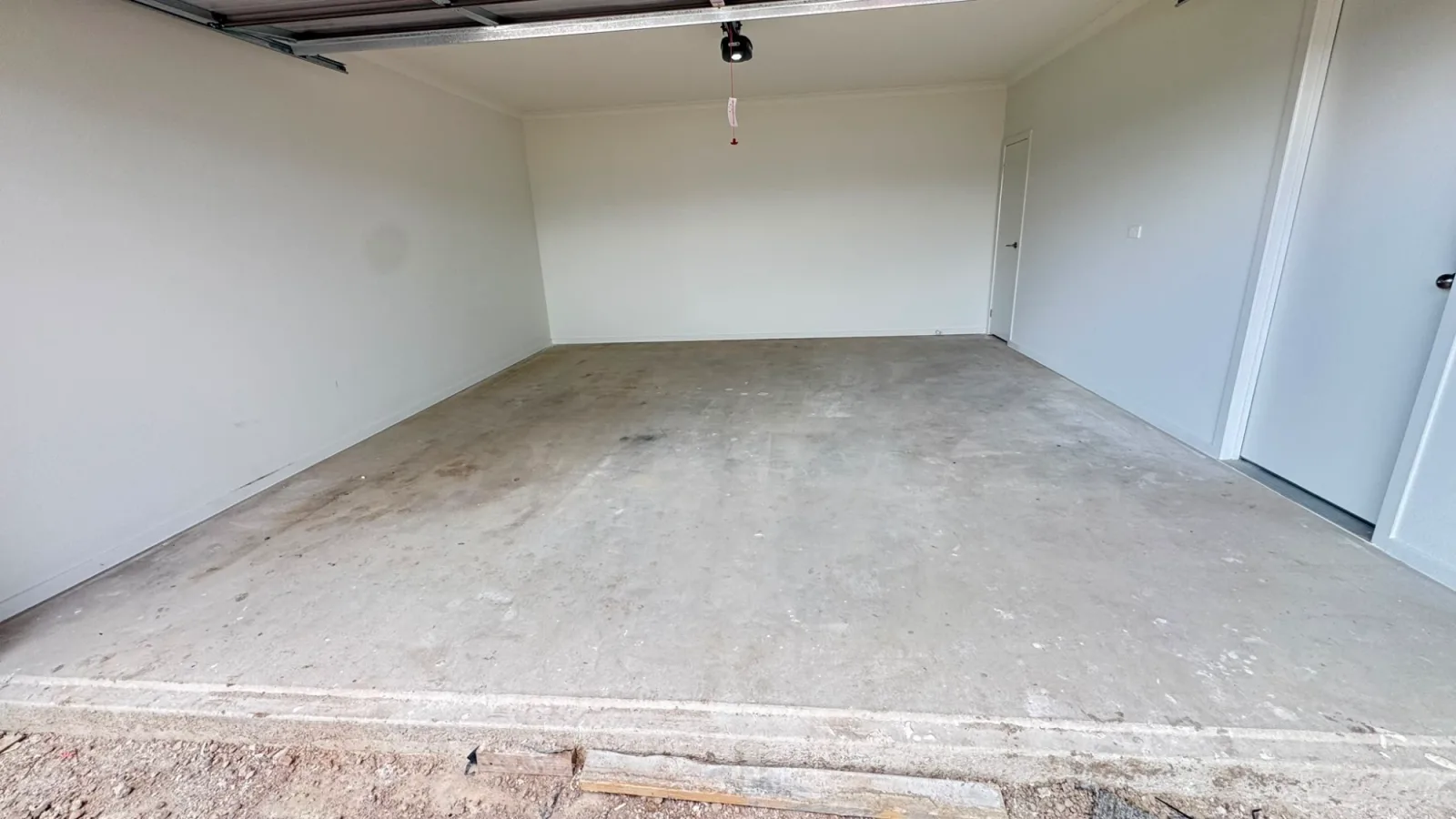
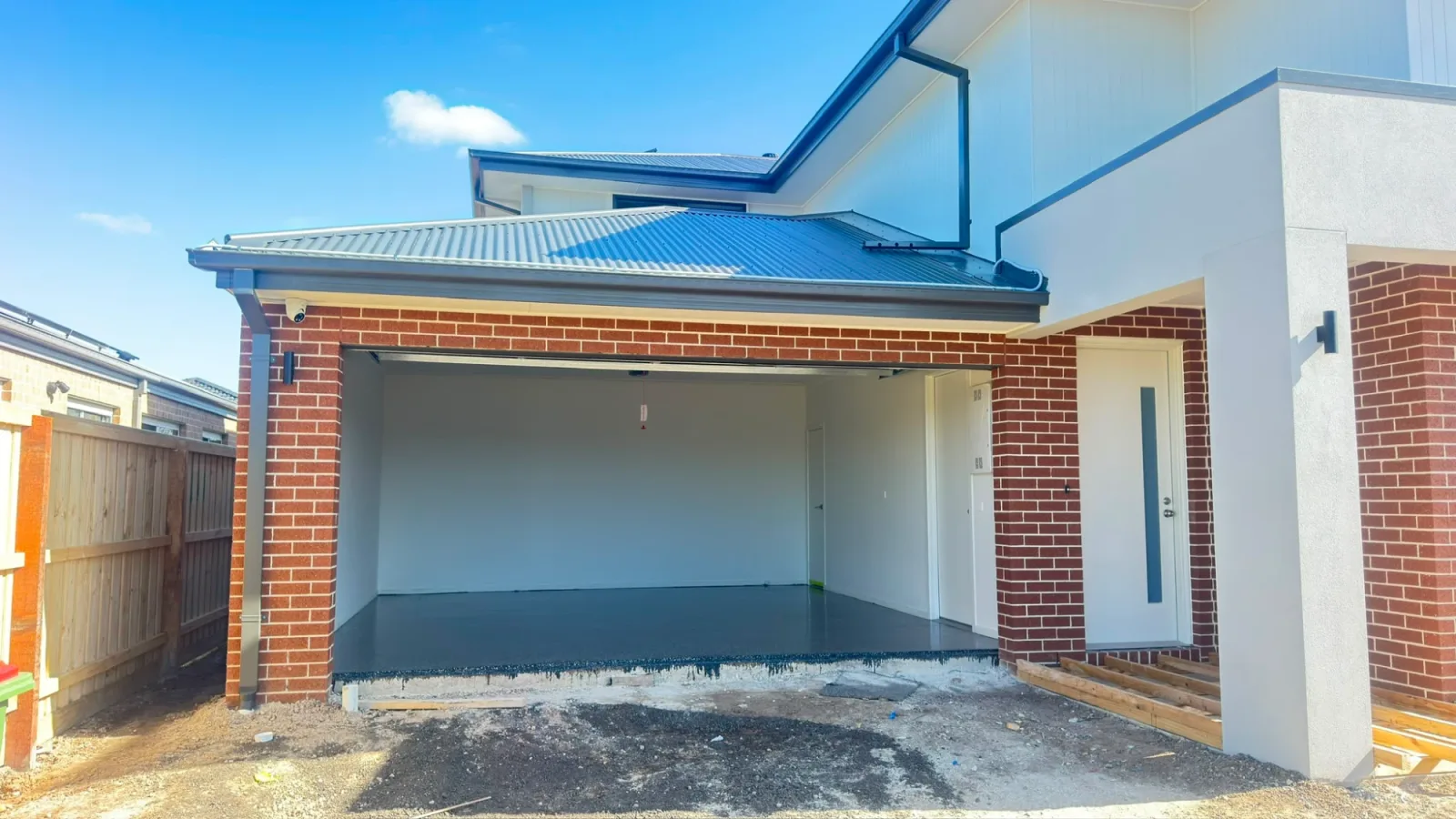
The photograph above is the slab exactly as it was handed over, and it is worth looking at properly because it is not unusual — it is what almost every new garage slab in Melbourne looks like on day one.
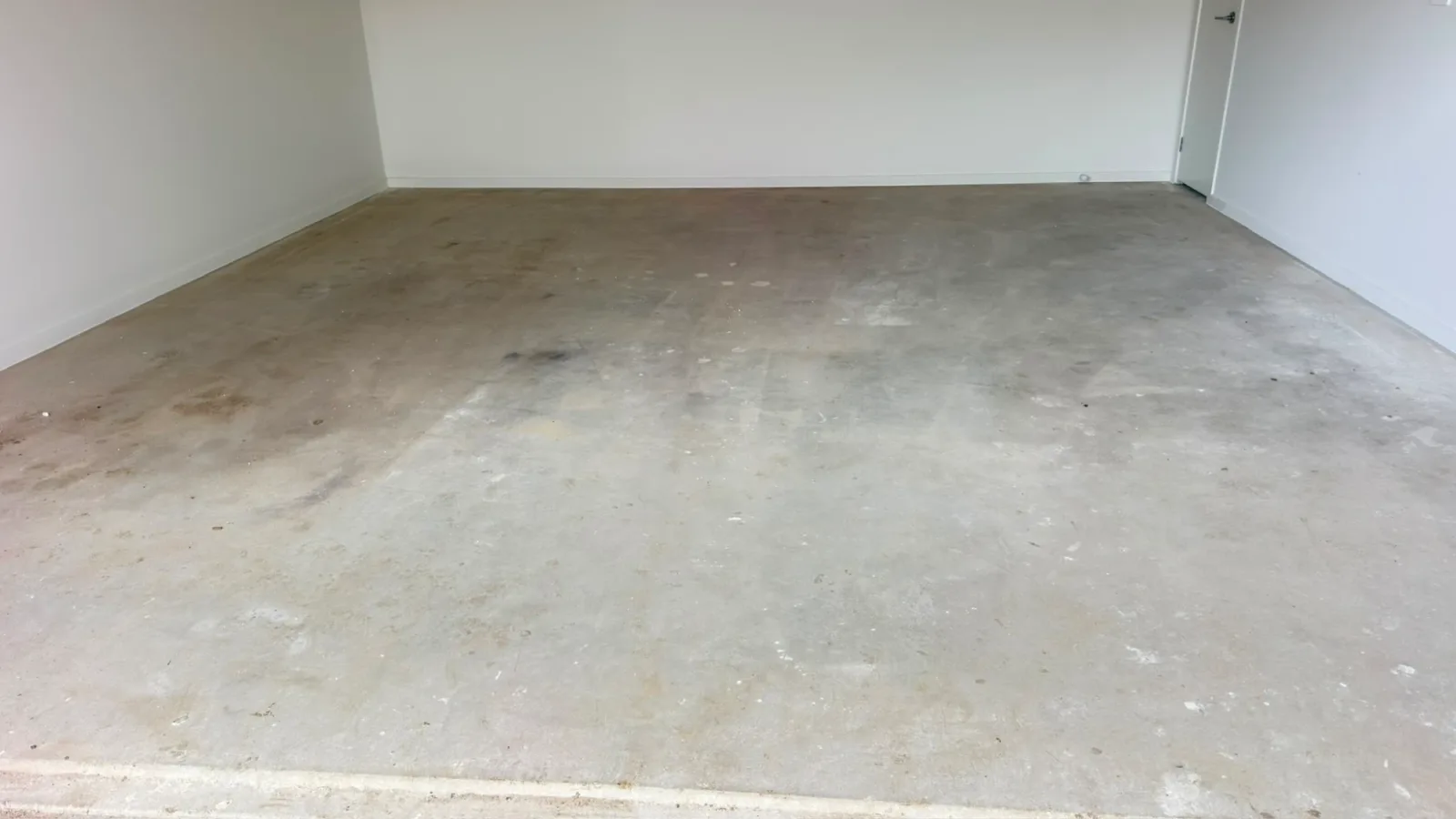
Four separate things were on that concrete:
- A builder's sealer. Invisible, applied at handover as a matter of course, and specifically formulated to stop things bonding to concrete. It is the single biggest reason coatings fail on new slabs — and the single biggest reason acid etching is useless here, because acid reacts with cement and simply cannot get through a sealer. That comparison is set out in full in diamond grinding vs acid etching.
- Paint and render splatter. Visible across the middle and near the walls. Every drop is a spot where a coating applied over the top would be bonded to paint, not to concrete.
- Plaster and construction dust, ground into the surface by trade traffic through the build.
- Rust and oil staining, the orange-brown marks near the left wall and the darker patches through the centre.
We also moisture tested before quoting. Officer sits on the same reactive clay as the rest of the south-east growth corridor, slabs there are young, and water moving up through concrete will push a coating off from underneath regardless of how good the surface preparation was. Twenty minutes of testing at the quote stage removes that risk entirely.
Day one — the part you pay for and never see
Preparation is the whole job. It is also the part that produces no photograph worth putting on a website, which is precisely why it is the first thing a cheap quote quietly removes.
Walls were masked to roughly 300mm, then the slab was diamond ground with the grinder coupled to an industrial dust extractor. The extraction matters more than people expect — a garage has an internal access door into the house, and grinding without extraction sends fine concrete dust straight through it.
Grinding took off the sealer, the paint, the plaster and the weak top skin of the concrete in a single pass, leaving an open, slightly abrasive profile for the primer to key into. Epoxy bonds mechanically, not chemically: it grips the texture the grinder creates. No texture, no bond, no matter how expensive the resin.
Then the edges. A planetary grinder cannot reach the last hundred millimetres against a wall, so the perimeter and the corners were done separately with an edge grinder. Skipping this is a common shortcut and it shows immediately — the floor lifts at the edges first, usually within the first year.
Cracks were routed out into clean channels, filled with a structural repair compound and ground back flush. The slab was vacuumed, tacked off, and primed late in the day so the primer could cure overnight.
Day two — colour, flake and topcoat
The charcoal base coat went down first, rolled out wet and even. Then the flake — black, white and grey — was broadcast into it to refusal, meaning it is thrown until the surface physically will not take any more.
That phrase is worth knowing, because it is where flake floors are most often cheapened. A light scatter uses less material, costs the installer less and looks fine on the day. Six months later the pattern is patchy and the base colour shows through where traffic wears it. Broadcasting to refusal gives the even, seamless spread visible below.
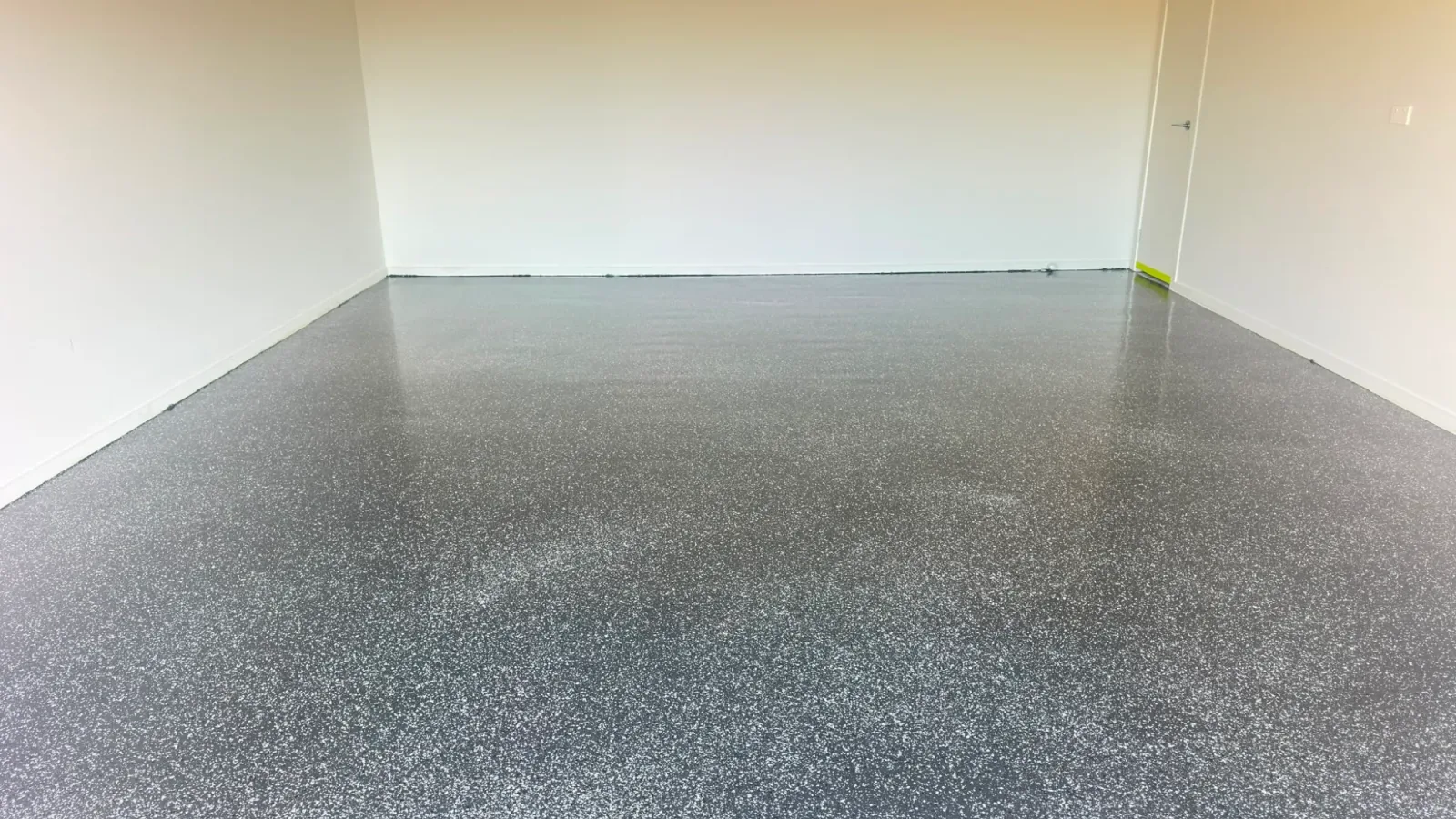
Once set, the loose flake was scraped back and vacuumed, and the clear polyaspartic topcoat went on last. The topcoat is what carries the abrasion resistance, the UV stability and the resistance to hot tyre pickup — and it is the reason we do not substitute a concrete sealer at this stage, for the reasons set out in why concrete sealers are not suitable for epoxy floors.
The detail most people notice last and appreciate most
Look at the front edge of the slab in that photograph. The coating has been carried down and over it rather than stopped at the lip.
That edge is what you see from the street every single time the door goes up. Left raw it stays grey, collects dirt and chips at the corner, and it quietly undoes the finish of everything behind it. Carried over, the floor reads as a finished surface rather than a rectangle of coating that ran out.
It is also a genuine argument for doing the floor before the driveway. With bare ground in front of the garage we could work the edge properly from outside. Once a driveway is poured hard up against that lip, doing it cleanly is far more awkward.
The finished floor
Charcoal with a black, white and grey flake is the most requested garage combination we install, and for good reason. It hides tyre marks, dust and the general grime of a working garage far better than a light floor, while the white and grey in the blend still bounce light around a space that usually only has one small window and a roller door.
It is also seamless. There are no grout lines, no joins and nothing for dust to collect in — which is where it pulls ahead of the interlocking tile systems people often compare it against. That comparison is worked through in flake epoxy vs garage tiles.
Want the same for your garage? Book a free on-site measure or call 0451 980 606.
What happened after we left
The cure schedule is not a formality and it is where new floors get damaged:
| When | What you can do |
|---|---|
| 24 hours | Walk on it |
| 48 hours | Move storage, shelving and boxes back in |
| 72 hours | Park a car on it |
Driving on a floor at 48 hours instead of 72 is the single most common way a brand-new coating gets marked. The full sequence and the reasoning behind each stage is in how long epoxy flooring takes.
Aftercare is genuinely simple: soft broom or dust mop for day to day, warm water and a mild detergent when it needs more, no harsh solvents, and wipe oil or fuel rather than leaving it to sit. Do that and you should expect fifteen years or more out of it — see how long epoxy flooring lasts.
What this job says to other Officer homeowners
Three things carry over to almost every new build in Officer, Pakenham, Beaconsfield and Clyde:
- Your new slab is not a clean slab. It is sealed and contaminated, and both have to be ground off. A quote that does not mention grinding is quoting a different, smaller job.
- The window before you move in is the best one you will get. Empty garage, no driveway, no cars to relocate. It never gets easier than that.
- Reactive clay means the slab will move. Hairline cracking is normal in the south-east and entirely manageable — but only if cracks are routed and filled rather than coated over.
If you are weighing up whether it is worth doing at all, 7 signs your garage floor needs epoxy flooring is a useful read, and what a garage floor epoxy service provider actually does sets out what should be included in any quote you receive.
What it cost
A standard double garage of this size starts from $2,400 for the complete flake system, with everything above included — grinding, edge work, repairs, primer, base coat, flake and polyaspartic topcoat. A single garage starts from $1,400.
What moves the number is the slab, not the square metres: an existing coating to strip, a high moisture reading or significant crack repair all add work. We identify every one of those at the measure and price them before we start, rather than discovering them on day one. Full pricing sits in double garage epoxy flooring cost in Melbourne and how much epoxy flooring costs in Melbourne.
Frequently asked questions
How long did the Officer double garage take?
Two days on site. Day one was masking, diamond grinding, repairs and primer. Day two was the coloured base coat, the flake broadcast, scrape-back and the clear polyaspartic topcoat. Cure ran on after that: walk-on at 24 hours, storage back at 48, car in at 72.
What did it cost?
A standard double garage of this size starts from $2,400 for the complete flake system, including all preparation. The final figure depends on the slab: an old coating to strip, a high moisture reading or significant crack repair will move it, and we identify all of that at the free on-site measure rather than on the day.
Why does a brand-new slab need grinding at all?
Because it is not bare. Builders seal garage slabs at handover, and that sealer is invisible and specifically designed to stop things bonding to the concrete. On top of it sits paint, plaster and render from the build. All of it has to come off mechanically before a coating will key in.
Could the paint and plaster just be scraped off instead?
Scraping takes the lumps off and leaves the sealer, the stains and the weak surface layer behind. Grinding removes all four in one pass and leaves an open profile for the primer. They are not alternatives to each other.
What flake colour was used?
A charcoal base with a black, white and grey flake blend, under a clear topcoat. It is the most requested garage combination we install because it hides tyre marks and dust far better than a light floor while still lifting the light in the space.
Why coat over the front edge of the slab?
Because that edge is what you see from the street every time the door goes up, and it is the first part to chip if it is left raw. Carrying the coating down and over it gives a finished line instead of a cut-off one. On this job the driveway had not been poured yet, which made it straightforward.
Is it better to do the floor before moving in?
Far better. The garage is empty, nothing needs shifting, and there is no car to park elsewhere for three days. On a new build it is one of the few jobs that is genuinely easier before you move in than after.
Should the driveway go in first or the garage floor?
The garage floor first if you can. Working before the driveway means the crew can get to the slab edge from the raw ground and finish it properly, and there is no new concrete to protect from grinding dust or foot traffic.
Was the slab tested for moisture?
Yes, before quoting. New slabs in the south-east hold moisture, and moisture rising through concrete will lift a coating from underneath no matter how well the surface was prepared. A high reading means a moisture-barrier primer, which adds about a day.
What about the cracks that appear in new estate slabs?
Officer sits on reactive clay that swells and shrinks through the seasons, so hairline cracking on young slabs is normal. Cracks get routed out into a clean channel, filled with a structural repair compound and ground flush before priming. Coated over instead, they simply telegraph back through the finish within a season.
Does the flake finish make the floor slippery?
The flake gives the surface texture, so it has more grip than a smooth gloss coating, particularly when dry. Any hard floor is slick with water on it. If a garage is going to get regularly wet we can add an anti-slip aggregate to the topcoat.
Will hot tyres damage it?
Not with a polyaspartic topcoat, which is what makes the difference. Hot tyre pickup is a failure mode of cheap single-part coatings and DIY kits. Give the floor its full 72 hours before parking on it and it will not be an issue.
How much dust did the grinding make inside the house?
Very little. The grinder runs coupled to an industrial dust extractor and the walls are masked before anything starts. Grinding without extraction sends fine concrete dust straight through the internal access door into the house, which is why we do not do it.
How long will this floor last?
Fifteen years or more in a domestic garage, and we back the workmanship with a written warranty. Floors that fail early almost always failed at the preparation stage, not because the coating wore out.
How do you clean it?
A soft broom or a dust mop for day-to-day, and warm water with a mild detergent when it needs more. No harsh solvents and nothing acidic. Wipe oil or fuel spills rather than leaving them to sit.
Can the same thing be done to an older garage?
Yes, and we do it constantly. An older slab usually needs more preparation, not less, because there may be an existing coating, oil contamination soaked into the concrete or larger cracks. It is all identified at the measure.
Do you work in Officer regularly?
Yes. Officer, Pakenham, Beaconsfield, Berwick, Clyde, Clyde North and Cranbourne are all regular territory for us, and we cover the rest of Melbourne from our base in Mickleham.
Can I choose a different colour?
Yes. Charcoal and grey blends are the most popular for garages, but the base colour and flake mix are both chosen from physical samples before the booking is confirmed. If you want something with more depth for an indoor space, metallic epoxy is a different system worth looking at.
Do you charge for the quote?
No. The on-site measure is free and carries no obligation. We assess the slab, test it for moisture, talk through colours and leave you with a fixed written price that lists what is included.
How far ahead do I need to book?
One to three weeks is typical, and longer through spring and before Christmas. If your home is still being built, the best time to call is once you have a handover date.
Book your garage in
We are a specialist epoxy installer based in Mickleham, working across Melbourne since 2020 with more than 2,000 floors completed. Officer, Pakenham, Beaconsfield, Berwick, Clyde and Cranbourne are regular territory.
Every floor is diamond ground with dust extraction — no etching, no exceptions — and the preparation is itemised on the quote so you can hold it against any other quote you have. The on-site measure is free and there is no obligation.
Call 0451 980 606, request a free quote online, or see more of our work and reviews on our Google Business Profile.
More on the systems we install: double garage epoxy flooring, single garage epoxy flooring, flake epoxy flooring and metallic epoxy flooring.
Planning an epoxy floor in Melbourne?
Book a free on-site inspection and get a fixed written quote — no obligation.