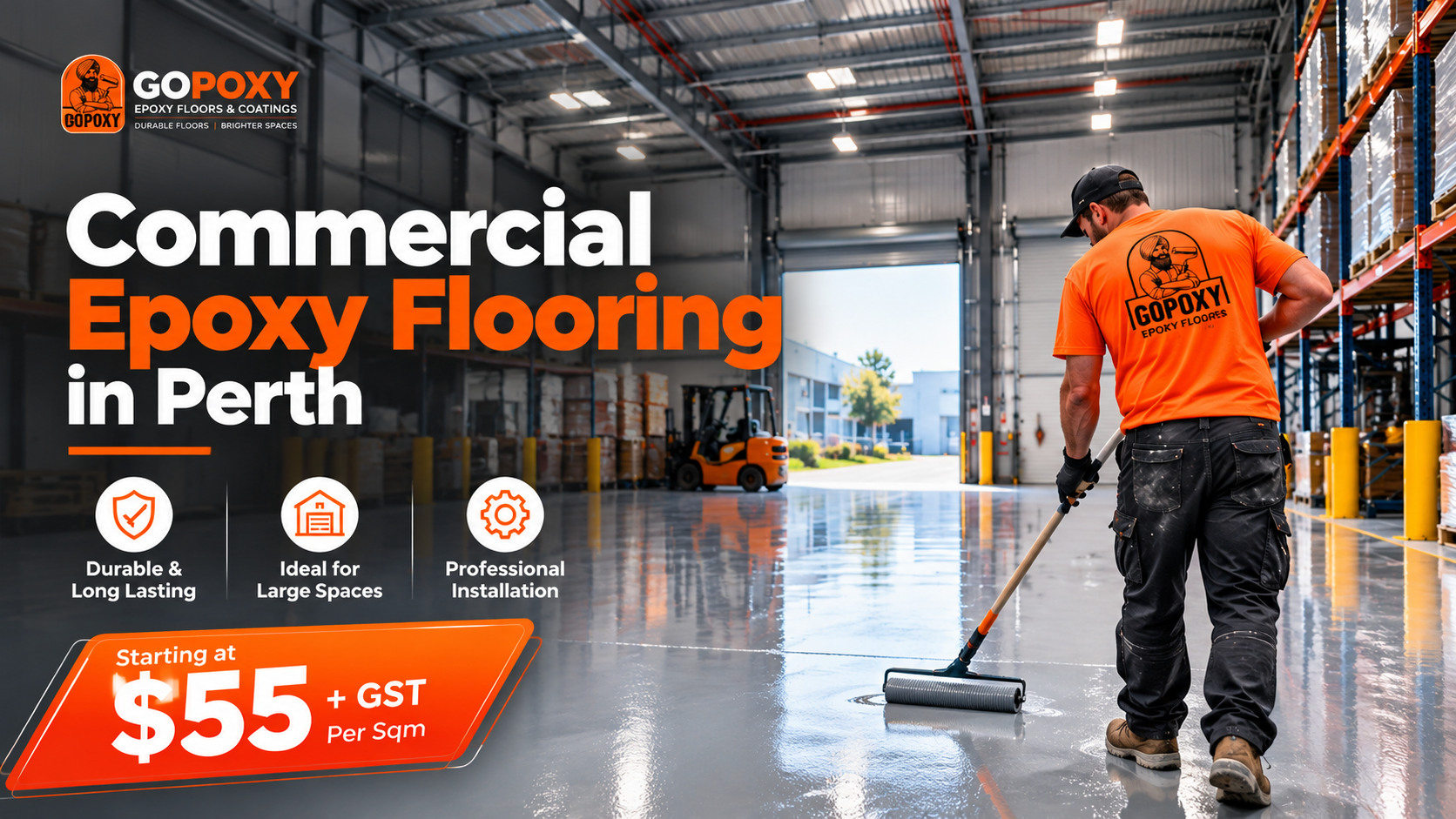
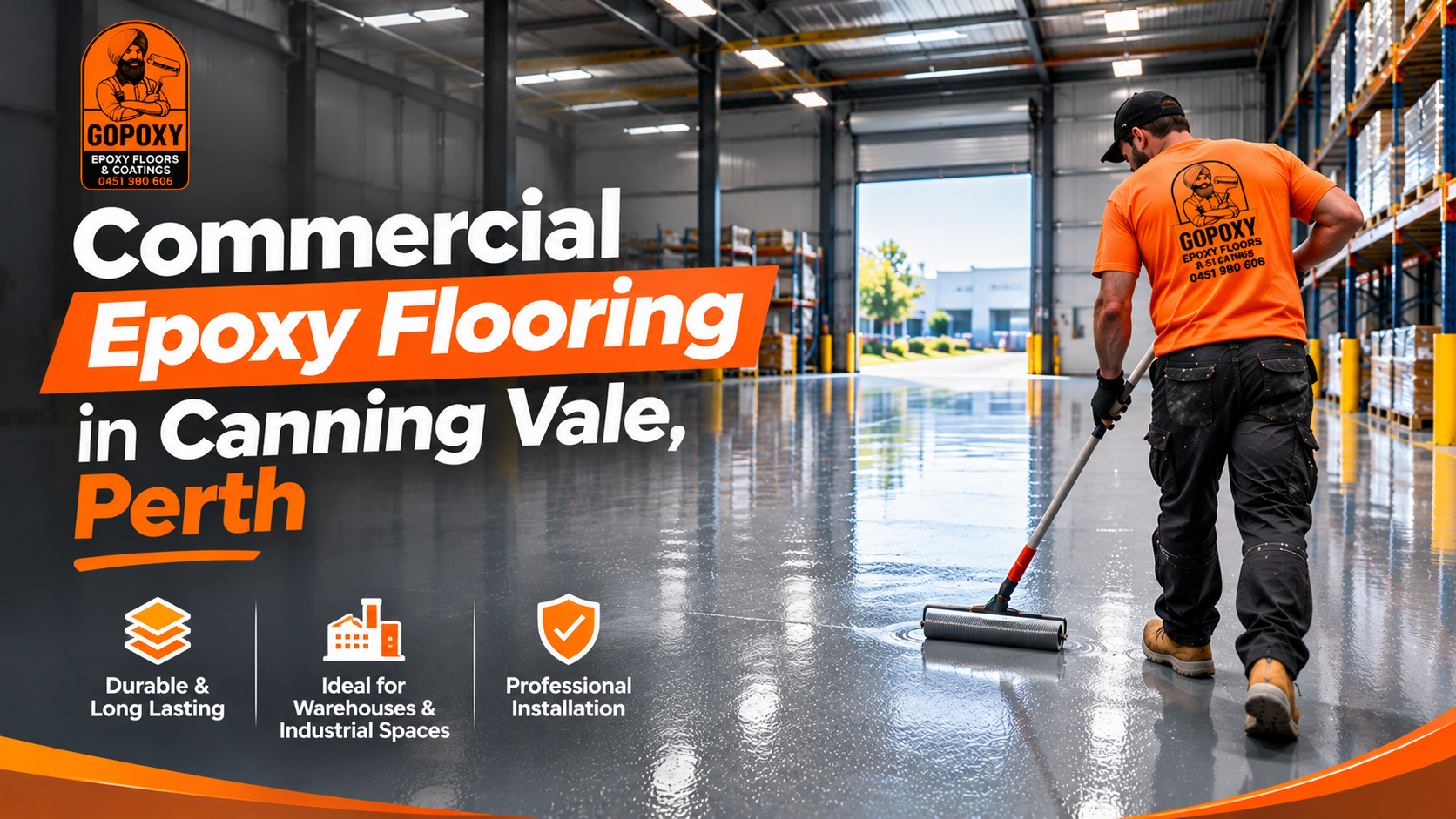
Canning Vale is one of the most concentrated industrial addresses in Western Australia. Bannister Road alone carries tens of thousands of square metres of high-truss warehousing, the Perth Markets precinct covers roughly 51 hectares of food wholesale and cold-chain logistics, and the whole area feeds straight onto Roe Highway via South Street and Nicholson Road.
Which means a very specific kind of flooring problem. These are not small workshops. They are large-format slabs carrying loaded forklifts, pallet impact at dock edges, wash-down in food areas and racking point loads — floors that fail expensively when the wrong system goes down on them.
This covers commercial epoxy flooring in Canning Vale (also written Canningvale): what it costs, the three systems worth considering, how the right one gets specified for an industrial environment, and how large floors get staged so a facility keeps operating.
The short answer
Commercial epoxy flooring in Canning Vale starts from $65 per square metre plus GST, supplied and installed — including mechanical surface preparation, moisture testing, primer, build coat and topcoat on a sound slab. The final figure depends on slab condition, total area, the system specified and whether the facility keeps trading during the work.
Why Canning Vale floors are a specific job
The industrial stock here splits into three broad groups, and each brings a different flooring requirement.
Large-format logistics and distribution
The Bannister Road estates run to very large single-span warehouses with high truss heights, deep racking and constant counterbalance forklift movement. On floors like these the controlling factors are point loading under racking legs, abrasion in the main travel lanes, and impact at dock edges where pallets land.
Industrial epoxy flooring for these buildings is about build thickness and resin selection rather than appearance. A coating that performs perfectly in a storage shed will polish through in a travel lane inside two years.
Food wholesale and cold chain
The Perth Markets precinct brings requirements most industrial floors never face: wash-down tolerance, resistance to organic acids from produce, hygiene detailing, and in cold-storage areas a system that will cure and perform at low temperature.
Coving matters here more than anywhere. Where the floor meets the wall, a continuous curved radius stops fluid and debris collecting in a 90-degree junction — and that junction is exactly what a food safety audit examines.
Manufacturing and trade workshops
Canning Vale also holds a deep base of smaller manufacturing units and trade premises. These floors see machinery loads, oils and coolants, dropped tooling and welding spatter. Zones within one building often need different systems: an assembly bay and a chemical store should not get the same specification simply because they share a roof.
What commercial epoxy flooring costs in Canning Vale
From $65 per square metre plus GST, supplied and installed. At that rate, on a structurally sound slab, the scope covers:
- Mechanical surface preparation — diamond grinding or shot blasting with dust extraction, never acid etching
- Moisture testing before the system is committed to
- Minor crack and joint treatment — cut, filled and ground flush
- Primer into clean, open concrete
- Build coat to the specified thickness
- Topcoat selected for the environment
- Site documentation — public liability, SWMS and data sheets for induction
Indicative totals at that starting rate:
| Facility | Approx. area | From (ex GST) |
|---|---|---|
| Trade unit or workshop | 200 m² | $13,000 |
| Small warehouse | 500 m² | $32,500 |
| Mid-size warehouse | 1,000 m² | $65,000 |
| Distribution facility | 2,500 m² | $162,500 |
Treat these as planning figures. Larger floors typically price better per square metre, because mobilisation, site setup and equipment transport are largely fixed costs that spread further across a bigger area. Slabs needing real remediation price worse. Both get established at the inspection rather than discovered mid-project.
The five things that move the price
| Factor | Effect |
|---|---|
| Slab condition | The largest variable. Spalling, deep cracking or a slab that has moved all add remediation first. |
| Existing coatings | A failing or unknown coating has to be mechanically removed before anything new goes down. |
| Contamination | Oil, fuel and chemical penetration requires decontamination and deeper grinding. |
| System specification | Build thickness, resin chemistry and topcoat, chosen for traffic and exposure. |
| Access and staging | After-hours shifts or zone-by-zone staging around live operations. |
Three systems, honestly compared
Commercial epoxy coating
Warehouse epoxy flooring and industrial epoxy flooring both sit here: a seamless, hard-wearing, chemically resistant surface within specification, able to carry line marking and safety colours. The right answer wherever forklifts run, chemicals are handled or the floor takes genuine punishment. Detail on commercial epoxy flooring, warehouse flooring and factory floor coatings.
Commercial flake flooring
Flake systems broadcast decorative vinyl chips into the coating beneath clear coats. In an industrial building they earn their place in the front office, the showroom and customer-facing areas — and the chips break up the visual field, so scuffing and minor slab imperfections read far less obviously than on a solid colour.
Commercial concrete sealing
Not every square metre needs a full coating. Where a slab is sound and the requirement is to stop dusting and make the surface easier to clean, concrete sealing is the proportionate answer and considerably cheaper across a large floor. On a big Canning Vale warehouse it is often the sensible choice for lower-duty storage zones, with epoxy reserved for travel lanes and dock areas.
Where a slab is too far gone for either, concrete resurfacing comes first. A contractor quoting a coating over a failing slab is selling the same problem back to you in two years.
Preparation decides whether any of it lasts
The top few millimetres of any concrete slab is laitance — weak fines and water that rose during the pour. Coat over it and the floor is only as strong as that crumbly layer, however good the resin is.
Mechanical preparation removes it and opens the concrete so primer can key into sound material. Acid etching does not do this reliably: it roughens the surface slightly, leaves residue behind, and cannot remove oil contamination at all. The comparison is in diamond grinding vs acid etching.
This is also the single most common place a cheap quote saves money, and the reason industrial floors delaminate. The detail is in why factory floors fail.
On a commercial slab, preparation also means moisture testing, oil and chemical decontamination, crack and joint treatment with movement joints detailed rather than coated over, patching at dock edges and thresholds, and removal of any failing existing coating.
Will it take the traffic?
The question that matters most in a Bannister Road warehouse, and the one most often answered loosely.
A resin floor handles forklifts, loaded pallet jacks and racking point loads — if specified for them. Build thickness, resin type and wheel material all come into it. What a floor will not survive is being specified for one duty and used for another. Full detail in can commercial epoxy flooring handle forklifts and heavy machinery.
Line marking and safety colours are applied after cure, and it is a sensible moment to review the layout against current traffic flow rather than reproducing lines drawn for a different racking arrangement.
Keeping the facility running
For most Canning Vale operations the coating is not the biggest number in the project. The shutdown is.
Cure times cannot be compressed: foot traffic typically returns at around 24 hours and vehicle traffic at around 72. What can be controlled is sequencing. Large floors are staged bay by bay or zone by zone so operations continue, or run after hours and across weekends where the layout does not allow staging.
A realistic programme states return-to-service times per area rather than one duration for the whole building. Worth calculating your own hourly cost of downtime before comparing quotes — it frequently changes which quote is actually cheapest. More in how long a commercial epoxy floor puts a business out of action and how long epoxy flooring takes.
Perth conditions that affect the work
Summer slab temperatures. Resin working time shortens as temperature rises, and inside a steel-framed Canning Vale warehouse through a Perth summer the slab can sit well above ambient. On large areas that means smaller batches, more people on the floor, or an early start — all of which affect how the job is planned and priced.
Sandy subgrade and older slabs. Some older industrial slabs in the area were poured without an effective vapour barrier. Ground moisture then travels up through the concrete and will eventually debond a coating from underneath, no matter how well it was applied on top. Moisture testing is the only way to know before committing to a system.
Two quotes, same floor, thousands apart
A 800 square metre warehouse floor gets two prices. One around $52,000, the other around $34,000. Same building, same stated outcome.
The gap is rarely margin. It is scope, and it usually hides in four places:
- Preparation method — acid etching instead of diamond grinding saves thousands and is the main reason floors fail early
- Build thickness — "epoxy floor" describes both a one-coat job and a four-coat system
- Remediation excluded — cracks and spalling left as a variation, priced once work has started and you have no alternative
- Topcoat substituted — the wrong chemistry softens in a wash-down area and ambers where daylight reaches it
The practical test: ask both contractors to state preparation method, number of coats, total build thickness and topcoat product. The two quotes usually stop looking comparable immediately.
How a project runs
1. Site inspection. Area, existing coatings, moisture, contamination, cracking, joint condition, traffic type and the operational constraints of the facility.
2. System recommendation. Epoxy coating, flake system or concrete sealing, compared against the duty of each zone, with the reasoning stated.
3. Surface preparation. Mechanical preparation with dust extraction, then repairs — cracks cut and filled, spalling patched, joints detailed, contamination removed.
4. Application. Primer, then the specified build and topcoat, applied to the product data sheet and the conditions on the day.
5. Cure, inspection and handover. Cured to specified times, inspected, line marked where required, handed over zone by zone.
What a genuine quote states
- Preparation method named — diamond grinding or shot blasting, not "surface preparation"
- System and build thickness specified, with the topcoat identified
- Remediation scope — what crack, joint and spalling work is included
- What happens if the slab is worse than expected, agreed before work starts
- A staged programme with return-to-service times per area
- Line marking and detailing — coving, thresholds, safety colours
- A fixed price in writing, with insurance and safety documentation
Comparable cost breakdowns are in commercial epoxy flooring prices in Perth, commercial epoxy flooring costs and factory flooring costs. System comparisons across environments are in the best flooring options for commercial spaces.
Looking after the floor
Maintenance is straightforward. Sweep or scrub with a pH-neutral detergent. No acids, no aggressive solvents, no close-range pressure washing. Oils and tyre marks sit on the topcoat rather than soaking in, so they lift rather than staining — see removing oil, fuel and tyre marks.
Resin floors are also repairable rather than replaceable, which matters on a large industrial slab where a single damaged bay should not mean recoating the building.
Canning Vale and the surrounding areas
We install warehouse epoxy flooring and industrial epoxy flooring for facilities throughout Canning Vale — including the Bannister Road industrial estates, the Perth Markets precinct and the smaller trade units off Nicholson Road — and across the neighbouring industrial areas:
Immediately around Canning Vale — Jandakot, Willetton, Southern River, Forrestdale, Bibra Lake, O'Connor, Myaree, Welshpool and Kewdale.
Wider Perth metropolitan — Rockingham, Neerabup, Henderson, Naval Base, Malaga, Osborne Park, Wangara, Landsdale, Balcatta, Hazelmere, High Wycombe, Forrestfield, Bayswater, Bassendean and Maddington.
There is a fuller guide to systems and specification in commercial epoxy flooring in Perth, and background on our systems in epoxy flooring and commercial epoxy flooring.
Scope note: in Western Australia we take on commercial and industrial flooring only — warehouses, factories, distribution centres, workshops and business premises. We do not quote residential work in Perth.
Frequently asked questions
Do you provide commercial epoxy flooring in Canning Vale?
Yes. Canning Vale is one of our core Perth industrial areas, covering the Bannister Road estates, the Perth Markets precinct and the smaller trade units off Nicholson Road. We work on commercial and industrial projects only in Western Australia.
How much does commercial epoxy flooring cost in Canning Vale?
From $65 per square metre plus GST, supplied and installed. That covers mechanical surface preparation, moisture testing, minor crack and joint treatment, primer, build coat and topcoat on a sound slab.
What does a 1,000 square metre warehouse floor cost?
Around $65,000 plus GST at the starting rate. Floors of that size often price better per square metre, because mobilisation and setup costs spread further across a larger area.
Is the rate fixed or does it change?
It is a starting rate. Slab condition is the largest variable: existing coatings, oil contamination, spalling or a slab that has moved all add remediation. Everything is established at the inspection and then fixed in writing before work starts.
What is not included at that rate?
Significant remediation such as deep cracking, widespread spalling, levelling a slab that has moved, removing a failing existing coating, or decontaminating heavy oil penetration. Line marking, coving and after-hours work are quoted separately.
Do you work in the Bannister Road industrial estates?
Yes. Large-format logistics and warehousing floors are a core part of what we do, including high-truss warehouses with deep racking and constant forklift movement.
Can you do food and cold storage floors in the Perth Markets precinct?
Yes. Food areas need coving where the floor meets the wall, wash-down tolerance and resistance to organic acids from produce. Cold-storage areas need a system that will cure and perform at low temperature, which is a different specification again.
What is coving and why do food facilities need it?
Coving curves the floor finish up the wall in a continuous radius instead of meeting it at a right angle. That 90-degree junction collects fluid and debris, and it is exactly what a food safety audit examines.
Will the floor handle forklifts and racking loads?
If specified for them. Build thickness, resin type and wheel material all matter, as does point loading under racking legs. A floor specified for storage duty will not survive a main travel lane.
Why does the slab have to be mechanically prepared?
The top few millimetres of a slab is weak laitance. Coating over it means the floor is only as strong as that crumbly layer. Diamond grinding or shot blasting removes it and opens the concrete so the primer bonds to sound material.
Do you use acid etching?
No. Acid etching roughens the surface slightly, leaves residue and cannot remove oil contamination. It is not adequate preparation for a commercial floor, and it is the main reason industrial floors delaminate early.
What if the slab has moisture problems?
It is identified at inspection through moisture testing. Some older industrial slabs in the area were poured without an effective vapour barrier, and ground moisture will eventually debond a coating from underneath. A moisture-tolerant system or an alternative approach is then specified.
Can the facility keep operating during the work?
Usually yes. Large floors are staged bay by bay or zone by zone, or run after hours and across weekends where the layout does not allow staging. The programme should state return-to-service times per area rather than one duration for the building.
How long before we can drive on it?
Foot traffic typically returns at around 24 hours and vehicle traffic at around 72. Cure times cannot be compressed, so they get built into the programme rather than hoped away.
Is concrete sealing cheaper than a full coating?
Considerably, and across a large Canning Vale warehouse the saving is substantial. Sealing suits sound slabs where the requirement is reduced dusting and easier cleaning. Many facilities use sealing in low-duty storage zones and epoxy in travel lanes and dock areas.
Does Perth summer heat affect installation?
Yes. Resin working time shortens as temperature rises, and slab temperatures inside a steel-framed warehouse can sit well above ambient. On large areas that means smaller batches, more people on the floor, or an early start.
Can you include line marking?
Yes, applied once the coating has cured. It is a sensible point to review the layout against current traffic flow rather than reproducing lines drawn for an older racking arrangement.
Can a damaged area be repaired without recoating the whole floor?
Yes. Resin floors are repairable, which matters on a large industrial slab where one damaged bay should not mean recoating the entire building.
Which areas around Canning Vale do you cover?
Jandakot, Willetton, Southern River, Forrestdale, Bibra Lake, O'Connor, Myaree, Welshpool and Kewdale, plus the wider Perth metropolitan industrial areas including Rockingham, Neerabup, Henderson, Malaga, Osborne Park and Wangara.
How do I arrange a site inspection?
Call 0451 980 606 or use the contact form with the facility type, approximate floor area and location. The inspection is free, and you receive a system recommendation and a fixed written price.
See completed work
- Google Business Profile — reviews and completed projects
- Facebook — finished commercial and industrial floors
- Instagram — work in progress, including preparation stages
- WhatsApp — send photos and floor area for an initial estimate
The preparation photos are the informative ones. Any contractor can photograph a finished floor; far fewer will show the slab it started as.
Commercial Epoxy Flooring — Canning Vale, Perth
From $65/m² + GST
Supplied and installed, including mechanical preparation, moisture testing, primer, build coat and topcoat. Free site inspection, fixed price in writing, programme staged around your operations.
Mon – Sat, 7:00am – 6:00pm · Or request a site inspection online
2,000+ projects completed since 2020. More about GoPoxy.
Planning an epoxy floor in Melbourne?
Book a free on-site inspection and get a fixed written quote — no obligation.