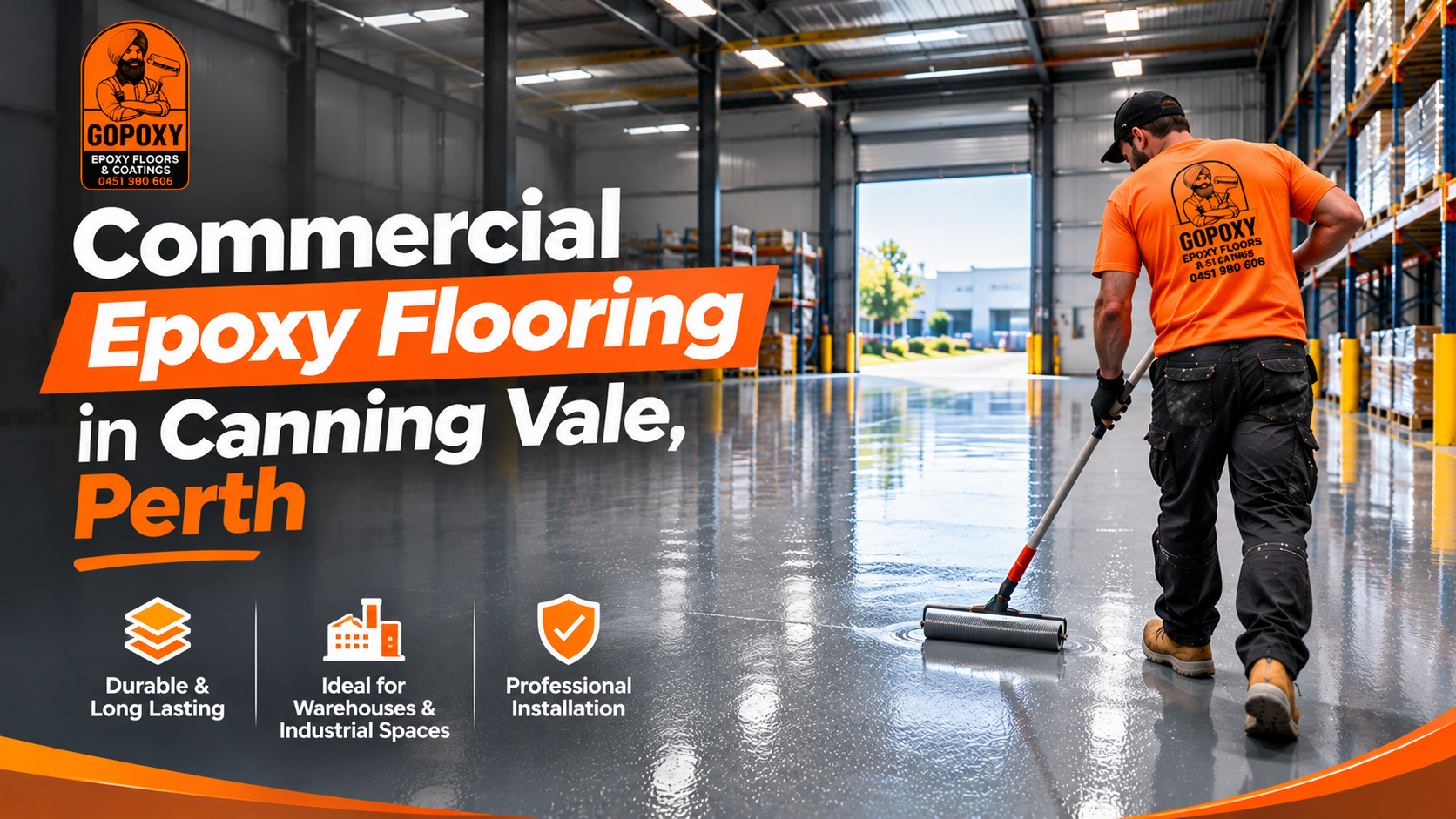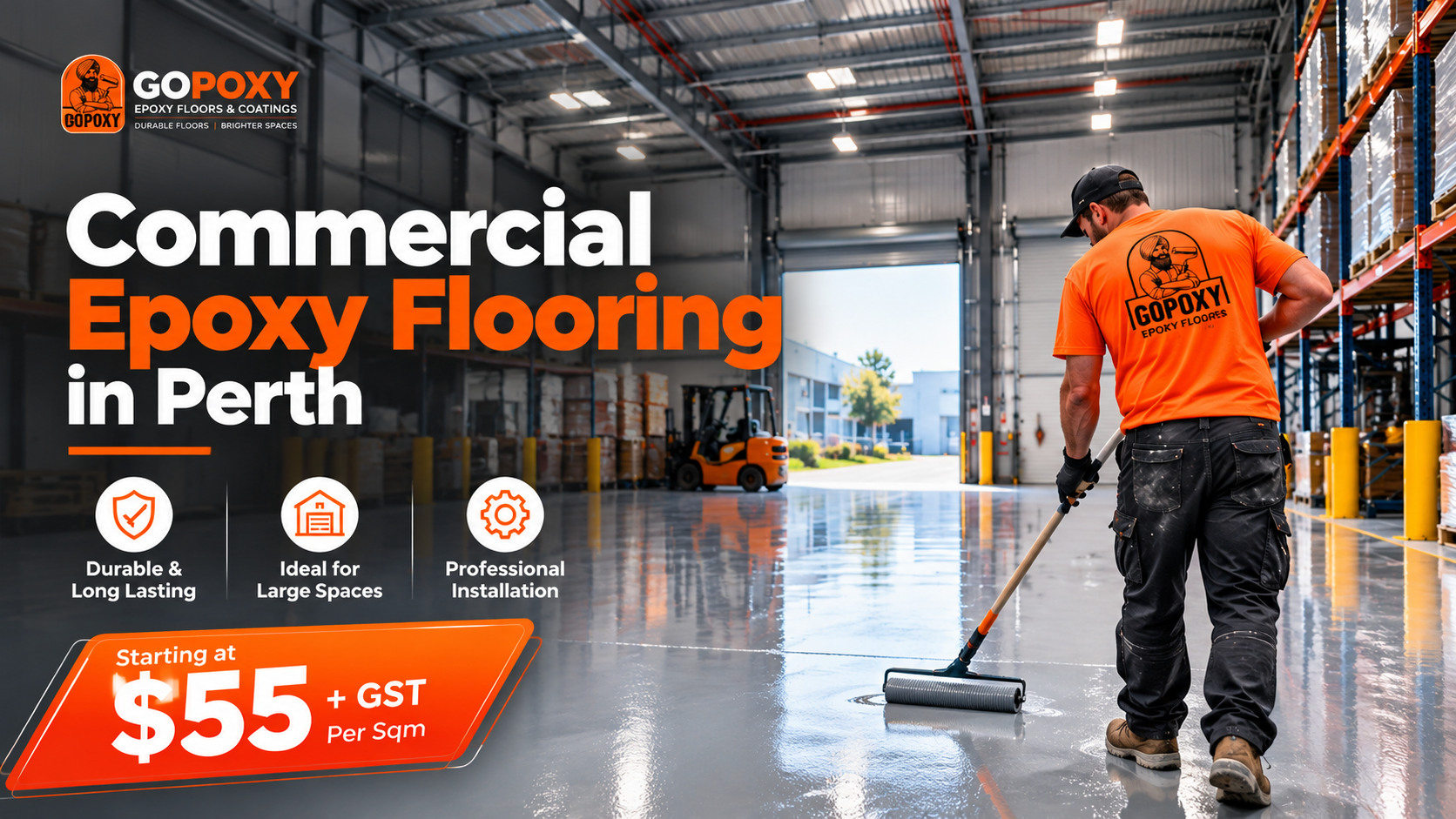
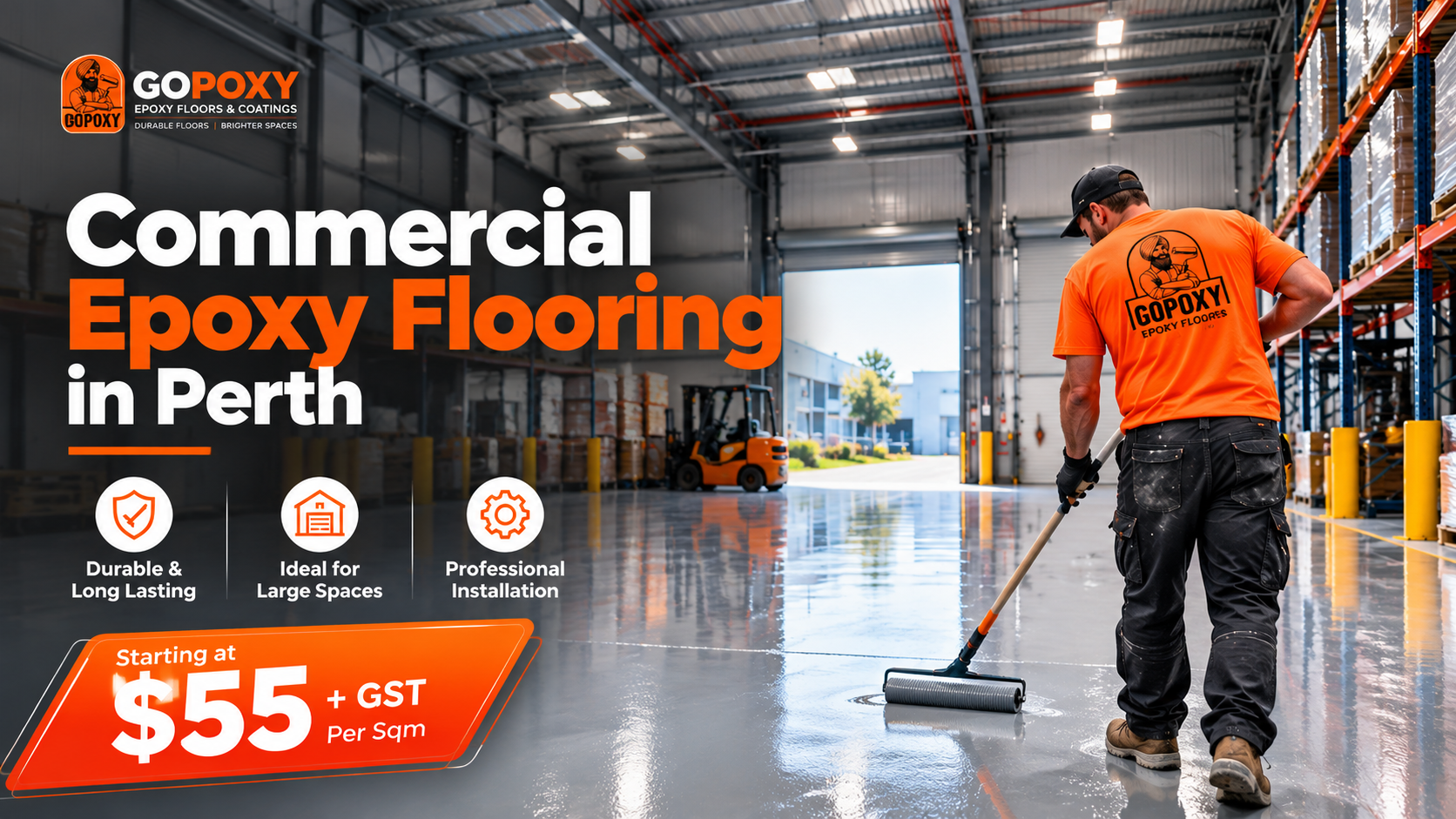
A commercial floor is not a decorative decision. It is a piece of operating infrastructure that forklifts run across, pallets are dropped onto, and chemicals get spilled on — and when it fails, it does not fail quietly. It fails as dust in your product, as a trip hazard in a walkway, as patches of resin lifting under the racking, and as a shutdown you did not budget for.
This is a practical guide to commercial epoxy flooring in Perth: the three coating systems worth considering, how the right one is chosen for an industrial environment, why surface preparation decides whether any of it lasts, and how large projects get staged so a facility can keep operating.
The short answer
GoPoxy provides commercial and industrial epoxy flooring, decorative flake flooring and concrete sealing across Perth — warehouses, factories, distribution centres, manufacturing plants and commercial workshops. Commercial floors are always quoted after a site inspection, because the system depends on traffic, chemical exposure, slab condition and whether the facility has to keep operating during the work.
Why commercial floors fail, and what that tells you
It is worth starting here, because understanding the failure modes tells you what actually matters in a quote.
Delamination. The coating lifts away from the concrete in sheets, usually starting at a high-traffic lane or around a drain. This is an adhesion failure, and it is nearly always traced back to preparation: the slab was not mechanically ground, or it was coated over a sealer or curing compound, or there was oil in the concrete that nobody removed.
Wearing through under traffic. The coating abrades away in forklift lanes until bare concrete shows. That is a specification problem — a system built for foot traffic put into a facility running loaded machinery.
Chemical attack. Softening, blistering or discolouration where oils, solvents, acids or coolants sit. Standard epoxy resists a great deal, but not everything, and the system has to be matched to what the floor actually meets.
Moisture-driven failure. Blistering and debonding that starts from underneath. Slabs without an effective vapour barrier push moisture up through the concrete, and it will eventually lift a coating off from below however well it was applied on top. This is why moisture testing belongs in the inspection, not in the post-mortem.
Three of those four are preventable at the quoting stage. The long version is in why factory floors fail, and it reads the same in Perth as anywhere else.
Three commercial flooring systems
Different environments need different answers. Specifying one system for every situation is how businesses end up recoating in three years.
1. Commercial epoxy flooring
A seamless, resin-based coating applied over prepared concrete. It is the workhorse system for industrial environments: hard-wearing, cleanable, chemically resistant within its specification, and able to carry line marking and safety colours.
Build thickness and resin type are selected according to the duty. A warehouse running counterbalance forklifts all day is a different specification from a storage facility with occasional pallet-jack traffic, even though both get described as "warehouse flooring".
Typical applications:
- Commercial warehouses and warehouse floor coatings
- Industrial and manufacturing facilities
- Distribution and logistics centres
- Commercial workshops and service bays
- Storage facilities and racking areas
- Plant rooms and process areas
Load-bearing capability is the question most often asked and most often answered badly — covered properly in can commercial epoxy flooring handle forklifts and heavy machinery.
2. Commercial flake flooring
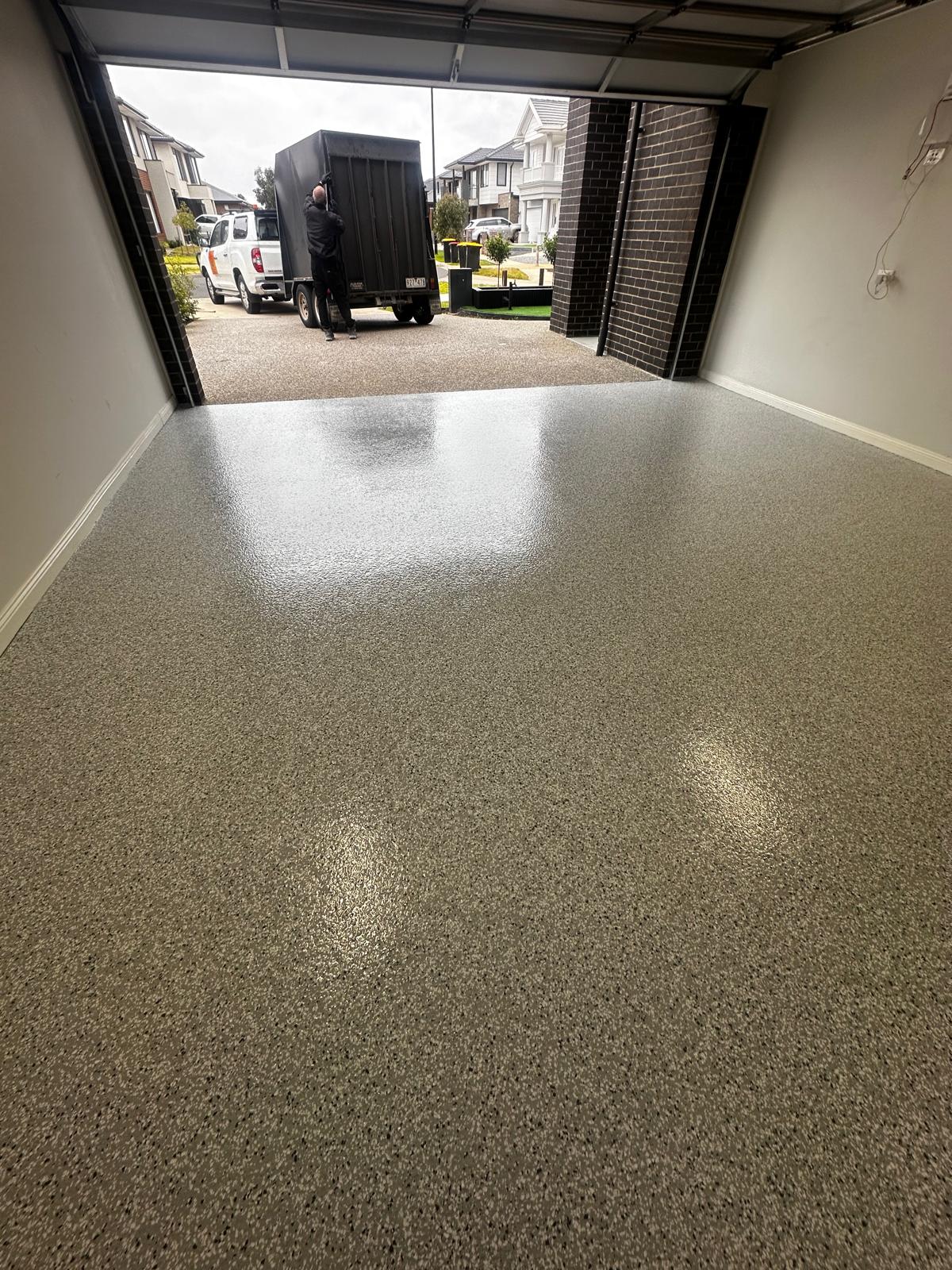
Decorative vinyl flake broadcast into the coating and sealed beneath a clear topcoat. It gives a seamless, hard-wearing surface with a finish that suits spaces where appearance carries weight alongside durability.
The practical advantage in a working environment is that flake breaks up the visual field, so dust, scuffing and minor slab imperfections are far less visible than on a solid colour. The texture also adds grip underfoot.
Typical applications:
- Commercial showrooms and display areas
- Retail and customer-facing spaces
- Business premises and office areas within industrial buildings
- Amenities, corridors and staff areas
- Workshop areas where appearance matters
Colour and flake size are selected to suit the space. More on flake flooring systems.
3. Commercial concrete sealing
Not every floor needs a full coating. Where the concrete is sound and the requirement is to reduce dusting, limit absorption and make the surface easier to maintain, concrete sealing is often the proportionate answer — and considerably less disruptive to apply across a large area.
Typical applications:
- Large-format warehouse floors
- Storage facilities and hardstand areas
- Industrial concrete in lower-duty zones
- Commercial premises where full coating is not justified
Where a slab is too deteriorated for either sealing or coating, concrete resurfacing comes first. Recommending a coating over a failing slab is how a contractor turns your problem into your problem again twelve months later.
Surface preparation is the whole job
If there is one section to take seriously, it is this one — because it is the difference between a floor that lasts a decade and one that peels.
The top few millimetres of any concrete slab is the weakest part of it: fine particles and water that rose during the pour, known as laitance. Coat over it and the floor is only as strong as that crumbly layer. Mechanical preparation — diamond grinding or shot blasting, depending on area and profile required — removes it and opens the concrete so the primer can key into sound material underneath.
Acid etching does not achieve this reliably. It roughens the surface slightly, leaves residue behind, and cannot remove oil contamination at all. The comparison is set out in diamond grinding vs acid etching.
On a commercial slab, preparation also means:
- Moisture testing before any system is committed to
- Oil and chemical decontamination, because resin will not bond through contamination
- Crack and joint treatment — cut out, filled and ground flush, with movement joints detailed rather than coated over
- Patching spalled and pitted areas, typically worst at dock edges and door thresholds
- Removal of existing coatings where they are failing or incompatible
A quote that prices a coating per square metre without stating the preparation method is not a comparable quote.
How the right system gets specified
Five variables drive the decision, and they should all be established during the inspection.
| Variable | What it changes |
|---|---|
| Traffic type and load | Build thickness and resin selection |
| Chemical exposure | Resin chemistry and topcoat choice |
| Thermal conditions | Cure profile; relevant near ovens, cold storage or in summer heat |
| Slab condition and moisture | Preparation scope, primer type, whether resurfacing is needed first |
| Operational constraints | Staging, cure times, after-hours or weekend work |
Slip resistance is the sixth consideration wherever a floor gets wet. Grip can be adjusted by adding a fine aggregate to the topcoat, and the required rating should be stated in the specification rather than assumed.
Industries we work with in Perth
Warehousing, logistics and distribution
Perth's freight and logistics corridor around Kewdale and Welshpool, close to the airport and the intermodal terminal, concentrates a large share of the state's distribution capacity. These floors take constant forklift traffic, point loading under racking legs, and pallet impact at dock edges.
The work usually includes line marking and safety colours applied after cure — a sensible moment to review the layout against current traffic flow rather than reproducing the old lines.
Manufacturing and industrial facilities
Production floors bring machinery loads, vibration, process chemicals and wash-down. Zones within a single plant often need different systems: a packing area and a chemical dosing area should not receive the same specification simply because they share a roof.
Resources and heavy fabrication
Perth's position as the service centre for Western Australia's resources sector means a large base of fabrication shops, equipment maintenance workshops and supply facilities — particularly around Henderson, Bibra Lake and Jandakot. These environments are demanding: tracked and wheeled plant, hydraulic oils and coolants, welding and grinding sparks, and dropped steel.
Coating selection here is about impact tolerance and chemical resistance, and about being honest regarding what a resin floor will and will not survive.
Commercial workshops and service centres
Vehicle and equipment workshops need surfaces that tolerate oil, fuel and coolant and clean up without staining — see removing oil, fuel and tyre marks. These sites are usually staged bay by bay so work continues.
Showrooms and business premises
Where customers and staff see the floor, flake and decorative systems give a clean, professional, seamless finish that still handles commercial traffic. Comparisons across commercial environments are in the best flooring options for commercial spaces.
Perth conditions worth planning around
Two local factors affect commercial coating work in the Perth metropolitan area.
Summer slab temperatures. Resin systems have a working time that shortens as temperature rises. In a steel-framed warehouse through a Perth summer, slab temperatures can sit well above ambient, which compresses the window between mixing and placing. On large areas this is a planning issue — it changes batch sizes, team numbers and often the time of day the work happens.
Coastal and saline exposure. Facilities closer to the coast and the port areas deal with salt-laden air, and where that combines with older concrete it influences both preparation and the primer selected.
Neither is exotic. Both are reasons a specification written for a different climate should not simply be copied across.
How a commercial flooring project runs
Step 1 — Site inspection. The slab is assessed on site: area, existing coatings, moisture, contamination, cracking, joint condition, traffic type and the operational constraints of the facility.
Step 2 — System recommendation. Options are presented against the duty of the space — epoxy coating, flake system or concrete sealing — with the reasoning stated rather than a single take-it-or-leave-it number.
Step 3 — Surface preparation. Mechanical preparation with dust extraction, followed by repairs: cracks cut and filled, spalling patched, joints detailed, contamination removed.
Step 4 — Application. Primer, then the specified build and topcoat, applied to the product data sheet and to the environmental conditions on the day.
Step 5 — Cure, inspection and handover. The floor is allowed to cure to the specified times, inspected, line marked where required, and handed over zone by zone.
Planning around operations
The question that decides most commercial projects is not what the floor costs. It is what the shutdown costs.
Large facilities are rarely coated in one hit. Work is staged by zone or bay so operations continue, or run after hours and across weekends where the layout does not allow staging. Cure times are the constraint that cannot be compressed: foot traffic typically returns at around 24 hours and vehicle traffic at around 72, with faster systems available where downtime is genuinely expensive.
A realistic programme states return-to-service times per area rather than one total duration for the building. The arithmetic behind this is in how long a commercial epoxy floor puts a business out of action and how long epoxy flooring takes.
What commercial epoxy flooring costs in Perth
There is no honest square-metre rate that covers commercial work, and any contractor quoting one over the phone has not asked enough questions.
The variables that move the figure:
- Total floor area — larger areas improve the rate, to a point
- Slab condition — the single biggest swing factor, especially existing coatings and contamination
- Preparation scope — grinding versus shot blasting, and how much repair work
- System specification — build thickness, resin type, topcoat
- Access and staging — whether the facility keeps operating, and whether work runs after hours
- Line marking and detailing — coving, joints, thresholds, safety colours
What a commercial quote should contain: the preparation method named, the system and build specified, a staged programme with return-to-service times per area, and a fixed price. Comparable cost breakdowns are in commercial epoxy flooring costs and factory flooring costs.
Commercial service areas across Perth
We work with commercial and industrial facilities across the Perth metropolitan area, with a focus on the established industrial precincts:
Eastern and airport corridor — Kewdale, Welshpool, Hazelmere, High Wycombe, Forrestfield, Perth Airport, Bayswater, Bassendean and Maddington.
Northern corridor — Malaga, Osborne Park, Wangara, Landsdale, Balcatta, Neerabup and Joondalup.
Southern corridor — Canning Vale, Bibra Lake, Jandakot, Henderson, Naval Base, O'Connor, Myaree, Forrestdale and Rockingham.
For larger projects outside the metropolitan area, it is worth contacting the team to discuss availability and scheduling.
A note on scope: in Perth we take on commercial and industrial flooring only — warehouses, factories, distribution centres, workshops and business premises. We do not quote residential work in Western Australia.
Why businesses choose GoPoxy
- Commercial and industrial focus — large-scale facilities rather than small domestic jobs
- Three systems, honestly compared — epoxy coating, flake flooring or concrete sealing, specified to the environment rather than to a price list
- Preparation-first approach — mechanical preparation and moisture testing as standard, not as an upgrade
- Programme built around operations — staged by zone with return-to-service times stated per area
- Fixed pricing in writing, with documentation for site inductions and safety requirements
- 2,000+ projects completed since 2020
Background on the business is on about GoPoxy, and our wider commercial epoxy flooring and epoxy flooring pages set out the systems in more detail.
Frequently asked questions
What commercial flooring does GoPoxy offer in Perth?
Commercial epoxy flooring, decorative flake flooring and concrete sealing, for large commercial and industrial projects. In Perth we take on commercial and industrial work only, not residential.
Do you handle large warehouse flooring projects in Perth?
Yes. Large-scale commercial and industrial floors are the focus. The starting point is the warehouse area, the condition of the existing concrete, the traffic it carries and whether the facility has to keep operating during the work.
What is the difference between commercial epoxy flooring and concrete sealing?
Epoxy flooring applies a resin-based coating system over mechanically prepared concrete, giving a thicker, harder-wearing and more chemically resistant surface. Concrete sealing treats the existing surface to reduce dusting and absorption. Epoxy suits higher-duty environments; sealing is often the proportionate answer where the slab is sound and the requirement is maintenance rather than protection.
Is epoxy flooring suitable for industrial facilities?
In most cases yes, but the system has to be specified for the environment. Traffic type and load, chemical exposure, thermal conditions and slab moisture all change what is appropriate. A system built for foot traffic will not survive a forklift lane.
How much does commercial epoxy flooring cost in Perth?
It depends on total floor area, slab condition, the preparation scope, the system specified and how the work has to be staged. There is no honest square-metre rate that covers commercial work, which is why pricing follows a site inspection and is then fixed in writing.
How long does a commercial epoxy flooring installation take?
It depends on area, preparation, the system and curing requirements. Large facilities are usually staged by zone rather than done in one hit. Foot traffic typically returns at around 24 hours and vehicle traffic at around 72.
Can the facility keep operating during installation?
Usually, yes. Work is staged zone by zone or bay by bay, or run after hours and across weekends where the layout does not allow staging. A good programme states return-to-service times per area rather than one duration for the whole building.
Can you inspect an existing commercial concrete floor?
Yes. The inspection covers area, existing coatings, moisture, contamination, cracking, joint condition and traffic type, then suitable options are discussed against the duty of the space.
Why does the concrete have to be mechanically prepared?
The top few millimetres of a slab is weak laitance. Coating over it means the floor is only as strong as that crumbly layer. Diamond grinding or shot blasting removes it and opens the concrete so the primer can bond to sound material.
Do you use acid etching?
No. Acid etching roughens the surface slightly, leaves residue and cannot remove oil contamination. It is not an adequate preparation method for a commercial floor.
What happens if the slab has moisture problems?
It gets identified at inspection through moisture testing. Slabs without an effective vapour barrier can push moisture up and debond a coating from underneath, so either a moisture-tolerant primer system is specified or an alternative approach is recommended.
Can you coat a floor with oil and chemical contamination?
Only after decontamination. Resin will not bond through oil, and staining that looks superficial has often penetrated several millimetres. Affected areas are degreased and ground back, and heavily soaked areas sometimes need localised removal.
Can you remove an existing failing coating?
Yes. Where an existing coating is lifting, unknown or incompatible, it is mechanically removed before the new system goes down. Coating over a failing floor simply transfers the problem forward.
Will the floor handle forklifts and heavy machinery?
If specified for them. Build thickness and resin selection are chosen according to traffic type, wheel material and point loading, which is why the traffic has to be established before the system is chosen.
Can you include line marking and safety colours?
Yes, applied after the coating has cured. It is a sensible point to review the layout against current traffic flow rather than reproducing the existing lines.
Is epoxy flooring slippery in wet areas?
A fine aggregate can be added to the topcoat to increase grip where floors get wet. The required slip rating should be stated in the specification rather than assumed.
What about washdown and food production areas?
Those need coving where the floor meets the wall, so the junction does not trap fluid, plus a system selected for wash-down and the cleaning chemicals in use.
Does Perth heat affect the installation?
Yes. Resin systems have a working time that shortens as temperature rises, and slab temperatures in a steel-framed warehouse can sit well above ambient in summer. That changes batch sizes, team numbers and often the time of day the work is done.
Which Perth areas do you service?
The Perth metropolitan commercial and industrial precincts, including Kewdale, Welshpool, Canning Vale, Malaga, Osborne Park, Wangara, Bibra Lake, Henderson, Jandakot, Hazelmere, Balcatta and surrounding areas. Contact the team to confirm availability for projects outside these areas.
How do I arrange a site inspection?
Call 0451 980 606 or use the contact form with the facility type, approximate floor area and location. The inspection is free and comes with a system recommendation and a fixed written price.
See completed work
- Google Business Profile — reviews and completed projects
- Facebook — finished commercial and industrial floors
- Instagram — work in progress, including preparation and repair stages
- WhatsApp — send photos of a slab for an initial view
The preparation photos are the informative ones. Any contractor can photograph a finished floor; far fewer will show the slab it started as.
Commercial Epoxy Flooring — Perth
Book Your Commercial Site Inspection
Warehouses, factories, distribution centres and commercial workshops. Slab assessment, system recommendation and a fixed price in writing — with a programme built around your operations.
Mon – Sat, 7:00am – 6:00pm · Or request a site inspection online
Planning an epoxy floor in Melbourne?
Book a free on-site inspection and get a fixed written quote — no obligation.