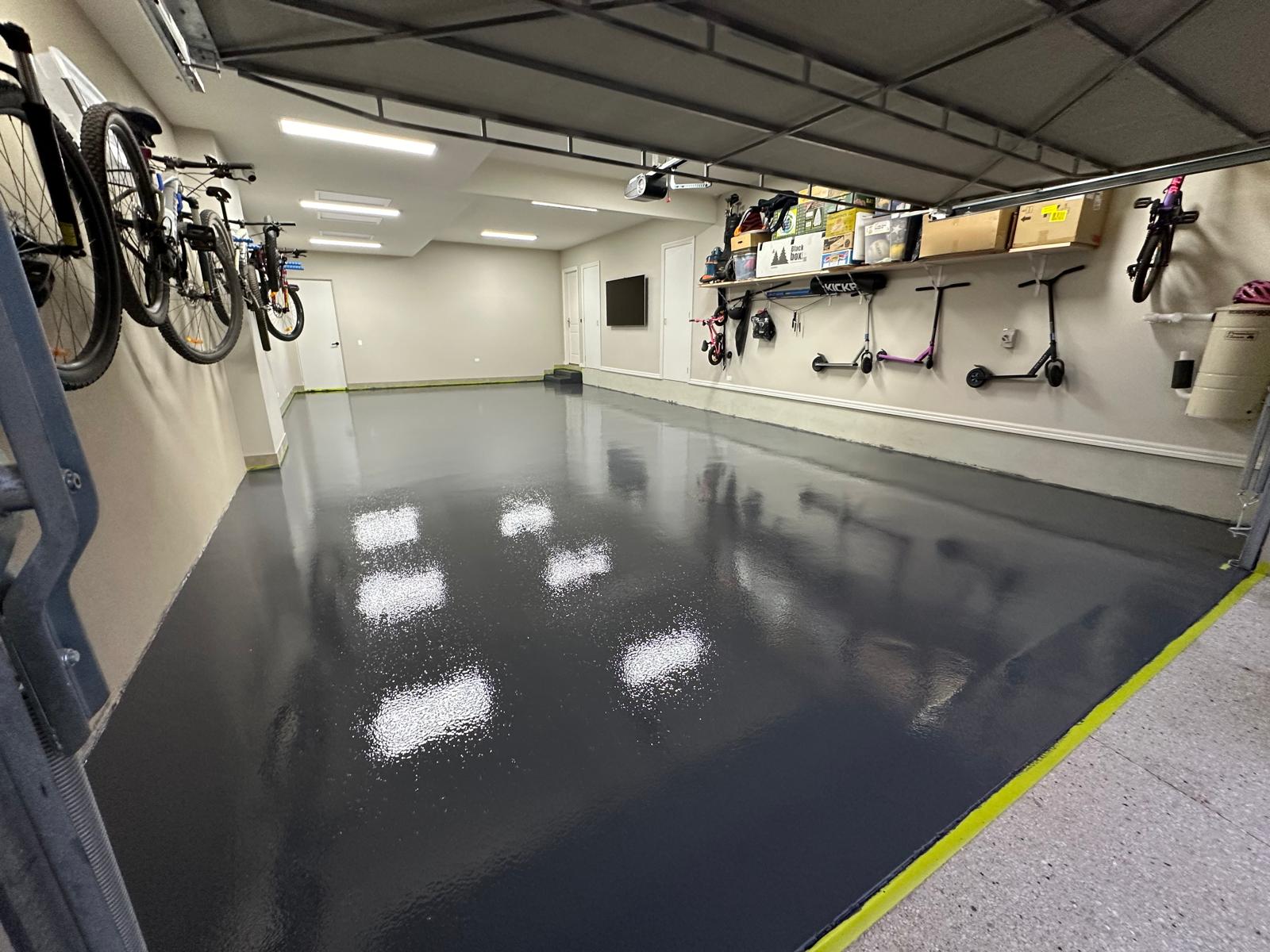
A three-car garage in Heidelberg that was already doing everything a family garage does — bikes, scooters, shelving, storage, a television on the back wall — with one thing still unfinished. The floor. Here is the whole job.
The job at a glance
| Location | Heidelberg, Melbourne north-east |
|---|---|
| Space | Three-car garage, approx. 54 m² |
| System | Solid colour epoxy with a clear high-gloss polyaspartic topcoat |
| Colour | Charcoal |
| Preparation | Diamond grinding with dust extraction, edge grinding, crack repair |
| Time on site | Two days |
| Full cure | 72 hours before vehicles |
| Investment | From $55/m² for solid colour — quoted on measure |
The brief
This garage was not a bare shell waiting to be finished. It was already a working part of the house — LED battens across the ceiling, painted walls and skirting, wall-mounted bike racks down one side, shelving and storage down the other, scooters hung at kid height, a television mounted at the back.
Everything had been done except the thing everyone stands on. The slab was still raw concrete in a room that had otherwise been finished properly, and it was letting the whole space down.
That is a more common brief than people expect. Garages get fitted out gradually — storage first, lighting next, and the floor last because it feels like the biggest job. It is usually the one that makes the most difference.
Why solid colour, not flake
Most of the garages we coat get a flake system, and for a working garage it is the right call — the flake breaks up the surface visually and hides dust, tyre marks and general grime.
This one went a different way, and it was a deliberate choice.
A solid colour under a clear high-gloss topcoat produces a surface with no visual texture at all. It reflects. In a garage with good ceiling lighting — and this one has a lot of it — that gloss bounces light around the room and makes the space read as an extension of the house rather than as storage.
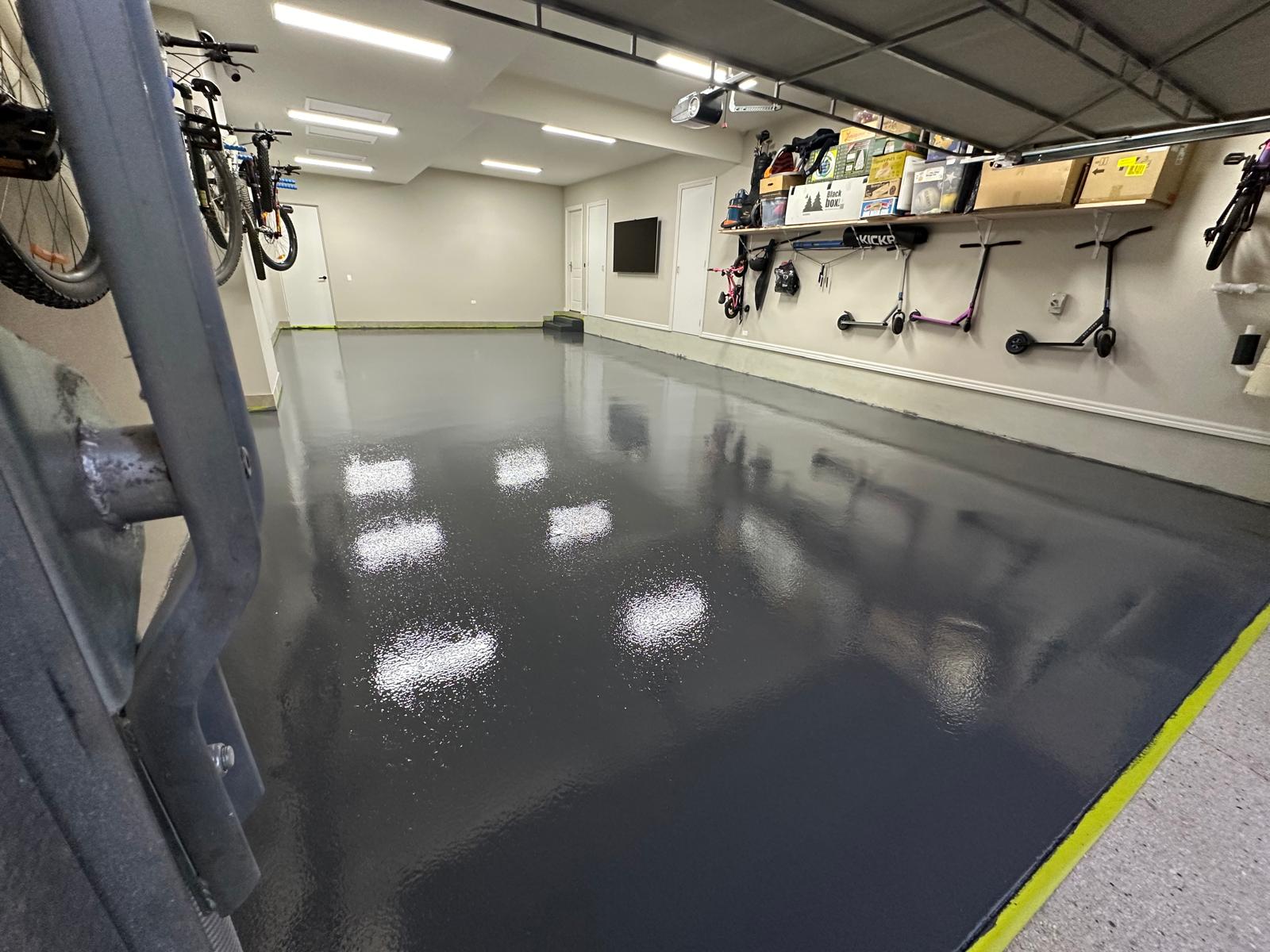
Look at the ceiling battens reflected across the floor in that photograph. They read clean and unbroken, with no roller texture and no ripple. That is the whole test of a solid-colour finish: any unevenness in application shows up immediately in the reflection, which is exactly why a solid gloss floor is less forgiving to install than flake.
The honest trade-off
A dark gloss floor shows more than a mid-grey flake does. Dust settles visibly, footprints show, tyre marks stand out. It also wipes clean in seconds with a dust mop, which flake does not quite manage.
If this were a workshop with a car on stands and oil changes happening, we would have steered toward flake. For a family garage that stores bikes and looks good doing it, gloss was the better answer. The comparison in flake epoxy vs garage tiles covers the related question of texture versus surface.
What we found on the slab
Heidelberg is a genuinely varied suburb to work in. There is a lot of renovation activity here, and period and inter-war housing sits alongside newer building, so slab age and condition range enormously from one street to the next.
That means the on-site assessment does real work rather than confirming the obvious. On a slab like this one we are checking four things before quoting anything:
- Moisture. Tested with the slab, every time. Water rising through concrete lifts a coating from underneath no matter how well the surface is prepared.
- Existing coatings. Sealers and old paint are common on established garages and have to come off entirely.
- Oil penetration. Surface contamination grinds away; deeper penetration needs degreasing and sometimes a tolerant primer.
- Cracking. Routed out, filled with a structural repair compound, ground flush — never coated over.
Working around a garage that is already fitted out
This is the practical part, and it is the question we get asked most on jobs like this: does all of it have to come out?
No. Anything on the walls stays. The bike racks, the shelving, the scooter hooks, the television — none of it moved. We mask beneath and behind wall-mounted storage and coat right up to the wall.
Anything on the floor has to go for the two days. Bins, boxes, tools, anything standing on the slab. In this garage that meant clearing the floor area while everything mounted up high stayed exactly where it was.
Masking around a fitted-out garage takes longer than masking an empty one. Skirting, door frames, the step at the back and the threshold all get cut in by hand. It is slower, and it is the difference between a floor that looks installed and a floor that looks finished.
Day one — preparation
Masking first, then the grinder. The slab was diamond ground with dust extraction, which matters more than usual in a garage that connects to the house and has storage, soft furnishings and electronics in it. Grinding without extraction sends fine concrete dust through every one of those.
Grinding removes any existing sealer, the weak surface layer of the concrete, and leaves an open profile for the primer to key into. Epoxy bonds mechanically — it grips the texture the grinder creates. No texture, no bond, regardless of what the coating cost. The full case is in diamond grinding vs acid etching.
Then the edges. A planetary grinder cannot reach the final hundred millimetres against a wall, so the perimeter and corners were done separately with an edge machine. In a garage with storage down both walls this is fiddly work, and it is the first place a floor lifts if it gets skipped.
Cracks routed and filled, slab vacuumed, tacked off, primed late in the day to cure overnight.
Day two — colour and gloss
The charcoal base coat went down first, rolled out wet and worked to a consistent film. On a solid colour there is nowhere to hide — no flake to break up the surface — so the application has to be even across the whole floor.
Then the clear polyaspartic topcoat, which is what carries the gloss, the abrasion resistance, the UV stability and the resistance to hot tyre pickup. We use the same topcoat on every floor regardless of what is underneath it, for the reasons set out in why concrete sealers are not suitable for epoxy floors.
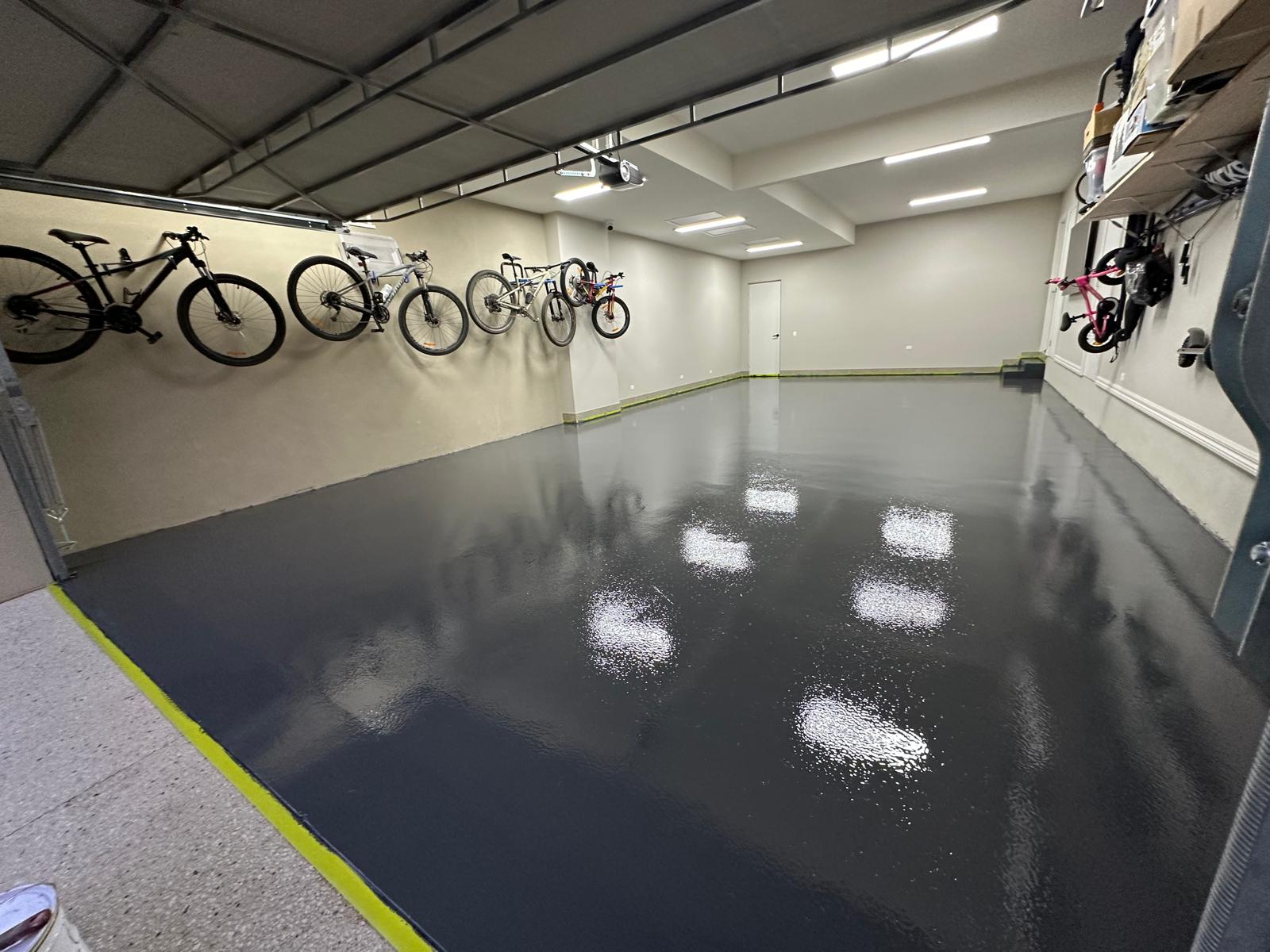
Seamless from one end to the other. No joins, no grout lines, no transitions — nothing for dust to collect in and nothing to trip on. On a 54 square metre floor that continuity is a large part of why the space reads as one room.
Three-car garages: what changes
Not as much as people assume.
| Single | Double | Triple | |
|---|---|---|---|
| Approx. area | 18 m² | 36 m² | 54 m² |
| Days on site | 2 | 2 | 2 |
| Cost per m² | Highest | Middle | Lowest |
A triple garage takes the same two days as a single. The extra area adds time within each stage rather than adding stages, and grinding a large open floor is considerably more efficient per square metre than grinding a small one with walls close on every side.
It also works out cheaper per square metre. Masking, setup, mobilisation and clean-up are largely fixed costs in time, so they spread across more floor. A triple garage does not cost three times a single — closer to two and a half.
Garage-specific pricing sits in double garage epoxy flooring cost and single garage epoxy flooring cost, with the full picture in how much epoxy flooring costs in Melbourne.
The finished garage
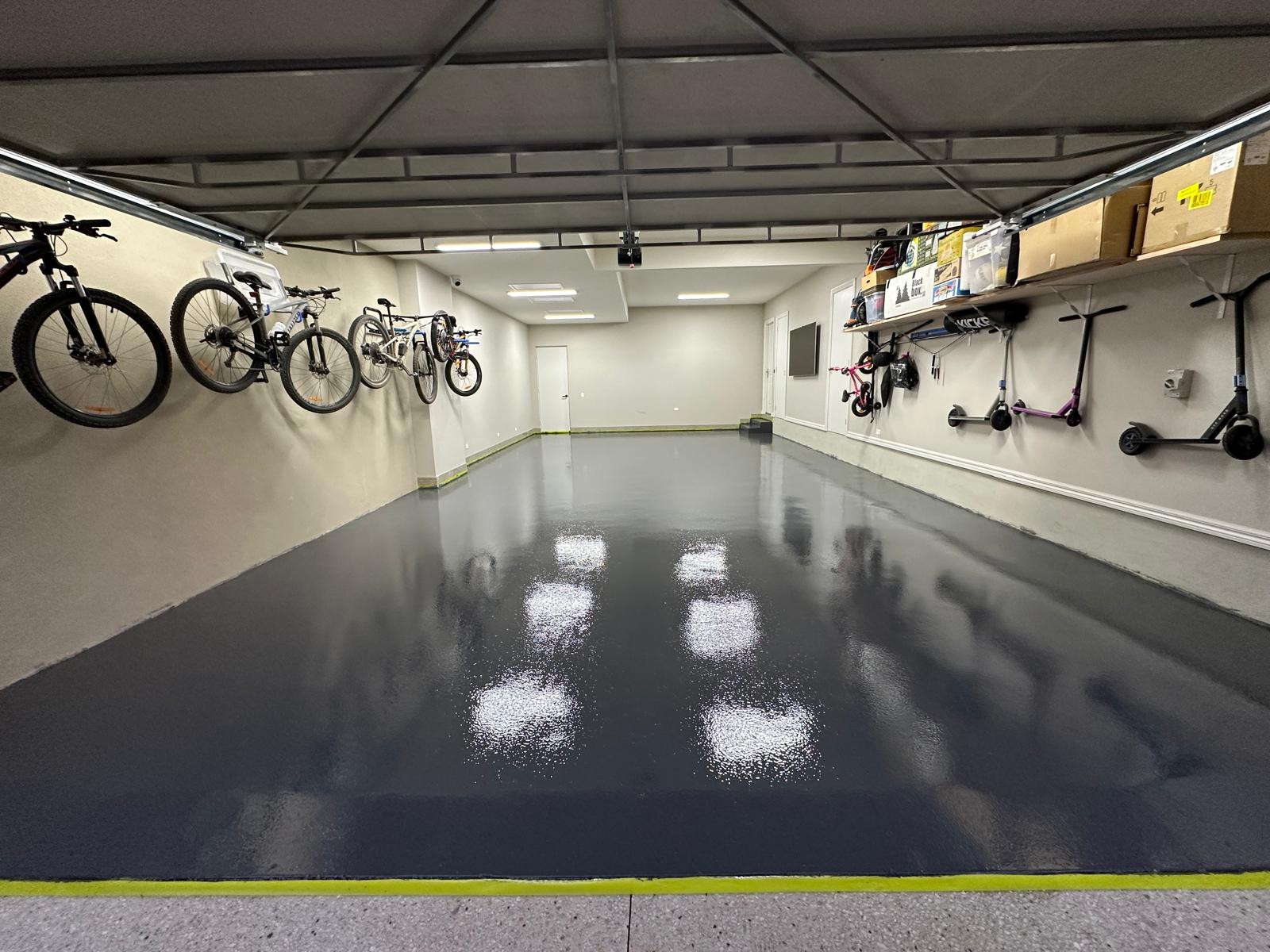
What makes this one work is that it is obviously used. Bikes on the wall, scooters at kid height, boxes on the shelf, a television for whoever is out there working on something. It is not a showroom.
The floor is what pulls it together — and it will keep looking like that, because a polyaspartic topcoat over a properly ground slab is built for fifteen years or more of exactly this kind of use. See how long epoxy flooring lasts.
Looking after a gloss floor
- Dust mop weekly. Grit is what abrades a floor over years, and it shows on gloss sooner than on flake.
- Warm water and pH-neutral detergent when it needs more. No acids, no harsh solvents, nothing abrasive.
- Wipe spills rather than leaving them. Full detail in how to remove oil, fuel and tyre marks from epoxy flooring.
- Respect the cure times — 24, 48 and 72 hours. Driving on it early is how new floors get marked.
Frequently asked questions
How much does a three-car garage epoxy floor cost?
A triple garage is roughly 54 square metres, and we quote these on measure rather than from a fixed figure. As a guide, solid colour starts from $55/m² and flake from $65/m² for the complete system including preparation. The slab condition matters more than the area.
How long does a three-car garage take?
Two days on site, the same as a double. The extra area adds time to each stage rather than adding a stage, and grinding a larger floor is more efficient per square metre than grinding a small one.
Why choose solid colour instead of flake?
Gloss and seamlessness. A solid colour under a clear topcoat gives a mirror-like surface with no visual texture, which suits a garage being used as a finished space. Flake is the more forgiving choice for a working garage because it hides dust and tyre marks.
Does a high-gloss floor show more dirt?
Yes, honestly. A dark gloss floor shows dust, footprints and tyre marks more readily than a mid-grey flake. It also cleans in seconds with a dust mop. It is a trade of a little more upkeep for a much stronger look.
Can you coat around shelving and wall-mounted storage?
Yes. Wall-mounted racks, bike hooks and shelving stay exactly where they are — we mask beneath them and coat up to the wall. Only items sitting on the floor need moving.
Do I have to empty the whole garage?
Anything on the floor has to come out for the two days. Anything on a wall can stay. In a garage like this one, that meant moving bins, boxes and bikes off the floor while everything mounted up high stayed put.
Is Heidelberg a difficult area to work in?
Not difficult, but varied. Heidelberg has a lot of renovation activity and period housing alongside newer builds, so slabs range widely in age and condition. That makes the on-site assessment do real work rather than confirm the obvious.
Do older Heidelberg slabs need extra preparation?
Often. Older garages may carry a previous coating, decades of oil, or cracking from settlement. All of it is identified at the measure and priced before we start rather than discovered halfway through.
What is the topcoat on a gloss floor?
A clear polyaspartic topcoat. It carries the gloss, the abrasion resistance, the UV stability and the resistance to hot tyre pickup. It is the same topcoat we use on every floor regardless of the finish underneath.
Will hot tyres lift a solid colour floor?
Not with a polyaspartic topcoat. Hot tyre pickup is a failure mode of cheap single-part coatings and DIY kits, not of a properly specified system.
When can I park on it?
Walk on it after 24 hours, move storage back after 48, park a car after 72. Those timings stretch in cold weather.
Why is there yellow tape in the photos?
Because they were taken the moment the topcoat went down, before the masking came up. We photograph floors while they are still wet-looking, which is also when the gloss reads best.
Does a large garage cost less per square metre?
Slightly. Masking, setup and mobilisation are largely fixed costs in time, so they spread across a bigger floor. A triple garage does not cost three times a single.
Can you do a tandem or extra-deep garage?
Yes. Tandem garages, extra-deep bays and garages with a workshop area at the back are all straightforward. The measure establishes the actual area rather than assuming a standard size.
What if my garage has a step or a plinth?
Steps, plinths and thresholds are coated as part of the job. They get masked and cut in by hand, which is slower than the open floor but part of a proper finish.
Do you moisture test?
Always, before quoting. Water rising through a slab lifts any coating from underneath regardless of how well the surface was prepared.
How do I clean a gloss epoxy floor?
Dust mop for day to day, warm water and a pH-neutral detergent when it needs more. No acids, no harsh solvents, nothing abrasive.
How long will it last?
Fifteen years or more in a domestic garage, backed by a written workmanship warranty. Floors that fail early failed at preparation.
Do you work across the north-east?
Yes — Heidelberg, Ivanhoe, Rosanna, Bulleen, Templestowe, Eltham, Greensborough and the surrounding suburbs, plus the rest of Melbourne from our base in Mickleham.
Is the quote free?
Yes. The on-site measure costs nothing and carries no obligation. We assess the slab, test it for moisture, talk through finishes and leave a fixed written price.
Thinking about your own garage?
Whether it is a single, a double or a three-car like this one, the process is the same and so is the standard of preparation. We measure the space, assess the slab, moisture test it and leave you a fixed written price.
We are based in Mickleham and work right across Melbourne, including Heidelberg, Ivanhoe, Rosanna, Bulleen, Templestowe, Eltham and Greensborough. The measure is free and there is no obligation.
Call 0451 980 606 or book a free on-site measure.
See more finished floors
- Google Business Profile — photos, reviews and current availability
- Facebook — completed jobs and customer feedback
- Instagram — install days and close-up finishes
More: epoxy flooring in Heidelberg, double garage epoxy flooring, single garage epoxy flooring, garage floor coating in Melbourne, our Officer double garage case study.
Planning an epoxy floor in Melbourne?
Book a free on-site inspection and get a fixed written quote — no obligation.